Here’s the short answer. A 30-minute walk every day, at a pace that makes you breathe a little harder, gets you past the amount of activity the World Health Organization recommends for adults. It’s linked to a lower risk of heart disease, type 2 diabetes, depression and early death. It also tends to help you sleep better and feel calmer, often from the very first walk.
And it costs nothing. No gym, no kit beyond a decent pair of shoes, no app.
Below we’ll look at what the research actually says (including where it’s weaker than the headlines suggest), how far 30 minutes takes you in miles, kilometres and steps, and how to make the habit easy enough that you keep it.
Why 30 minutes is such a useful number
The World Health Organization recommends that adults get at least 150 minutes of moderate-intensity activity a week. Thirty minutes a day, five days a week, is exactly 150. Walk every day and you reach 210 minutes, with a couple of spare days for when life gets in the way.
That matters, because according to the WHO about 31% of adults worldwide (roughly 1.8 billion people) don’t reach that level. People who are not active enough have a 20–30% higher risk of death than people who are.
There’s one catch. The guidelines are about moderate activity, which means a brisk walk rather than a slow wander. The NHS describes brisk walking as about 3 miles per hour. It suggests a simple check called the talk test: if you can still talk but couldn’t sing the words to a song, you’re walking briskly.
How far is a 30-minute walk, and how many steps?
It depends on your pace. Using the average step length of 76.2 cm (2.5 ft), which works out at about 2,112 steps per mile, here’s what half an hour looks like:
| Pace | Distance in 30 minutes | Estimated steps |
|---|---|---|
| Easy (2 mph) | 1 mile (1.61 km) | about 2,112 |
| Brisk (3 mph) | 1.5 miles (2.41 km) | about 3,168 |
| Fast (4 mph) | 2 miles (3.22 km) | about 4,224 |
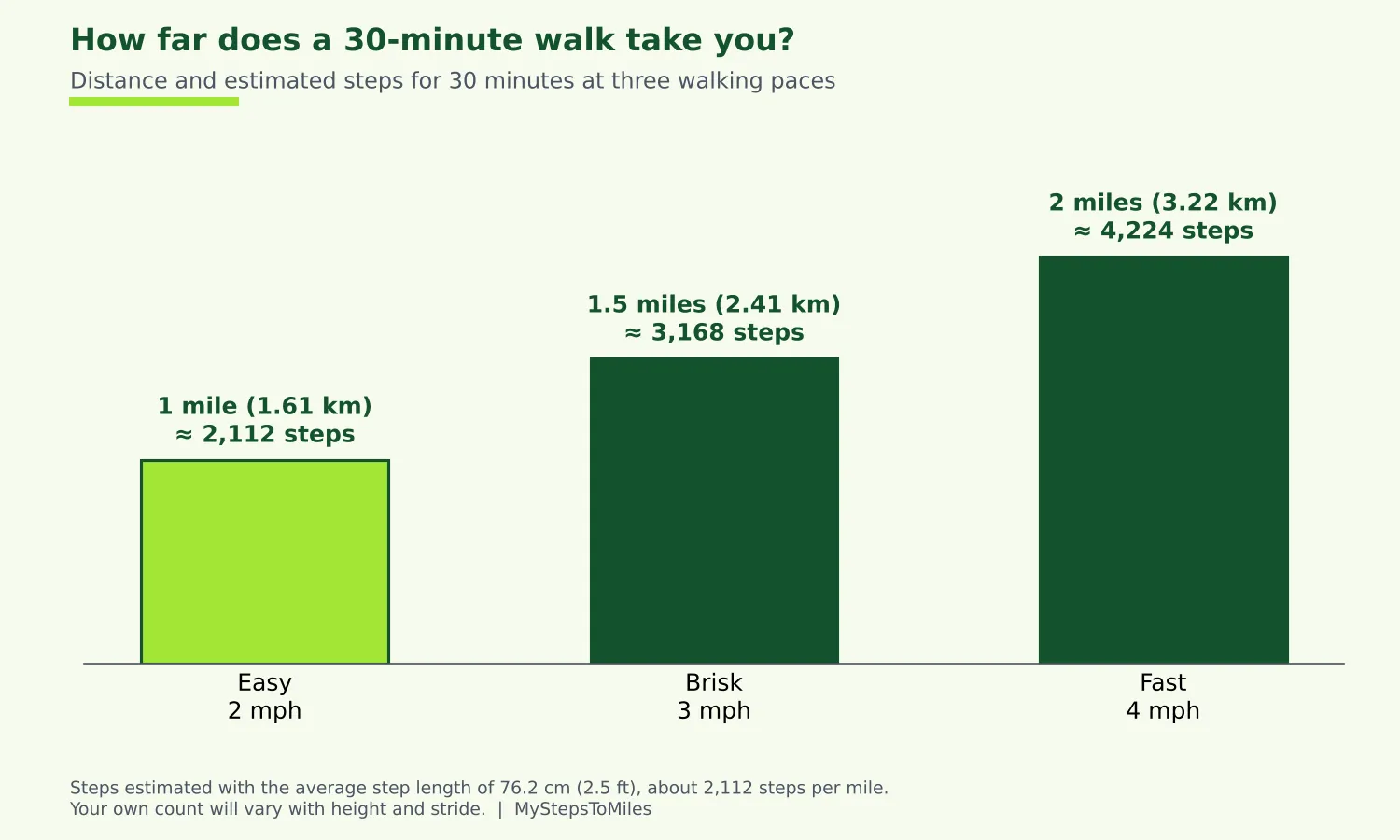
So a brisk daily half-hour adds up to about 10.5 miles (16.9 km) a week, and around 547 miles (881 km) over a year.
These numbers are averages, though. A tall walker covers more ground with each step than a shorter one, so they take fewer steps for the same distance. To see your own figures, put your step count into the MyStepsToMiles calculator and choose Better mode, which uses your height, or Exact mode if you know your own stride. You can also switch between the 2, 3 and 4 mph pace options to see how long a walk will take.
The health benefits of a daily 30-minute walk
1. A healthier heart and a longer life
This is where the evidence is strongest. A large review from the University of Cambridge, published in the British Journal of Sports Medicine in 2023, pooled studies of more than 30 million people. It found that even 75 minutes a week of moderate activity, about 11 minutes a day, was linked to a 23% lower risk of early death, a 17% lower risk of cardiovascular disease and a 7% lower risk of cancer.
So 30 minutes a day is roughly three times that minimum. The researchers found the biggest gains come when you go from doing nothing to doing something, with extra benefits becoming smaller beyond 150 minutes a week. That’s good news if you’re starting from the sofa: your first walks probably count the most.
The US Centers for Disease Control and Prevention (CDC) adds that regular moderate activity can lower blood pressure and improve cholesterol, two of the biggest drivers of heart disease and stroke.
2. Better blood sugar and lower diabetes risk
According to the CDC, regular activity lowers the risk of type 2 diabetes and helps people who already have it control their blood sugar. Walking is one of the easiest ways to get that activity. (Walking straight after a meal seems to be especially helpful for blood sugar. We’ll look at that in detail later in this series.)
3. A brighter mood and less anxiety
You don’t have to wait months to feel this one. The CDC notes that physical activity can reduce short-term feelings of anxiety in adults, and that people tend to “feel better, function better, and sleep better” soon after being active.
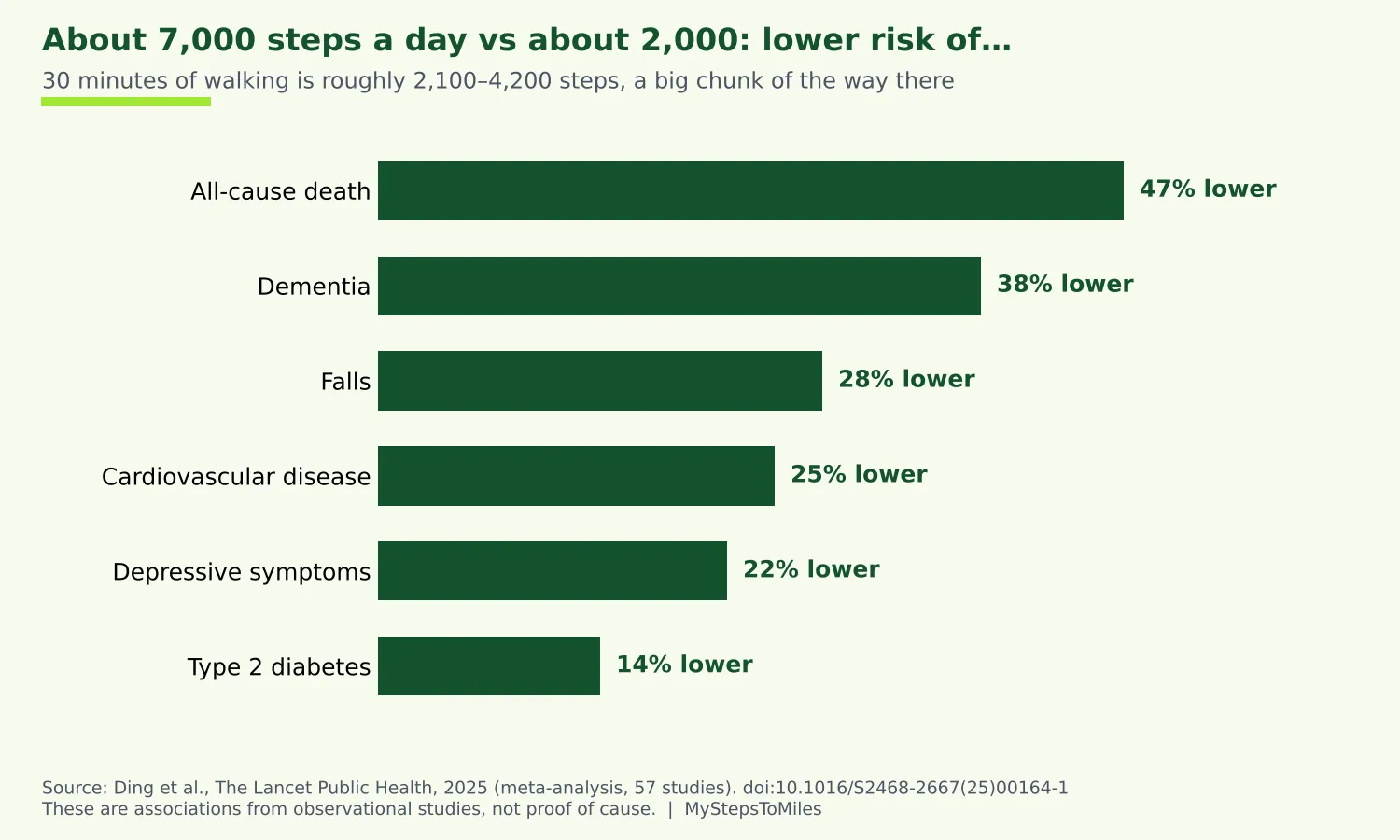
Over the longer term, a 2025 review in The Lancet Public Health found that people walking about 7,000 steps a day had a 22% lower risk of depressive symptoms than people walking about 2,000. A brisk 30-minute walk gives you roughly 3,000 of those steps in one go.

4. Better sleep
Being active during the day is linked to better sleep at night, according to the CDC. Plenty of people find an evening walk helps them switch off. If you find it leaves you too alert, try walking earlier in the day instead.
5. A sharper brain as you age
The CDC says regular activity helps keep thinking, learning and judgement sharp as we age. In the same 2025 Lancet Public Health review, around 7,000 steps a day was linked to a 38% lower risk of dementia compared with 2,000 steps.

6. Steadier on your feet
Falls are a serious risk as we get older. The same review linked about 7,000 daily steps with a 28% lower risk of falls. The CDC also says that active older adults have a lower risk of hip fracture and fewer problems with everyday tasks.
7. Help with your weight, with one honest caveat
Walking burns energy, and the CDC says activity helps people keep their weight steady. But walking alone usually isn’t a quick route to weight loss. The CDC is clear that losing weight and keeping it off works best when regular activity is combined with healthy eating. We’ll look at this properly on Day 10 of this series.
A quick, honest word about the research
Most of the big numbers above come from observational studies. These follow large groups of people over years and compare the more active with the less active. They show a strong, consistent link, but they can’t fully prove that walking alone caused the difference. People who walk more may also eat better or be healthier to begin with. The researchers try to account for this, but it’s worth knowing.
What we can say with confidence is that every major health body, from the WHO to the NHS to the CDC, recommends regular moderate activity, and walking is the easiest way most people can get it.
How many steps does 30 minutes add to your day?
Your daily step count matters too, not only your minutes. A 2022 study in The Lancet Public Health of nearly 47,500 adults found the risk of early death kept falling as daily steps rose, then levelled off at about 6,000–8,000 steps for people aged 60 and over and about 8,000–10,000 for younger adults.
If you already take around 4,000–5,000 steps a day just getting about, a brisk 30-minute walk adds roughly 3,000 more. That puts you right in that 7,000–8,000 range. Want to see what those totals mean in distance? Have a look at our 8,000 steps to miles and 10,000 steps to miles pages.
How to make a 30-minute walk part of every day
Knowing the benefits is the easy bit. Doing it daily is harder, so here are some ideas that work for real people:
- Split it up. Three 10-minute walks still add up to 30 minutes. The NHS says even a brisk 10-minute daily walk has health benefits.
- Attach it to something you already do. Walk after lunch, or right after you drop the kids at school. A walk tied to an existing routine is much easier to remember.
- Use the talk test. Aim for “can talk, can’t sing”. If you can sing, speed up a little.
- Walk with someone. A friend, partner or neighbour makes the time fly, and you’re less likely to cancel.
- Track it simply. Log each walk in My Walks on MyStepsToMiles. Seeing your streak grow is surprisingly motivating, and there’s a 30-day milestone to aim for.
- Start where you are. If 30 minutes feels like too much right now, start with 10 and add five minutes each week.

On Day 14 we’ll go deeper into building a walking habit that actually sticks.
Frequently asked questions
Is walking 30 minutes a day enough exercise?
For most adults, a brisk 30-minute walk on most days meets the WHO’s minimum of 150 minutes of moderate activity a week. The WHO also recommends muscle-strengthening activities on two or more days a week, so adding some simple strength exercises makes it a well-rounded routine.
How many steps is a 30-minute walk?
Using the average step length of 76.2 cm, about 2,100 steps at an easy 2 mph, about 3,200 at a brisk 3 mph and about 4,200 at a fast 4 mph. Your own number depends on your height and stride.
How far can you walk in 30 minutes?
Around 1 mile (1.6 km) at an easy pace, 1.5 miles (2.4 km) at a brisk pace and 2 miles (3.2 km) at a fast pace.
Does it matter if I split my 30 minutes into shorter walks?
Not much. Current guidelines count activity of any length, and the NHS says even a 10-minute brisk walk has benefits. What matters most is the total and doing it regularly.
When will I notice the benefits?
Many people feel calmer and sleep better within days, as the CDC notes. Longer-term changes, like lower blood pressure or a lower risk of disease, build up over weeks, months and years of regular walking.
Ready to see your own numbers?
Whatever your height, pace or step count, the MyStepsToMiles calculator will turn today’s walk into miles, kilometres and walking time in seconds. No app, no sign-up. Try it after your walk today, log it in My Walks, and come back tomorrow to keep the streak going.
This article is general information, not medical advice. Talk to a doctor before a big change in how active you are.