You head out for a walk to feel better. Then you get home with a stiff neck, a grumbling lower back, or shins that complain on the stairs. It’s easy to blame your age, your shoes or walking itself.
Often the real cause is your walking posture, and it’s smaller and easier to fix than you’d think: where your eyes are pointing, how far each foot reaches, and whether your arms are allowed to do their job. Here’s the short version, then we’ll go through each fix in turn.
Quick answer: what good walking posture looks like. Keep your head up with your eyes about 10 to 20 feet ahead. Let your shoulders drop and relax. Stand tall without arching or leaning back. Tighten your stomach a little. Swing your arms freely with a slight bend in the elbows. Take shorter, quicker steps that land close under your body and roll from heel to toe. Change one thing at a time, not everything at once.
Find your fix: match the ache to the change
Most walking niggles have a usual suspect. Find your problem in the left column and start with that fix.
| What you notice | Common cause | The small fix |
|---|---|---|
| Stiff neck or headache after walking | Looking down at your feet or phone | Fix 1: eyes up, 10–20 feet ahead |
| Tight, aching shoulders | Shoulders hunched up; clutching a phone or bag | Fix 2: shrug, drop, free your hands |
| Achy lower back | Slouching, arching or leaning backwards | Fix 3: stand tall, stomach gently in |
| Sore shins or knees, loud slapping steps | Overstriding: your foot lands far in front of you | Fix 4: shorter, quicker steps |
| Flat-footed, clumpy steps | Landing on the whole foot at once | Fix 5: roll heel to toe, push off |
| Getting tired sooner than expected | Arms held still or swinging across the body | Fix 6: let your arms swing |
| Walks feel slow and “not like exercise” | A low step rate | Fix 7: aim for about 100 steps a minute |
One honest note before we start: posture tweaks help with everyday stiffness and tired muscles. Pain that is sharp, getting worse, causes a limp or doesn’t settle after rest is a reason to see a doctor or physiotherapist, not just to adjust your form.
The 60-second posture check before you set off
Do this standing at your front door. It takes a minute and sets up the whole walk.
- Head: ears over your shoulders, chin level with the ground.
- Shoulders: shrug them up to your ears, then let them drop and settle slightly back.
- Back: stand tall, “not arched forward or backward”, as the Mayo Clinic puts it.
- Stomach: tighten it a little, as if you’re about to zip up snug jeans.
- Arms: let them hang, then bend the elbows slightly.
- Feet: pointing forwards, about hip-width apart.
Then start slowly. Mayo Clinic suggests walking at an easy pace for the first few minutes to warm up your muscles, then picking up speed.
Fix 1: Lift your eyes (the neck-ache fix)
Your head is heavy. When you look down at the pavement or your screen, your neck muscles work hard to hold it there, step after step. Healthline’s walking guide recommends looking at a point roughly 10 to 20 feet ahead, with your chin parallel to the ground.
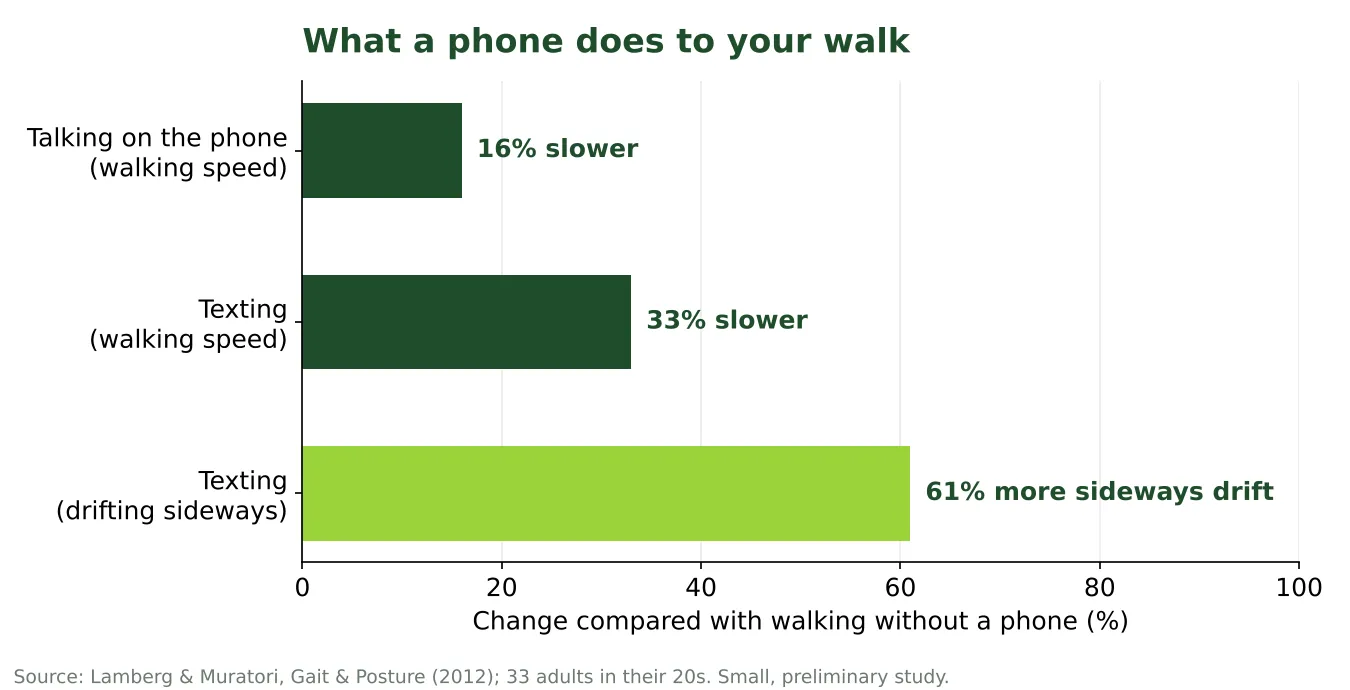
Phones make this harder. In a small study at Stony Brook University, published in Gait & Posture, 33 young adults walked more slowly and drifted further off a straight line while texting (ScienceDaily summary). Texting slowed them by 33%, talking on the phone by 16%. The researchers called the results preliminary, but the message is easy to act on.
Try this today: if you need your phone, stop, check it, then walk on. Use headphones for calls so your head stays up.
Fix 2: Drop your shoulders and free your hands
Tension creeps up while you walk. You start relaxed, and ten minutes later your shoulders are near your ears. Healthline suggests a simple reset: shrug, let your shoulders fall, and repeat the shrug every so often during the walk.
Carrying things makes it worse. A handbag on one shoulder, a water bottle gripped in one hand, a phone in the other. Each one stops an arm from moving freely. A small backpack or a running belt solves this for very little money.
Fix 3: Stand tall, stomach gently in (the lower-back fix)
Think “tall”, not “stiff”. Picture a string gently pulling the top of your head upwards. Your back stays long, your chest is open and you don’t arch.

Then draw your belly button in slightly. Healthline notes that a lightly engaged core supports balance and can ease strain on your back. You’re not holding your breath or sucking in hard. It’s about a quarter of your full effort.
Watch out for the backward lean. Some people tip back slightly when they walk fast or downhill. The Princeton Medicine guide in Fix 4 links an upright or backward-leaning trunk with overstriding, and suggests a slight forward lean from the ankles (not from the waist) instead.
Fix 4: Take shorter, quicker steps (the shins and knees fix)
This is the fix that surprises people most. To walk faster, most of us reach further forward with each foot. That’s called overstriding: your heel lands well in front of your body, so every step acts like a small brake.
A sports medicine physician’s guide at Princeton Medicine lists the signs: loud or heavy footsteps, a feeling of slowing down with each step, knee pain after downhill walking, shin discomfort even though you don’t run, and hip or lower-back fatigue after walks. This is clinical experience rather than a published study, but it matches Healthline’s advice to keep strides moderate and get your power from pushing off the back foot.
The fix: let your foot land closer to underneath you, and take slightly quicker steps instead of longer ones. Don’t force yourself onto your toes. Landing on your heel is normal in walking. The problem is landing too far ahead.
Try this today: listen to your feet. If you can hear a slap with every step, shorten your stride until the sound softens.
Why shorter steps change your miles
Here’s the part most posture guides skip. When your step gets shorter, it takes more steps to cover the same mile. So if you fix your stride, your old distance estimates may no longer be right.
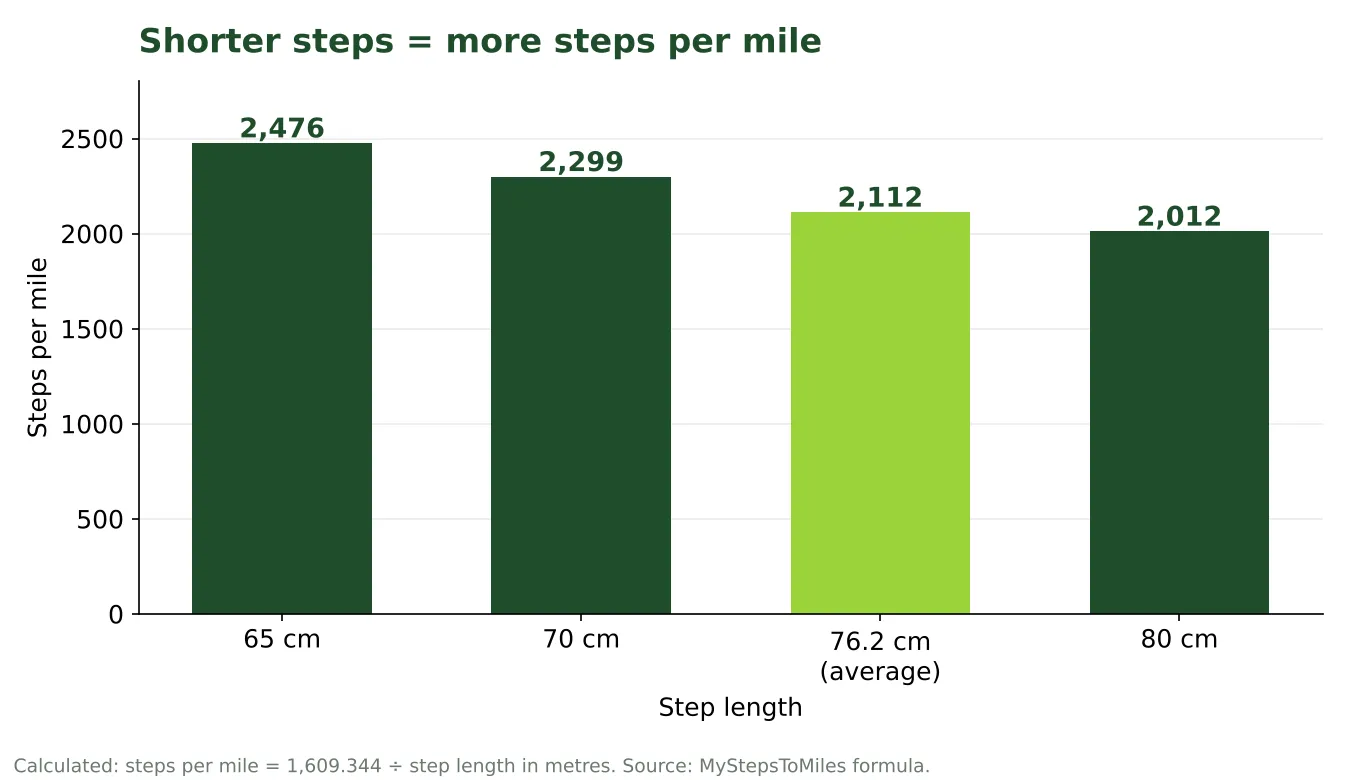
A worked example: 5,000 steps at the average step length of 76.2 cm is about 2.37 miles (3.81 km). The same 5,000 steps at 70 cm is about 2.17 miles (3.5 km). That’s a 0.2-mile gap on every 5,000 steps, and it adds up over a week.
This is where the MyStepsToMiles calculator helps. Switch to Exact mode and enter your own stride. Exact mode asks for the distance of 10 steps, so to measure your stride, walk a known distance (a 100-metre straight on a sports track works well) at your new, natural pace, count your steps, then divide 100 by the number of steps and enter the distance of 10 steps. If you don’t want to measure, Better mode estimates your step from your height. Step length is roughly 41.3% of height for women and 41.5% for men, so someone 170 cm tall has a step of about 70 cm.
Fix 5: Roll from heel to toe
Mayo Clinic’s advice is to walk smoothly and roll each foot from heel to toe. Your heel touches down first, your foot rolls forwards, and you push off through your toes.
If your steps feel flat and clumpy, it often means the whole foot is hitting the ground at once. Slow down for a minute and exaggerate the roll, then let it settle into your normal pace. Comfortable, well-cushioned shoes with good heel and arch support make this easier. See our guide on how to choose walking shoes.
Fix 6: Let your arms swing (the tiredness fix)
Your arms aren’t just along for the ride. In a 2009 study led by Steven Collins and published in Proceedings of the Royal Society B, people who held their arms still used about 12% more energy to walk than when they swung them normally. Swinging them the “wrong” way (same arm as same leg) raised the cost by about 25% (study summary, Medical Xpress).
So let them move. Keep a slight bend in the elbows, swing from the shoulder, and keep your hands roughly at waist height. Avoid crossing them in front of your body. Mayo Clinic says it’s fine to pump your arms a little when you want to go faster.
Fix 7: Find your rhythm (about 100 steps a minute)
If walks feel too gentle to count as exercise, your step rate is a simple dial to turn. The CADENCE-Adults study, published in 2019 in the International Journal of Behavioral Nutrition and Physical Activity, found that about 100 steps a minute matched moderate intensity for adults aged 21 to 40, and about 130 steps a minute matched vigorous intensity (UMass Amherst summary). Treat it as a rough guide if you’re outside that age range.
How to check yours: count your steps for 15 seconds and multiply by four. If you’re well below 100, take quicker steps (which also helps Fix 4).
At about 100 steps a minute, a 30-minute walk is around 3,000 steps. At the average step length, that’s roughly 1.42 miles (2.29 km). You can see how this fits with your day on the 2,500 steps to miles page and 5,000 steps to miles page. The calculator’s pace options (2, 3 or 4 mph) also show how long a walk will take.

Don’t fix everything at once: a simple 4-week plan
Changing seven things at once is a recipe for a stiff, robotic walk. Try one or two a week instead.
| Week | Focus | What to notice |
|---|---|---|
| Week 1 | Fixes 1 and 2: eyes up, shoulders down | Is your neck less stiff afterwards? |
| Week 2 | Fixes 3 and 4: stand tall, shorter steps | Are your footsteps quieter? Re-measure your stride in Exact mode. |
| Week 3 | Fixes 5 and 6: heel-to-toe roll, arm swing | Do you feel less tired at the end? |
| Week 4 | Fix 7: about 100 steps a minute | Count for 15 seconds, twice per walk. |
New habits feel odd for the first few walks. That’s normal. Log each one in My Walks on MyStepsToMiles so you can see your streak grow, and aim for the 30-day milestone. It’s a nice way to notice that your walks are getting easier, not just longer.
Frequently asked questions
What is the correct posture for walking?
Head up with your eyes 10 to 20 feet ahead, shoulders relaxed and down, back tall, stomach lightly tightened, arms swinging with bent elbows, and steps that land close under your body and roll heel to toe.
Should you land on your heel when walking?
Yes, a heel-first landing is normal for walking. The thing to avoid is landing with your heel far out in front of you (overstriding). Shorter, quicker steps usually sort this out.
Why does my lower back ache when I walk?
Slouching, arching or leaning back can all add strain, and a gentle tall posture with a lightly engaged stomach often helps. If the pain is sharp, spreads down your leg, or doesn’t ease with rest, see a doctor.
Will better posture change how many steps I take per mile?
It can. If you shorten an overstride, each step covers less ground, so you take more steps per mile. Re-measure your stride and use the calculator’s Exact mode to keep your distance accurate.
Is it better to take longer strides to walk faster?
Usually not. Quicker steps, a good arm swing and a strong push-off from the back foot get you moving faster without the braking effect of overstriding.
Try it on your next walk
Pick one fix from the table, just one, and try it on your next walk. Then pop your steps into the MyStepsToMiles calculator to see exactly how far you went. It’s free, there’s no app to download and no sign-up.
This article is general information, not medical advice. Talk to a doctor before a big change in how active you are.
Sources
- Mayo Clinic, Walking: trim your waistline, improve your health: https://www.mayoclinic.org/healthy-lifestyle/fitness/in-depth/walking/art-20046261
- Healthline, How to walk: posture tips and benefits: https://www.healthline.com/health/how-to-walk
- Princeton Medicine, Overstriding while walking: https://www.princetonmedicine.com/blog/overstriding-while-walking-the-hidden-braking-forces-that-aggravate-hips-knees-and-shins
- ScienceDaily, Texting while walking may affect gait (Lamberg & Muratori, Gait & Posture, 2012): https://www.sciencedaily.com/releases/2012/01/120118173246.htm
- Medical Xpress, arm swinging and walking energy (Collins et al., Proc. R. Soc. B, 2009): https://medicalxpress.com/news/2009-07-limb-arm-swinging-riddle.pdf
- UMass Amherst, CADENCE-Adults study (IJBNPA, 2019): https://www.umass.edu/news/article/walking-health-benefits-just-got-easier