It’s 10 pm. You glance at your phone: 4,812 steps. Is that good? Is it bad? Should you feel proud, or guilty about the lift you took instead of the stairs?
Most of us check that number every day without knowing what it means. A step count on its own is just a number. Once you know what’s normal, how far it takes you, and what’s worth aiming for, it becomes a plan.
The short answer: The average adult takes about 5,000 steps a day. A Stanford study of more than 700,000 smartphone users in 111 countries put the world average at 4,961 steps. With an average step of 76.2 cm, that’s about 2.3 miles (3.8 km), or roughly 47 minutes of walking at 3 mph, spread across the day. Research suggests about 7,000 steps a day (about 3.3 miles) brings big health benefits. For the average person, the gap is only about one extra mile, or around 20 minutes of walking.
The average steps per day around the world
The biggest study of everyday walking so far used anonymous data from the Argus phone app. Researchers led by Tim Althoff at Stanford looked at 717,527 people across 111 countries, and the results were published in Nature in 2017. Here’s how a few countries compared, converted to distance with the average 76.2 cm step:
| Where | Average steps per day | About how many miles | About how many km |
|---|---|---|---|
| Hong Kong (highest) | 6,880 | 3.3 miles | 5.2 km |
| China | 6,189 | 2.9 miles | 4.7 km |
| World average | 4,961 | 2.3 miles | 3.8 km |
| United States | 4,774 | 2.3 miles | 3.6 km |
| India | 4,297 | 2.0 miles | 3.3 km |
| Indonesia (lowest) | 3,513 | 1.7 miles | 2.7 km |
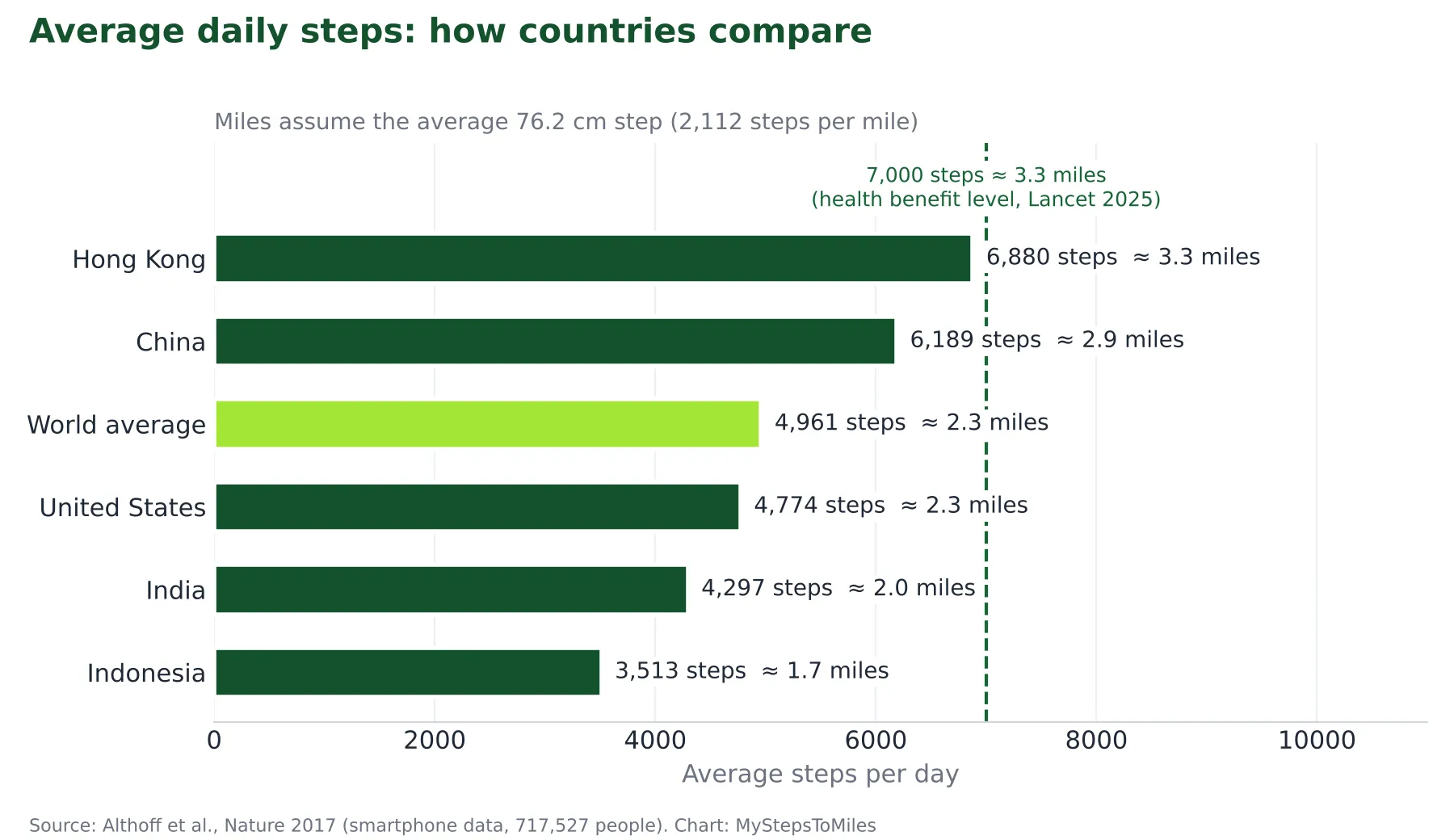
So if your phone says somewhere around 4,000 to 6,000 steps, you’re right in the middle of the pack. That’s useful to know, but there’s a catch. These figures only count steps taken while the phone was in a pocket or hand. Leave it on your desk and those steps go unrecorded, so the real averages are probably a little higher.
The Stanford team noticed something else: people in more walkable cities took more steps, whether they were men or women. Where you live shapes your number more than you might think.
Men vs women
In most data sets, men log slightly more steps than women:
- In a 2010 pedometer study of about 1,100 American adults, men averaged 5,340 steps and women 4,912. That’s about 2.5 miles vs 2.3 miles.
- In the Stanford smartphone data for India, men averaged 4,606 steps and women 3,684, about 2.2 miles vs 1.7 miles.
There’s one more twist. Women are often shorter, so they usually have a shorter step. The same step count can mean a slightly shorter distance, which is why a calculator that uses your height gives a fairer picture (more on that below).
Where does your day fit? The step bands researchers use
Being average and being active are not the same thing. Researchers have a simple ladder for adult step counts, set out by Tudor-Locke and colleagues in 2011. Here it is with the distances added:
| Band | Steps per day | About how many miles |
|---|---|---|
| Basal activity | Under 2,500 | Under 1.2 miles |
| Limited activity | 2,500–4,999 | 1.2–2.4 miles |
| Low active | 5,000–7,499 | 2.4–3.6 miles |
| Somewhat active | 7,500–9,999 | 3.6–4.7 miles |
| Active | 10,000–12,499 | 4.7–5.9 miles |
| Highly active | 12,500 and up | 5.9 miles and up |
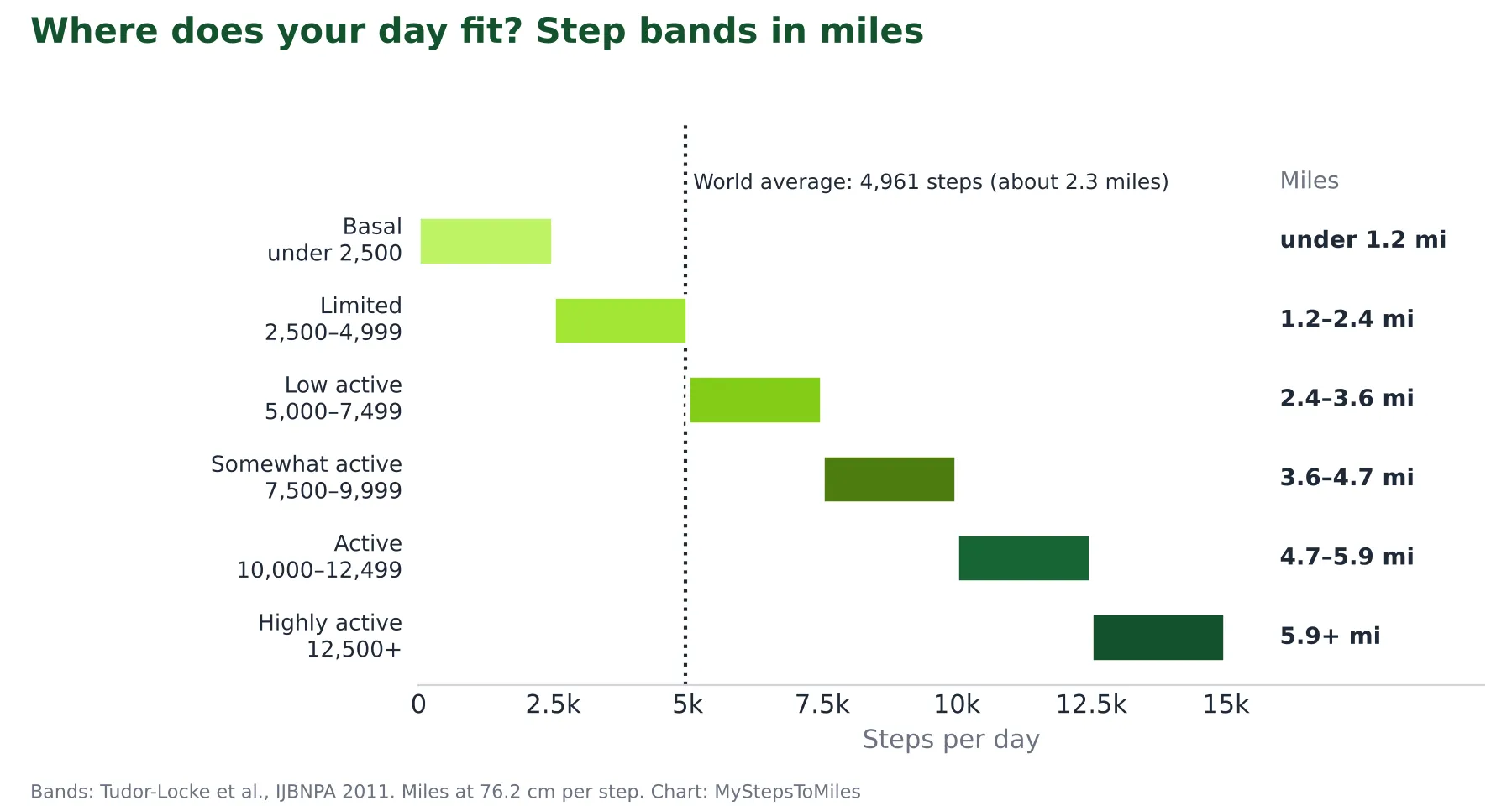
Look where the world average lands: 4,961 steps, right on the line between “limited” and “low active”. In other words, the typical person is only just moving enough to leave the bottom two rungs.
That isn’t a reason to feel bad. It’s a reason to feel hopeful, because moving up one rung usually takes far less than you’d expect.
Average isn’t the same as enough: what the research says
So what should you aim for? The best evidence we have points to a number well below the famous 10,000.
- A large 2025 review in The Lancet Public Health reviewed 57 studies. Compared with 2,000 steps a day, people walking about 7,000 steps had a 47% lower risk of dying during the studies, a 38% lower risk of dementia, 22% fewer depressive symptoms and 28% fewer falls.
- An earlier 2022 analysis of 15 studies covering about 47,500 adults found that the benefit levelled off at around 6,000–8,000 steps for people aged 60 and over, and 8,000–10,000 steps for younger adults.
- The World Health Organization recommends at least 150 minutes of moderate activity a week, and says 31% of adults worldwide (about 1.8 billion people) didn’t reach that in 2022. Tudor-Locke’s review estimated that 150 minutes a week of moderate-to-vigorous activity lines up with roughly 7,000 steps a day.
A fair warning: these studies show links, not proof. People who walk more may be healthier for other reasons too. Still, the pattern is strong and points the same way: more steps help most when you’re starting from a low number, and you don’t need a giant target to get real benefits.
The gap is smaller than you think
This is where turning steps into miles really helps. “Walk 2,000 more steps” sounds vague. “Walk one more mile” is something you can picture, like a loop of the park or the walk to a further bus stop.
| If you average | To reach 7,000 you need | That’s about | Walking time at 3 mph |
|---|---|---|---|
| 3,000 steps | +4,000 steps | 1.9 miles | 38 minutes |
| 5,000 steps | +2,000 steps | 0.95 miles | 19 minutes |
| 6,000 steps | +1,000 steps | 0.5 miles | 10 minutes |
For someone at the world average, the whole gap is one 20-minute walk. Or two 10-minute walks, one after lunch and one after dinner. You can see those distances on the 2,500 steps to miles page and the 8,000 steps to miles page.
A few easy ways to find that extra mile:
- Take phone calls on your feet. A 15-minute call at an easy 2 mph covers about half a mile, or roughly 1,000 steps.
- Walk after meals. Ten minutes after lunch and ten after dinner covers the average person’s whole gap.
- Make the trip longer on purpose. Use the far entrance, the furthest parking space or the next bus stop.
- Climb up one rung at a time. If you average 4,000, aim for 5,000 for a week or two before pushing on. Small, steady steps up are easier to keep.
Why your number (and your miles) might not match
Before you compare yourself too closely, remember two things.
1. Your counter may be missing steps. If your phone is on the desk or charging, every step around the house or office goes uncounted. Wrist trackers can also miss steps when your hands are still, such as when you push a trolley. If you want to dig into this, see our guide on how accurate step counters are.
2. Your steps aren’t the same length as everyone else’s. The 2.3-mile figure uses the average 76.2 cm step. Your step length is roughly 41.3% of your height if you’re a woman and 41.5% if you’re a man. So:
- A woman who is 160 cm tall has a step of about 66 cm. Her 5,000 steps cover about 2.05 miles.
- A man who is 180 cm tall has a step of about 75 cm. His 5,000 steps cover about 2.32 miles.
Same steps, different distance. That’s why “how far did I walk?” has a personal answer.
How to find your own average in two minutes
Here’s a simple routine that turns your step count into something you can act on.
- Find your weekly average, not today’s number. Open your phone’s health app and look at the weekly or monthly view. One lazy Sunday shouldn’t define you.
- Type that number into the steps to miles calculator. It’s free, with no app and no sign-up.
- Choose Better mode and enter your height. This gives you a distance that fits your body, not the average person’s. If you’ve measured your own stride, use Exact mode.
- Pick a walking pace (2, 3 or 4 mph) to see how long that distance takes. It’s a great reality check: your “whole day” of steps may only be 40 minutes of actual walking.
- Set your next rung. Add about 1,000 steps (roughly half a mile) to your average. That’s your new daily target.
- Log it in My Walks. Watch your streak grow and work towards the 30-day milestone. Seeing your progress on screen makes it far easier to keep going.
Frequently asked questions
How many steps does the average person walk a day?
About 5,000. The largest study, of smartphone users in 111 countries, found a world average of 4,961 steps a day, about 2.3 miles at an average step length.
Is 5,000 steps a day good?
It’s about average, and it’s a solid starting point. In research terms it sits at the bottom of the “low active” band. Building up to around 7,000 steps (about 3.3 miles) is linked with much bigger health benefits. See the 5,000 steps to miles page for the distance and walking time.
What is the average number of steps per day for women?
It depends on the study and the country. American women averaged 4,912 steps in a 2010 pedometer study, and Indian women averaged 3,684 in the Stanford smartphone data. Both are a little lower than men in the same groups.
How many miles does the average person walk a day?
About 2.3 miles (3.8 km), based on 4,961 steps at the average 76.2 cm step. Your own figure depends on your height and stride.
Do I really need 10,000 steps a day?
Not necessarily. The research points to big gains well before 10,000, especially if you start low. If 10,000 is your goal, it’s about 4.73 miles. See the 10,000 steps to miles page and our article on how far 10,000 steps really is.
Your next step
You don’t need to be above average to be healthier. You just need to be a little ahead of where you were last week. Grab your weekly average, pop it into the steps to miles calculator, and see how far you really walk. Then add one mile. That’s it.
This article is general information, not medical advice. Talk to a doctor before a big change in how active you are.
Sources
- Althoff T et al. (2017), large-scale physical activity data from smartphones, Nature: https://pubmed.ncbi.nlm.nih.gov/28693034/
- Tudor-Locke C et al. (2011), step-count bands for adults, International Journal of Behavioral Nutrition and Physical Activity: https://link.springer.com/article/10.1186/1479-5868-8-79
- Paluch AE et al. (2022), daily steps and all-cause mortality, The Lancet Public Health: https://pubmed.ncbi.nlm.nih.gov/35247352/
- World Health Organization (2024), physical inactivity: https://www.who.int/news/item/26-06-2024-nearly-1.8-billion-adults-at-risk-of-disease-from-not-doing-enough-physical-activity