
You’ve just done 40 minutes on the treadmill. Your legs feel it. The console says 2.0 miles. Your watch says 1.7 (or, just as often, more than the treadmill). Your phone, sitting in the cup holder, barely noticed you’d moved. So which number is right, and did all that effort actually count?
Good news first.
The short answer: Yes. A step is a step. Every treadmill step counts towards your daily step goal in the same way a step on the pavement does. What can change is the distance those steps add up to. Many people take slightly shorter steps on a treadmill, so the same number of steps can cover less ground than it would outdoors. Your tracker can also miss steps if your arms aren’t swinging. The fix takes about 10 minutes: measure your own treadmill step once, then convert with that number.
The rest of this guide shows you why the numbers disagree, what the research says, and exactly how to get a distance you can trust.
Why your steps count the same but your miles might not
Distance is a simple sum: steps × step length. To get miles, you take your step length in metres and divide by 1,609.344 (the number of metres in a mile).
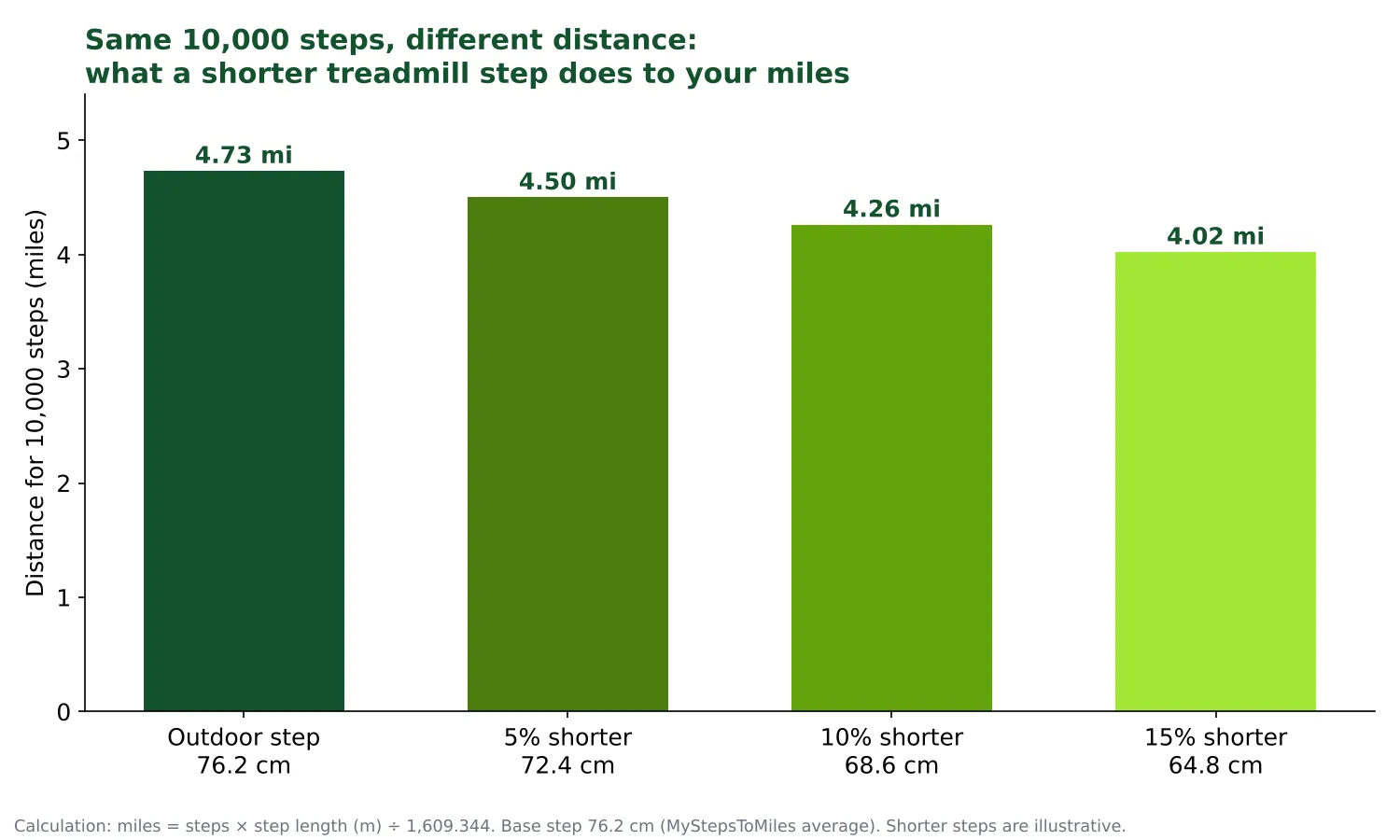
On MyStepsToMiles, the average step is 76.2 cm (2.5 ft). That works out at about 2,112 steps per mile, and 10,000 steps comes to roughly 4.73 miles (7.62 km), about 1 hour 35 minutes at 3 mph.
Now imagine your treadmill step is 10% shorter, say 68.6 cm. The step count stays the same, but the distance shrinks:
- 10,000 steps at 76.2 cm = 4.73 miles
- 10,000 steps at 68.6 cm = 4.26 miles
- One mile at 68.6 cm takes about 2,347 steps instead of 2,112
That’s almost half a mile of difference from the same 10,000 steps. Nobody did anything wrong; the steps were just a little shorter.
So if your goal is a number of steps, the treadmill is just as good. If your goal is distance, you need to know your treadmill step length. Before we fix that, it helps to know whether shorter treadmill steps are a real thing or a myth.
What the research says about treadmill steps
The fair answer is: it depends on the person, and the studies don’t fully agree.
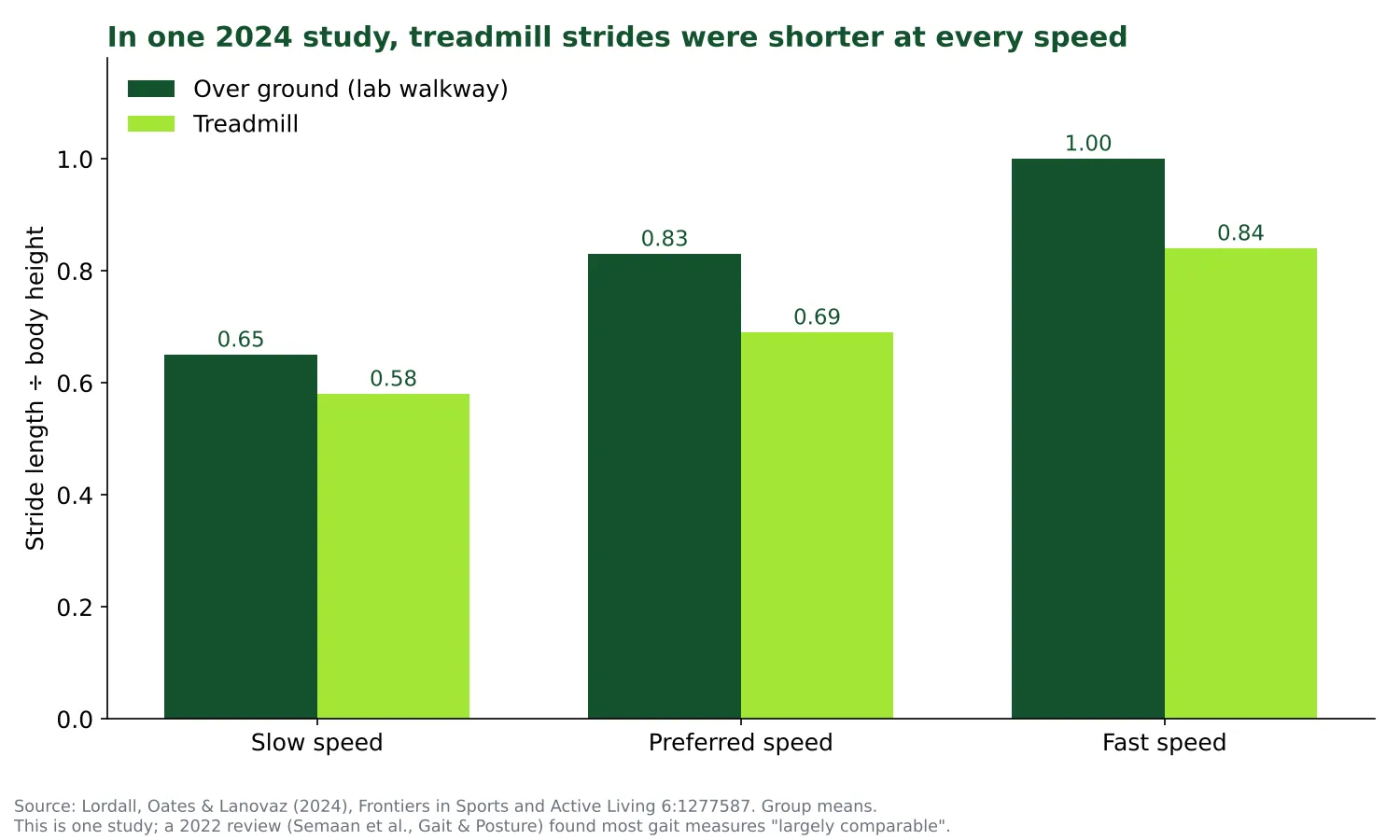
A 2024 study in Frontiers in Sports and Active Living compared the same people walking on a treadmill and over ground at slow, comfortable and fast speeds. On the treadmill, their strides were shorter at every speed, by roughly 11–17% once body height was taken into account.
But a 2022 systematic review in Gait & Posture, which pulled together many studies, found that step-and-stride measures were “largely comparable” between motorised treadmills and normal walking.
So what should you take from that? Some people shorten their step on a treadmill, especially when they’re new to it or a bit nervous about the moving belt. Others walk almost exactly as they do outside. You can’t tell which group you’re in by guessing, but you can find out in one short session. More on that in a moment.
First, let’s clear up why three gadgets can give you three different answers.
Why your watch, phone and treadmill disagree
Your watch is guessing distance indoors
Outdoors, many watches use GPS to see how far you’ve gone. Indoors there’s no GPS signal, so they estimate distance from your movement and the stride length they’ve learnt. Apple says Apple Watch learns your stride by walking or running outdoors with GPS, and recommends about 20 minutes of outdoor walking at your usual pace to calibrate it. If the stride it learnt outside is longer than your treadmill stride, the watch will over-estimate your treadmill miles.
Holding the handrails can hide your steps
Wrist-worn trackers mostly sense the swing of your arm. Grip the rails, rest your hands on the console, or hold a phone to read, and your wrist barely moves. A small 2018 study of the Fitbit Charge 2 on a treadmill, which included walking with and without holding the handrails, concluded the device was not reliable for counting steps in that setting. Simple fixes: let your arms swing naturally, or keep your phone in a pocket or clip a tracker to your waistband.
The treadmill can be wrong too
The console works out distance from how fast it thinks the belt is moving. Belts wear, machines get knocked out of calibration, and gym treadmills aren’t checked every week. Garmin’s manual lets you correct your watch to the treadmill’s display after at least 2.4 km (1.5 miles), which helps, but only if the treadmill itself is right.
The takeaway: no single screen is the “truth”. Your own measured step length is the most reliable number you can have.
The 10-minute fix: measure your treadmill step
This is the bit that ends the guessing. Do it once and you’ll know your treadmill distance from your step count every time after.
- Warm up for 3 minutes at your normal walking speed (for example 3 mph). Let go of the handrails.
- Note your step count on your phone or tracker. Keep the phone in your pocket, not the cup holder.
- Walk exactly 0.5 miles by the treadmill display. At 3 mph that’s about 10 minutes.
- Note your step count again and subtract the first number. That’s how many steps half a mile took you.
- Work out your step length: 804.7 metres (half a mile) ÷ your steps. For example, 1,180 steps → 804.7 ÷ 1,180 = 0.682 m, or 68.2 cm.
- Use it. Open the MyStepsToMiles calculator, choose Exact (“your own stride”). Exact mode asks for the distance of 10 steps, so for a 68.2 cm step enter 6.8 metres. From now on, converting treadmill steps to miles (or km) gives you a distance you can trust.
At 68.2 cm, one mile takes about 2,360 steps, compared with 2,112 at the average 76.2 cm. That’s why your watch and the treadmill so often argue.
Tip: If you suspect your treadmill is out of calibration, repeat the test on a route you know the length of outdoors, such as a running track, where four laps of the inside lane are about 1,600 metres. If your outdoor step is longer, keep two numbers: one for the treadmill and one for outside.
A worked example: one day, two distances
Let’s put numbers on it. Say you’re a woman who is 165 cm tall and you walk 8,000 steps a day, all on a treadmill.
- In Better mode (“uses your height”), the calculator estimates your step at 41.3% of your height: 165 × 0.413 = 68.1 cm. That gives 8,000 steps ≈ 3.39 miles (5.45 km).
- You do the 10-minute test and find your real treadmill step is 64 cm. In Exact mode, the same 8,000 steps ≈ 3.18 miles (5.12 km).
The difference is about 0.2 miles a day. Small on its own, but over 30 days it adds up to around 6 miles you would have “walked” on paper but not on the belt. If you’re training for a charity walk or tracking progress towards a distance goal, that gap matters.
If you’re curious how your usual totals convert, the 8,000 steps to miles page and 10,000 steps to miles page break them down by height and pace.
Do treadmill steps give you the same health benefits?
For everyday health, yes, the steps you take indoors count. The NHS physical activity guidelines recommend at least 150 minutes of moderate activity a week for adults, and list brisk walking as an example. They don’t say it has to happen outdoors.
You may have heard runners say “always set the treadmill to 1%”. That comes from a 1996 study of trained runners, which found a 1% incline best matched the energy cost of running outdoors at running speeds. It was about running, not walking, so if you’re a walker you don’t need to worry about it. Add a gentle incline if you’d like more of a challenge, not because your flat steps “don’t count”.
Each setting has its own strengths:
- Treadmill: no rain, no dark evenings, a steady pace, and easy to fit in before or after work.
- Outdoors: daylight, fresh air, changing scenery and natural ups and downs.
The best walk is the one you’ll actually do. Mixing both is perfectly fine.
Keep every walk in one place
Here’s where a lot of people lose motivation: rainy-day treadmill walks feel like they don’t “count”, so the streak breaks. They do count.

Log both kinds in the My Walks log on MyStepsToMiles. It keeps your streak going and shows your 30-day milestone, whether the steps happened on a belt or a footpath. Use the pace options (2, 3 or 4 mph) to see how long a walk will take, and switch to Exact mode on treadmill days if your step is shorter.
Frequently asked questions
Do treadmill steps count towards 10,000 steps a day?
Yes. Steps on a treadmill count towards your daily total just like steps outside. Just keep in mind that 10,000 treadmill steps may cover a little less distance. See the 10,000 steps to miles page for the full breakdown.
How many steps is a mile on a treadmill?
At the average step of 76.2 cm, it’s about 2,112 steps. If your treadmill step is shorter, it will be more, for example about 2,350 steps at 68.6 cm. The 10-minute test above tells you your own number.
Why does my Apple Watch show a different distance from the treadmill?
Indoors, the watch estimates distance from the stride it learnt during outdoor GPS walks. If your treadmill stride is different, or your arms aren’t swinging, the numbers won’t match. Calibrating with an outdoor walk and letting your arms swing usually helps.
Does holding the treadmill handrails affect my step count?
It can, especially with a wrist tracker, because it relies on arm movement. Walk hands-free if you can do so safely, or keep your phone in your pocket.
Is walking on a treadmill as good as walking outside?
For meeting activity guidelines, brisk walking counts wherever you do it. Outdoors adds scenery and natural terrain; the treadmill adds convenience and a steady pace.
Try it now
Next time the treadmill and your watch argue, you don’t have to pick a side. Pop your step count into the MyStepsToMiles calculator, choose Quick, Better or Exact mode, and see your real distance and walking time in seconds. No app, no sign-up.
This article is general information, not medical advice. Talk to a doctor before a big change in how active you are.
Sources
- Lordall, Oates & Lanovaz (2024), treadmill vs overground stride length, Frontiers in Sports and Active Living: https://www.frontiersin.org/articles/10.3389/fspor.2024.1277587/pdf
- Semaan et al. (2022), systematic review of treadmill and overground walking, Gait & Posture: https://pubmed.ncbi.nlm.nih.gov/34890914/
- Apple Support, calibrating Apple Watch for accuracy: https://support.apple.com/en-om/105048
- Hargis et al. (2018), Fitbit Charge 2 on a treadmill, International Symposium on Biomechanics in Sports: https://commons.nmu.edu/isbs/vol36/iss1/49
- Garmin, treadmill calibration in the watch manual: https://www8.garmin.com/manuals/webhelp/GUID-3A4F9C4A-8735-46C0-8DA9-65F11400B150/EN-US/GUID-86541696-B60E-44BC-9A46-4349C86A1CD8.html
- NHS, physical activity guidelines for adults: https://www.nhs.uk/live-well/exercise/physical-activity-guidelines-for-adults-aged-19-to-64/
- Jones & Doust (1996), treadmill grade and the energy cost of running: https://read.qxmd.com/read/8887211/a-1-treadmill-grade-most-accurately-reflects-the-energetic-cost-of-outdoor-running