You set off for “a quick walk”. Ninety minutes later you’re thirsty, a bit light-headed, and the nearest shop is a mile away. Or the opposite happens: you lug a litre of water and two cereal bars round the park for 25 minutes and bring them all home again.
Both come from the same mistake. We plan food and drink for a walk by guessing, and most of us are bad at guessing how long a walk will take.
The quick answer: how much water to drink while walking depends mostly on how long you’ll be out. For a walk under about an hour in mild weather, water is usually all you need. Have a drink before you go, take small sips during if you’re thirsty or it’s warm, and drink again afterwards. Once a walk goes past an hour, carry water and a small carbohydrate snack, such as a banana or a handful of dried fruit. Let thirst guide you, and don’t force down more than you need.
In short: under an hour = water before and after (a few sips during if it is warm). Over an hour = water during, plus a small snack. Over two hours = plan a refill stop.
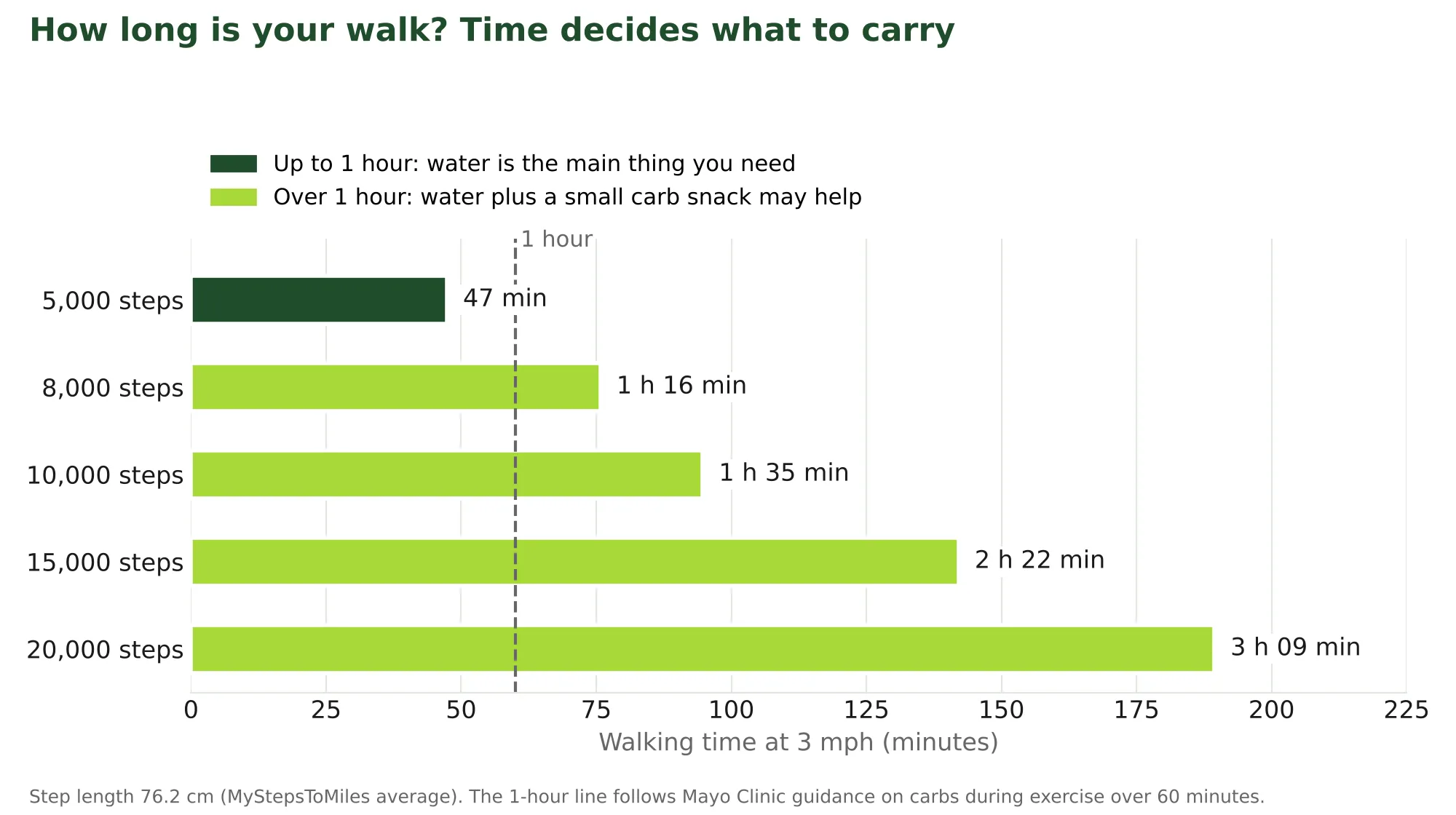
The trick is knowing which side of that one-hour line your walk falls on. That’s where your step count helps.
The real problem: you know your steps, not your minutes
Most people set walking goals in steps. Hydration and snack advice, though, is written in minutes and hours. Mayo Clinic, for example, says a carbohydrate-rich food or drink may help “if your workout is longer than 60 minutes” (Mayo Clinic).
So 10,000 steps. Is that over an hour or under? Most people guess “about an hour”. At a steady 3 mph, with an average 76.2 cm step, it’s closer to 1 hour 35 minutes. That gap is why so many people run out of water halfway.
Step 1: Turn your step goal into walking time
Put your step goal into the MyStepsToMiles calculator and pick your pace (2, 3 or 4 mph). You’ll get the distance and the walking time in seconds. Use Better mode if you want it to use your height, or Exact mode if you’ve measured your own stride.
Here’s what the numbers look like with the average 76.2 cm step:
| Step goal | Distance | Time at 2 mph | Time at 3 mph | Time at 4 mph |
|---|---|---|---|---|
| 5,000 | 2.37 mi (3.81 km) | 1 h 11 min | 47 min | 36 min |
| 8,000 | 3.79 mi (6.10 km) | 1 h 54 min | 1 h 16 min | 57 min |
| 10,000 | 4.73 mi (7.62 km) | 2 h 22 min | 1 h 35 min | 1 h 11 min |
| 15,000 | 7.10 mi (11.43 km) | 3 h 33 min | 2 h 22 min | 1 h 47 min |
| 20,000 | 9.47 mi (15.24 km) | 4 h 44 min | 3 h 09 min | 2 h 22 min |
Notice the 8,000-step row. At a relaxed 2 mph it’s nearly two hours on your feet. At a brisk 4 mph it’s under an hour. Same steps, very different water plan. For more on each goal, see the 5,000 steps to miles page, 10,000 steps to miles page, 15,000 steps to miles page and 20,000 steps to miles page.
Step 2: Your water plan, by walk length
Before you set off
Start the walk already topped up. Mayo Clinic suggests roughly 2 to 3 cups (473 to 710 ml) of water in the 2 to 3 hours before exercise. For a short walk, a glass of water an hour or so before is a sensible everyday version of that.
During the walk: sip, don’t gulp
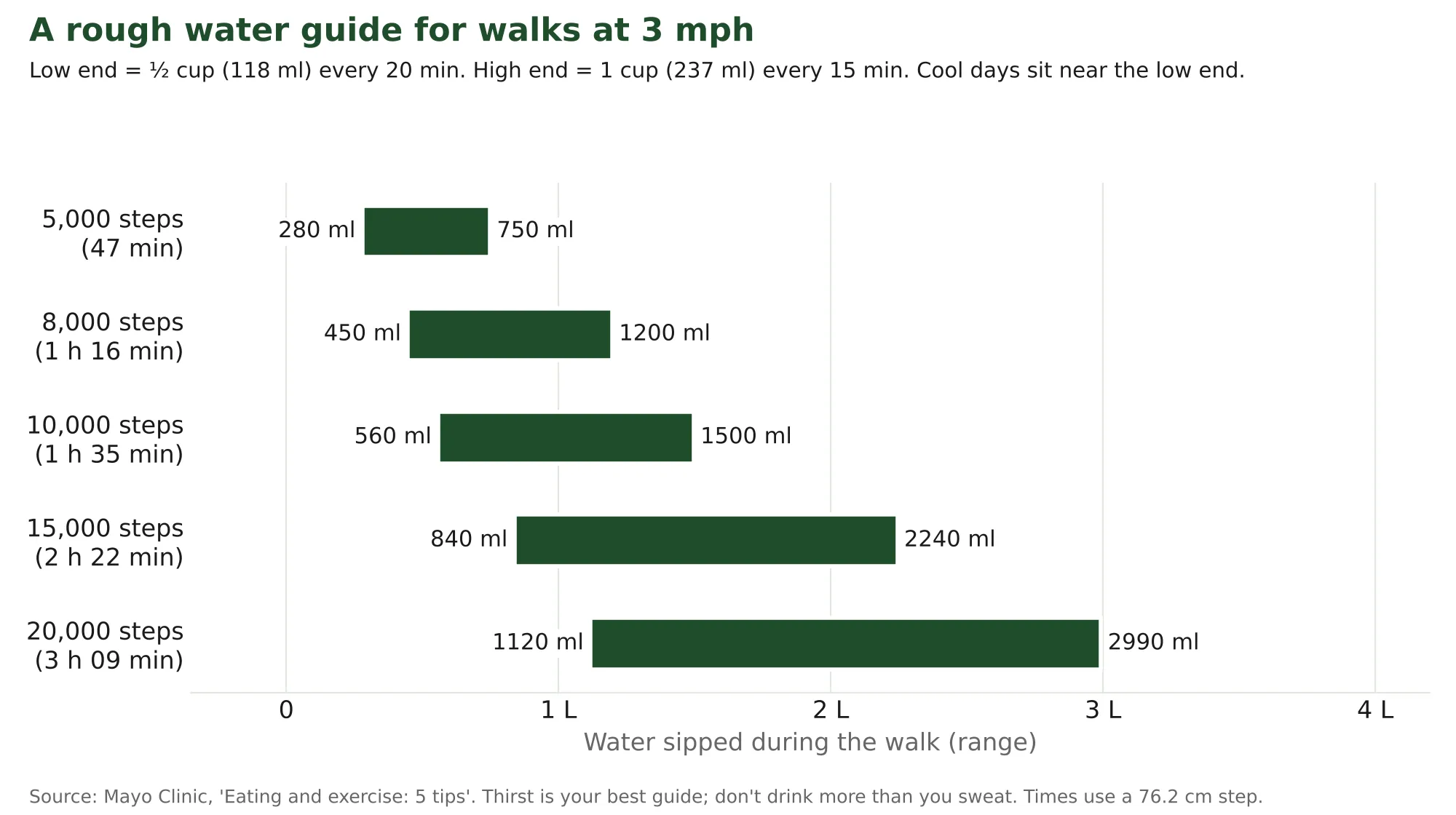
For longer or warmer walks, Mayo Clinic’s guide is about ½ to 1 cup (118 to 237 ml) every 15 to 20 minutes. That’s a few mouthfuls, not a bottle.
Turn that into a total and you get a useful range for packing:
- 5,000 steps (about 47 min at 3 mph): roughly 280 to 750 ml. One small bottle covers it.
- 10,000 steps (about 1 h 35 min): roughly 560 ml to 1.5 litres. A 750 ml bottle is fine on a cool day; take more in the heat.
- 20,000 steps (about 3 h 09 min): roughly 1.1 to 3 litres. Plan a refill stop rather than carrying it all.
The low end suits cool, cloudy days. The high end is for hot, sweaty ones. Most real walks sit somewhere in between.
After the walk
The NHS says to drink extra fluids if you’ve been sweating from physical activity, and that water is the best way to replace what you’ve lost. Want to be precise? Weigh yourself before and after a long walk. Mayo Clinic suggests 2 to 3 cups of water for every pound (about 0.5 kg) you lose.
The other mistake: drinking too much
More is not always better. Drinking far more than you sweat out over several hours can dilute the salt in your blood. This condition is called hyponatraemia. It’s rare on everyday walks, but it is a real risk at long events. An international expert panel, writing in the Clinical Journal of Sport Medicine in 2015, named overdrinking as the main cause and recommended drinking when you feel thirsty. A modelling study also points out that slower participants tend to be at higher risk. That’s relevant to walkers, because we’re out for longer.
So use the ranges above as a packing guide, not a target you must finish. Even for people working hard in the heat, the US CDC advises no more than about 1.4 litres (48 oz) an hour.
Step 3: Snacks: when you need them and when you don’t
Before the walk
A big meal right before a walk can feel heavy. Mayo Clinic suggests eating a large meal 3 to 4 hours before exercise, or a small meal or snack 1 to 3 hours before. For a gentle stroll after dinner, don’t overthink it. A short walk after eating is fine for most people (see walking after meals).
During walks over an hour
This is where a snack earns its place in your pocket. Go for something easy to carry and quick to eat, with some carbohydrate:
- a banana
- a small handful of dried fruit or a fruit-and-nut mix
- an oat or cereal bar
- a few crackers or a small sandwich on a long day out
Eat a little at a time, roughly every hour, rather than one big lunch halfway. On a walk under an hour, most people don’t need anything at all.
After the walk
Mayo Clinic suggests a meal with both carbohydrate and protein within two hours of a workout if possible. For most walkers that’s simply your next normal meal. Beans on toast, eggs and rice, or yoghurt with fruit all fit.
Three real-life walk plans
Here’s how it works in practice, using the calculator and the guide above.
1. The lunch-break walk: 5,000 steps at 4 mph. That’s about 36 minutes. Drink a glass of water before you leave the office and another when you’re back. No snack needed. Carry a small bottle only if it’s hot.
2. The Saturday 10,000: 4.73 miles at 3 mph. That’s about 1 hour 35 minutes. Take a 500 to 750 ml bottle and sip every 15 to 20 minutes. Put a banana in your pocket for the second half.
3. The charity challenge: 20,000 steps. That’s about 9.5 miles and more than 3 hours at 3 mph. Eat a proper breakfast 2 to 3 hours before. Carry one bottle and plan a refill point. Pack two or three small snacks and drink to thirst rather than forcing water down. For bigger days, see the how many miles is 25,000 steps article.
Log each one in My Walks on MyStepsToMiles. Over a few weeks you’ll learn your own pattern: how long your usual routes take, and how much you actually drink. Your streak and 30-day milestone give you a nudge to keep going.
Quick check: are you drinking enough?
You don’t need a fancy app for this. The NHS lists these signs of dehydration in adults:
- feeling thirsty
- dark yellow, strong-smelling pee
- peeing less often than usual
- feeling dizzy or light-headed
- feeling tired
- a dry mouth, lips and tongue
The simplest check is colour. The NHS suggests drinking enough during the day so your pee is a clear pale yellow.
Your 30-second pack list
- Check your walk time with the MyStepsToMiles calculator.
- Under an hour: drink before and after. Take a small bottle if it’s warm.
- One to two hours: carry a bottle (about 500 to 750 ml) plus one small snack.
- Over two hours: carry water, plan a refill, and take a snack for each hour.
- Hot day? Lean towards the top of the range, but still drink to thirst.
For everything else worth carrying on a long walk, see our what to carry on a long walk checklist.

Frequently asked questions
How much water should I drink while walking?
For walks over about an hour or on warm days, aim for a few sips (roughly ½ to 1 cup, or 118 to 237 ml) every 15 to 20 minutes, guided by thirst. On a short walk in mild weather, a drink before and after is usually enough.
Should I eat before a morning walk?
For a short, easy walk, you don’t have to. For a longer walk, a small snack 1 to 3 hours before can help you feel less flat. If you feel shaky or light-headed walking on an empty stomach, eat something small first.
What is a good snack for a long walk?
Something light and carb-based that travels well: a banana, dried fruit, an oat bar or crackers. Eat a little each hour once you’re past the one-hour mark.
How much water do I need for 10,000 steps?
At 3 mph, 10,000 steps takes about 1 hour 35 minutes. Using Mayo Clinic’s ranges, that’s roughly 560 ml to 1.5 litres during the walk, at the lower end on a cool day. A 750 ml bottle covers most mild-weather walks.
Can you drink too much water on a walk?
Yes, though it’s uncommon on everyday walks. Drinking far more than you sweat over several hours can lower blood salt levels. Experts recommend drinking when you’re thirsty rather than to a fixed schedule.
Plan your next walk in 10 seconds
Stop guessing. Type your step goal into the free MyStepsToMiles calculator. You’ll see the miles, kilometres and walking time at your pace, with no app and no sign-up. Then pack your water and snack to match.
This article is general information, not medical advice. Talk to a doctor before a big change in how active you are.
Sources
- NHS, Water, drinks and your health
- NHS, Dehydration
- Mayo Clinic, Eating and exercise: 5 tips to maximize your workouts
- US CDC/NIOSH, Heat stress: hydration
- Hew-Butler et al. (2015), consensus statement on exercise-associated hyponatraemia, Clinical Journal of Sport Medicine, via ScienceDaily
- Montain, Cheuvront and Sawka (2006), exercise-associated hyponatraemia, British Journal of Sports Medicine: https://pmc.ncbi.nlm.nih.gov/articles/PMC2492017/