Here’s the short answer. For any walk longer than about an hour, carry water, a small snack, your phone (charged), a couple of blister plasters, sun or rain protection for the day’s weather, and a light layer. That’s it. Everything fits in a small backpack or even a jacket with good pockets, and it weighs about as much as a bag of sugar plus a water bottle.
Why bother? Because long walks rarely go wrong in a dramatic way. They go wrong in small, annoying ways. A heel starts rubbing at mile three. You get thirsty with nowhere to buy a drink. The sun comes out and you’ve no hat. Each little thing chips away at the fun, and when walking stops being fun, people stop doing it.
So this checklist isn’t about survival gear. It’s about making long walks comfortable enough that you’ll want to do the next one. Let’s start with the question most people skip.
First: how long is your “long walk”, really?
What you need depends on how long you’ll be out, and most of us underestimate it. Using our average step length of 76.2 cm (2.5 ft), there are about 2,112 steps in a mile. That means 10,000 steps is roughly 4.73 miles (7.62 km), which takes about 1 hour 35 minutes at a steady 3 mph.
Now stretch that out. Here’s non-stop walking time for some common long-walk targets:
| Steps | Distance | At 2 mph | At 3 mph | At 4 mph |
|---|---|---|---|---|
| 10,000 | 4.7 mi / 7.6 km | 2 h 22 min | 1 h 35 min | 1 h 11 min |
| 15,000 | 7.1 mi / 11.4 km | 3 h 33 min | 2 h 22 min | 1 h 47 min |
| 20,000 | 9.5 mi / 15.2 km | 4 h 44 min | 3 h 09 min | 2 h 22 min |
| 25,000 | 11.8 mi / 19.1 km | 5 h 55 min | 3 h 57 min | 2 h 58 min |
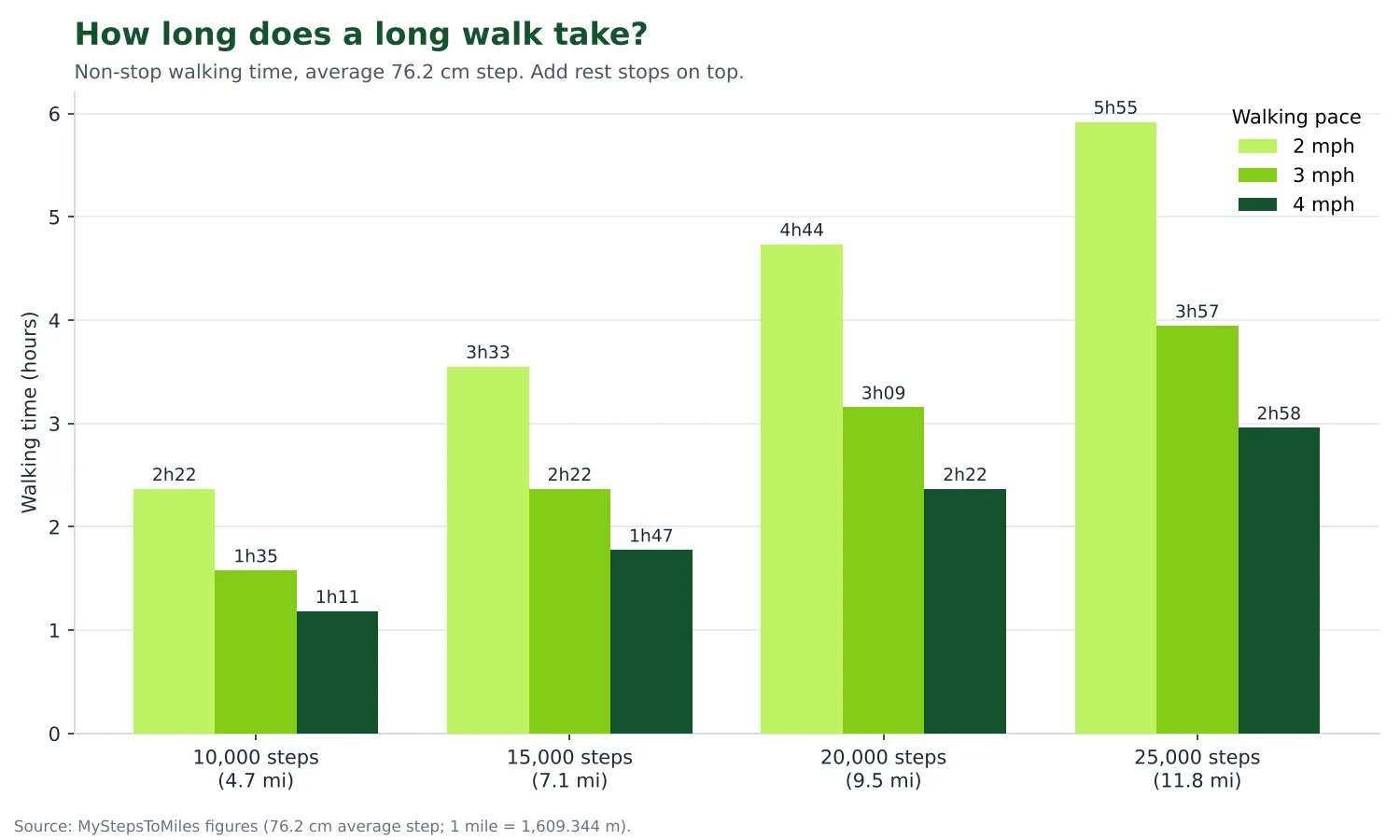
A relaxed 20,000-step day out is more than three hours on your feet, and closer to four once you add a café stop and a few photos. That’s long enough for the weather to change, your feet to swell slightly, and your stomach to start asking questions.
Before you pack, pop your planned steps or distance into the MyStepsToMiles calculator and pick the pace that matches you (2, 3 or 4 mph). If you know your height, use the Better mode, as it adjusts your step length; if you’ve measured your own stride, Exact mode is even closer. You’ll get a realistic time, and that time is what decides your packing list. For a typical target, the 15,000 steps to miles and 20,000 steps to miles pages show the numbers at a glance.
The essentials checklist
Here’s the list, then we’ll go through why each item earns its place.
- Water: about 500 ml for a walk of 1–2 hours in mild weather; more for longer or hotter walks
- A snack or two: something easy to eat on the move
- Phone, fully charged: plus a small power bank on longer or remote walks
- Blister kit: two or three plasters (hydrocolloid “blister plasters” are ideal)
- Sun protection: sunscreen (SPF 30+), hat, sunglasses
- A light layer: a thin jacket or waterproof that packs small
- A little cash and a bank card: for cafés, buses and emergencies
- Keys and any medicine you need: inhaler, tablets, glucose if you’re diabetic
- Optional extras: spare socks, a small hand sanitiser, tissues, a paper map for unfamiliar routes
1. Water: the one you can’t skip
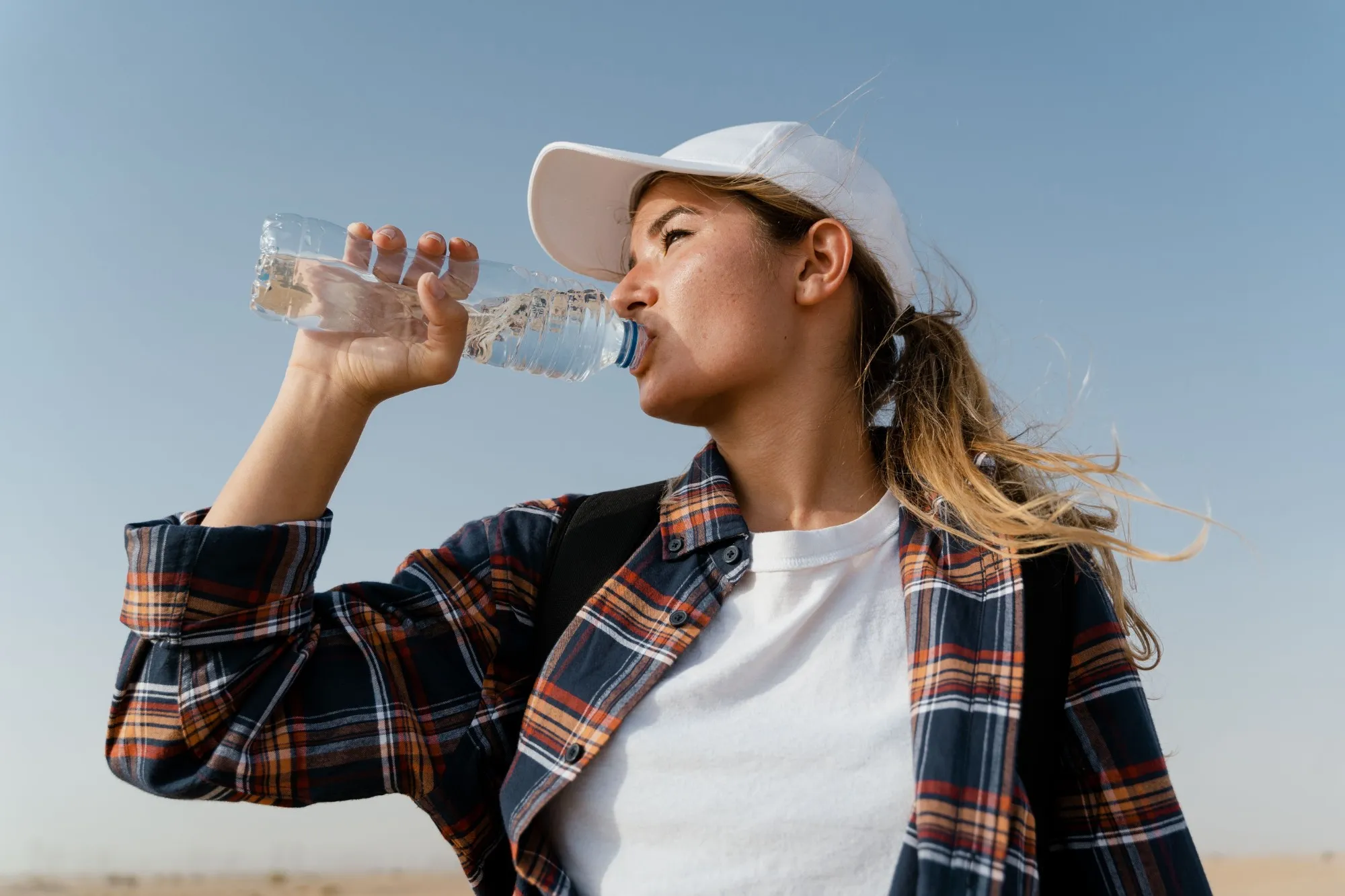
Water is the item that most affects how you feel on a long walk. The CDC’s advice for exercising in the heat is simple: drink more than usual and don’t wait until you’re thirsty (CDC, Heat and Athletes). Thirst tends to show up a little late.
How much? There’s no single right amount, because it depends on your size, your pace and the weather. As a rough guide, people working outdoors in moderate heat are advised by CDC/NIOSH to drink about one cup of water every 15–20 minutes. You won’t need that much on a cool autumn stroll, but it shows how quickly needs climb when it’s warm.
A practical approach: carry a 500 ml bottle for walks of one to two hours, and a litre for longer ones or hot days. Plan your route past a café, shop or water fountain so you can refill instead of carrying it all. Remember, one litre of water weighs about one kilogram, so refilling beats lugging.
2. A snack: small, simple, easy to eat
For a walk under an hour, most people don’t need food. Past the two-hour mark, a snack can stop that flat, grumpy feeling that makes the last mile drag. You don’t need special sports food. A banana, a small handful of nuts or dried fruit, an oat bar, or a sandwich does the job.
Pick things that won’t melt or squash, and that you can eat with one hand. If you’re walking for weight loss, choose something filling and modest in size rather than skipping food altogether and ending up ravenous at home. We’ll cover food and drink properly later in this series, on Day 26.
3. Your phone (and a bit of spare battery)
Your phone is your map, your camera, your step counter and your emergency line, all in one. That’s exactly why its battery matters. Mountain Rescue England and Wales point out that “many accidents occur towards the end of the day when both you and your phone are low on energy”, and suggest carrying a power pack (Ordnance Survey, advice from Mountain Rescue).
A few easy habits help:
- Start with a full charge.
- Turn screen brightness down and close apps you don’t need.
- On a long or remote walk, tell someone your route and when you expect to be back.
- In the UK, if you have hearing or speech difficulties, register for emergencySMS before you need it by texting “register” to 999.
Afterwards, log the walk in My Walks on MyStepsToMiles. It keeps your streak going and counts you towards the 30-day milestone, which is a nice little reward for a big day out.
4. A tiny blister kit
Blisters are the number-one reason a lovely long walk turns into a limp home. The NHS advice for preventing them is to wear comfortable, well-fitting shoes, break new shoes in with short wears first, wear moisture-wicking sports socks, and change your socks if your feet get sweaty (NHS, Blisters).
So pack two or three plasters, ideally hydrocolloid blister plasters, which the NHS says can protect the blister, reduce pain and help it heal. The trick is to stop the moment you feel a “hot spot” rubbing, before a blister forms. On walks over three hours, a spare pair of socks weighs almost nothing and feels wonderful halfway round.
If a blister does form, the NHS advises not to pop it yourself. Just cover it with a soft plaster or padded dressing. Shoes matter enough that we’ve given them their own article on Day 8.
5. Sun, rain and a light layer
Weather changes faster than you expect over a three- or four-hour walk. The NHS recommends sunscreen with at least SPF 30 and 4-star UVA protection, reapplied every two hours, and suggests staying in the shade between 11am and 3pm from March to October in the UK (NHS, Sunscreen and sun safety). A wide-brimmed hat and sunglasses help too.
In cooler months, swap the sun cream for a thin waterproof or windproof jacket. It packs into a fist-sized bundle and makes a cold, damp stop bearable. The CDC also suggests loose, lightweight, light-coloured clothing in hot weather, and walking earlier or later in the day when it’s cooler. Day 28 of this series goes deeper on walking in heat, rain and cold.
Does carrying a bag give you “more benefit”?
This is a fair question. If you’re carrying a backpack anyway, are you burning a lot more? The honest answer is: a little, but not much, with a normal day bag.
Scientists estimate the energy cost of walking with a load using a well-known formula from 1977 called the Pandolf equation. Running it for a 70 kg person walking on flat ground at 3 mph gives these estimates:
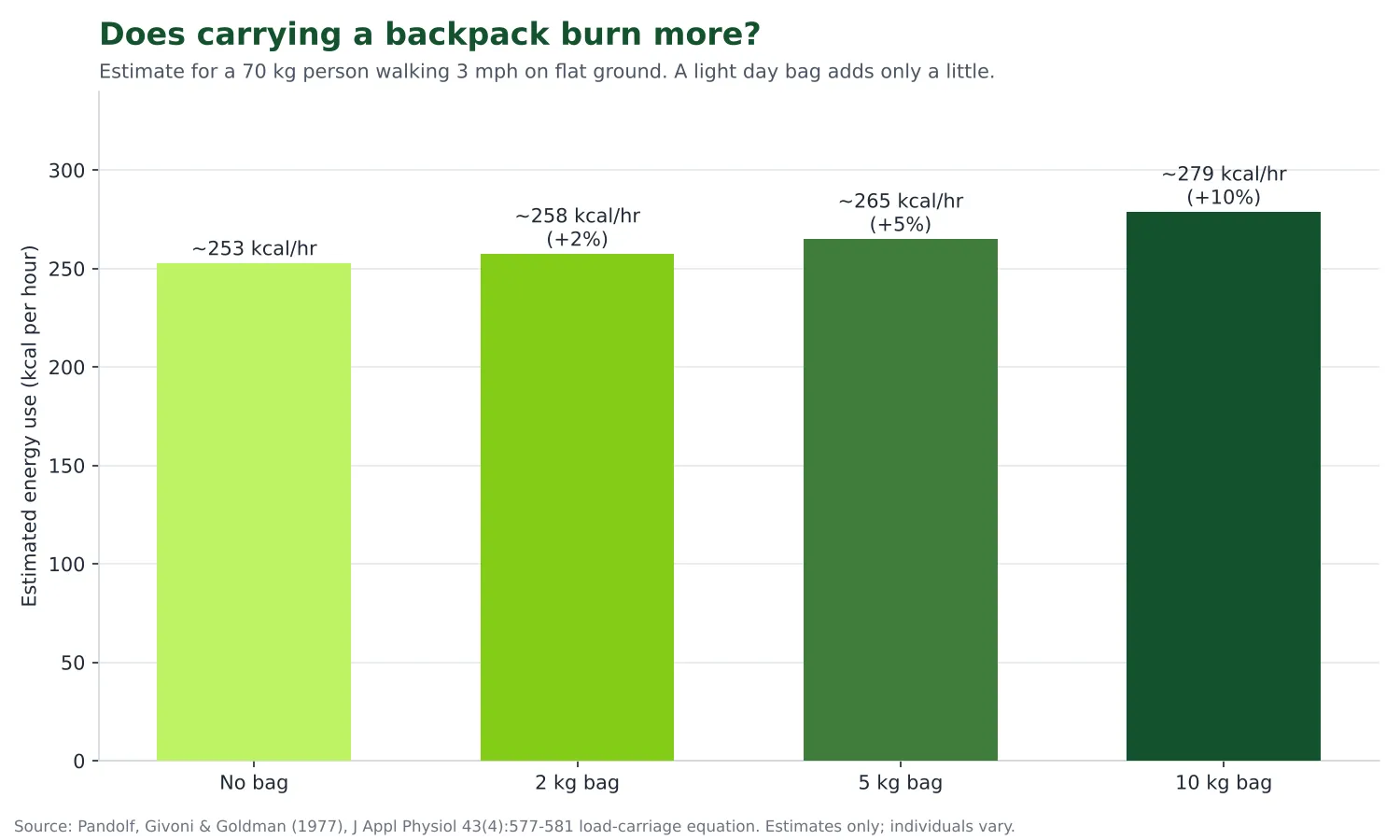
A 2 kg day bag (about what our checklist weighs) adds roughly 2%. Even 10 kg adds only around 10%. So don’t pack bricks to “burn more”. The real benefit of carrying the right kit is simpler: you can walk further and for longer, comfortably. An extra half-hour of walking because you weren’t thirsty or sore beats a heavier bag every time.
If you do want to try weighted walking (often called “rucking”), build up slowly, keep the weight high and close to your back, and talk to a doctor first if you have back, knee or heart problems.
How to pack it so you barely notice it
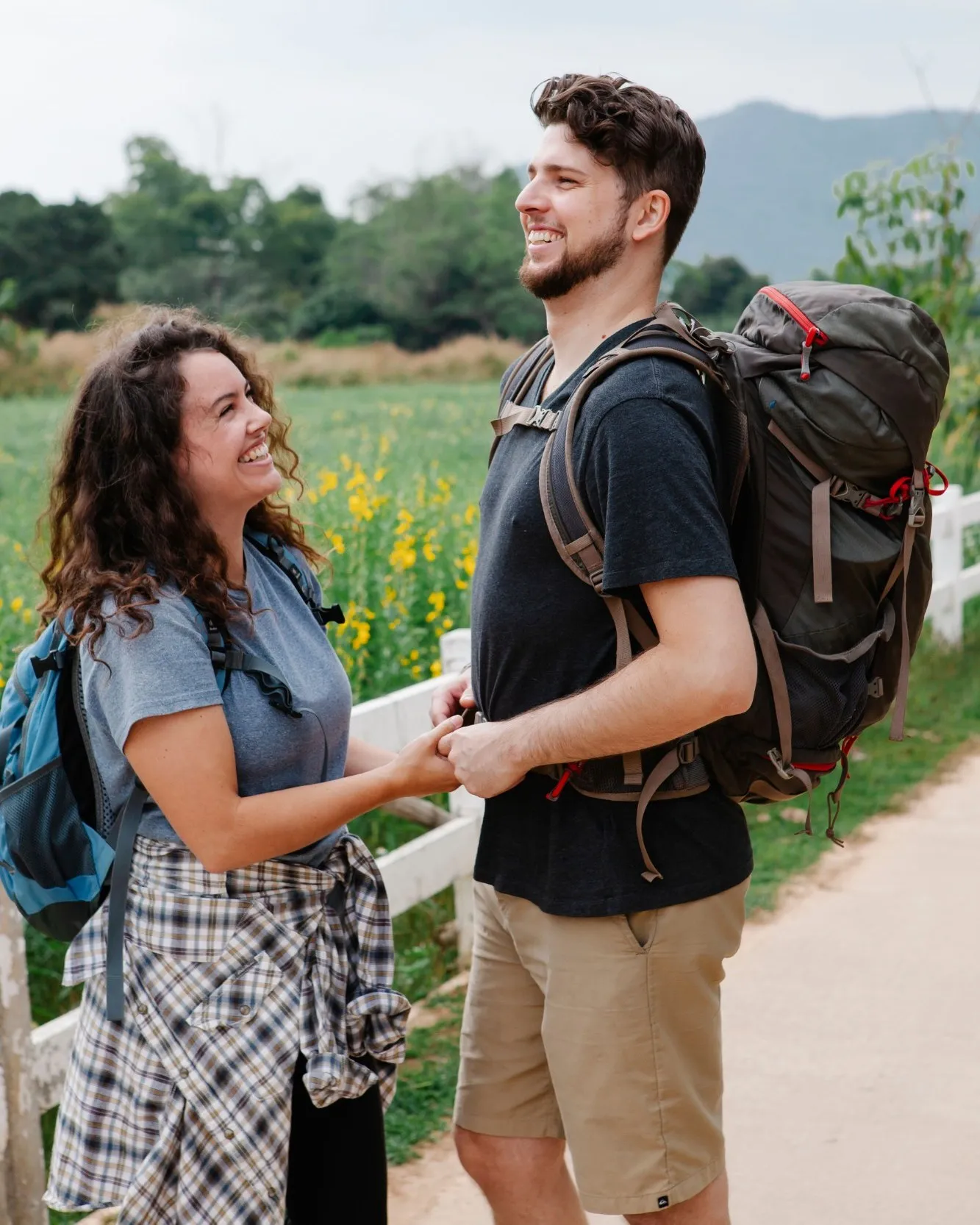
- Use a small backpack with two shoulder straps. It spreads weight better than a shoulder bag or tote.
- Heaviest things close to your back. Water bottle in the middle, not dangling off the side.
- Keep the “quick grab” items in a hip or side pocket. Phone, tissues, a snack and plasters.
- Aim for light. Our full checklist with 500 ml of water comes to roughly 1.5–2 kg. If yours is creeping past 4–5 kg for a day walk, take something out.
- Pack the night before. One less excuse when the alarm goes.
Quick checklist by walk length
| Walk length | What to take |
|---|---|
| Under 1 hour (up to ~6,000 steps) | Phone, keys. Water if it’s warm. |
| 1–2 hours (~6,000–12,000 steps) | Add a 500 ml bottle, 2 plasters, sun or rain layer. |
| 2–4 hours (~12,000–25,000 steps) | Add a snack, a power bank, cash/card, spare socks; 750 ml–1 litre of water or a refill stop. |
| 4+ hours or remote routes | Add a proper meal, a paper map, extra layer, and tell someone your route and return time. |
Not sure where your walk falls? The 6,000 steps to miles and 12,000 steps to miles pages show the distances and times for those cut-off points, and the 10,000 steps to miles page covers the classic daily target.
Frequently asked questions
What should I take on a 10-mile walk?
10 miles is about 21,120 steps with an average stride, or roughly 3 hours 20 minutes of walking at 3 mph. Take water (around a litre, or plan a refill), a snack, a charged phone, blister plasters, a weather layer and a little cash.
How much water should I carry on a long walk?
There’s no one-size answer. A 500 ml bottle covers most 1–2 hour walks in mild weather. For longer or hotter walks, carry a litre or plan refill stops, and drink before you feel thirsty, as the CDC advises.
Is it better to walk with a backpack or a waist bag?
For anything more than a phone and keys, a small two-strap backpack spreads the weight more evenly. A waist bag is handy for short walks or for keeping your phone and snacks within reach.
Does walking with a backpack burn more calories?
Slightly. By the Pandolf equation, a 2 kg day bag adds about 2% for a 70 kg person at 3 mph, and 10 kg adds about 10%. The bigger benefit is being comfortable enough to walk further.
How do I stop blisters on a long walk?
Wear well-fitting, broken-in shoes and moisture-wicking socks, change damp socks, and stop to cover any rubbing spot with a plaster straight away (NHS advice).
Ready for your next long walk?
Pick your target, then plug it into the MyStepsToMiles calculator to see exactly how far and how long it will be at your pace. It’s free, there’s no app and no sign-up. Pack the bag the night before, and when you get home, log it in My Walks and watch your streak grow.
This article is general information, not medical advice. Talk to a doctor before a big change in how active you are.
Sources
- CDC, Heat and Athletes: https://www.cdc.gov/heat-health/risk-factors/heat-and-athletes.html
- CDC/NIOSH, Keeping Workers Hydrated and Cool Despite the Heat: https://www.cdc.gov/niosh/bulletin/2011/heat2.html
- NHS, Blisters: https://www.nhs.uk/conditions/blisters/
- NHS, Sunscreen and sun safety: https://www.nhs.uk/live-well/seasonal-health/sunscreen-and-sun-safety/
- Ordnance Survey, Advice from Mountain Rescue (Mountain Rescue England and Wales): https://osmaps.com/discover/guides/mountain-safety/
- Pandolf KB, Givoni B, Goldman RF (1977). Predicting energy expenditure with loads while standing or walking very slowly. Journal of Applied Physiology 43(4):577–581.