
Twenty-five thousand steps sounds like a number from a fitness challenge, a holiday in a new city, or the day you said yes to “just one more” trail. So how far is it really?
For most people, 25,000 steps is about 10 to 12 miles (16 to 19 km). Using the average step length of 76.2 cm (2.5 ft), it works out at 11.8 miles, or 19.05 km. At a steady 3 mph, that is just under 4 hours of walking, not counting coffee stops.
That is the quick answer. But a 25,000-step day is a big day, and the exact distance depends on you: your height, your pace, and even whether you are on a pavement or a treadmill. Let’s walk through it properly, so you know what you are signing up for and how to make it feel good rather than gruelling.
The maths behind 25,000 steps
Turning steps into miles needs just one thing: how long each step is. Multiply the steps by your step length in metres, then divide by 1,609.344 (the number of metres in a mile).
With the average 76.2 cm step:
25,000 × 0.762 = 19,050 metres. 19,050 ÷ 1,609.344 = 11.84 miles.
Another way to see it: at about 2,112 steps per mile, 25,000 steps is a little under 12 miles. That is two and a half times a 10,000-step day, which is about 4.73 miles (7.62 km). If 10,000 steps is your usual benchmark, see our 10,000 steps to miles page, then imagine doing it twice, plus a bit more.
The catch is that “average” step. If you are shorter than about 184 cm, your real step is probably shorter than 76.2 cm, so the same 25,000 steps will carry you less far. That is where height comes in.
25,000 steps by height: why your answer is personal
A handy rule of thumb is that your step length is about 41.3% of your height if you are a woman and 41.5% if you are a man. It is an estimate, not a measurement, but it is far closer for most people than one number for everyone.
Here is what that means for a 25,000-step day:
| Height | Women | Men |
|---|---|---|
| 150 cm | 9.6 mi (15.5 km) | 9.7 mi (15.6 km) |
| 160 cm | 10.3 mi (16.5 km) | 10.3 mi (16.6 km) |
| 170 cm | 10.9 mi (17.6 km) | 11.0 mi (17.6 km) |
| 180 cm | 11.5 mi (18.6 km) | 11.6 mi (18.7 km) |
| 190 cm | 12.2 mi (19.6 km) | 12.2 mi (19.7 km) |
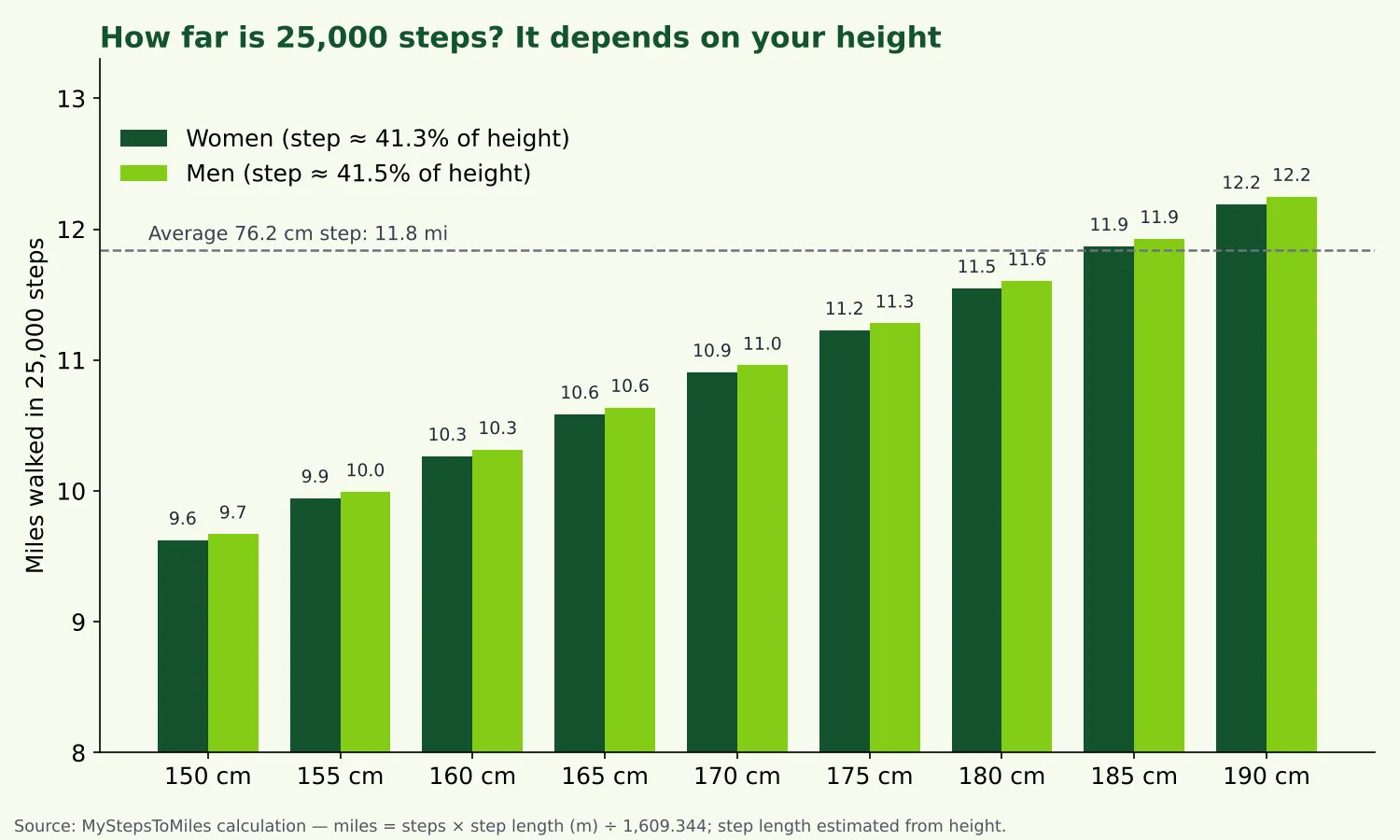
So a 160 cm walker covers roughly 10.3 miles in 25,000 steps, while a 190 cm walker covers about 12.2 miles. That is nearly two miles of difference for the same step count, about 40 minutes of extra walking at 3 mph.
If you want your own number rather than a table, use the steps to miles calculator. The Better mode uses your height, and the Exact mode lets you type in your own stride if you have measured it. More on measuring below.
How long does it take to walk 25,000 steps?
Time depends on pace. Using the average 76.2 cm step (11.84 miles), here is the walking time with no stops:
| Pace | What it feels like | Time for 25,000 steps |
|---|---|---|
| 2 mph | Easy stroll, window-shopping | About 5 h 55 min |
| 3 mph | Comfortable, purposeful walk | About 3 h 57 min |
| 4 mph | Brisk: you can talk, but not sing | About 2 h 58 min |
Real days are slower. Traffic lights, photos, lunch and the odd wrong turn all add up, so for planning purposes it is wise to allow 4½ to 6 hours for a 25,000-step day at a normal pace. You can switch between 2, 3 and 4 mph in the calculator to see how pace changes your time.
What a 25,000-step day really looks like

Here is the honest truth: very few people hit 25,000 steps by accident. It usually happens on one of these days:
- A city break. Exploring a new place on foot, from breakfast to dinner, can easily pass 20,000 steps.
- A long country walk or hike. A 10–12 mile route is a classic full-day walk.
- A charity walk or step challenge. Many organised walks sit around the half-marathon to marathon range.
- An active job. People who are on their feet all day, in warehouses, on farms or delivering post, can rack up big numbers.
If you want to build one into an ordinary day, it helps to break it into chunks. Here is one example of how 25,000 steps could add up:
| Part of the day | Steps (approx.) | Distance at 76.2 cm step |
|---|---|---|
| Morning walk | 6,000 | 2.8 mi |
| Commute and errands | 4,000 | 1.9 mi |
| Lunchtime walk | 3,000 | 1.4 mi |
| Evening long walk | 8,000 | 3.8 mi |
| Moving around home and work | 4,000 | 1.9 mi |
| Total | 25,000 | 11.8 mi |
Looked at this way, it is less a single marathon effort and more a day where walking is the main way you get about. If you want to see what each chunk means in distance, our 5,000 steps to miles and 8,000 steps to miles pages are good reference points.
How does 25,000 steps compare?
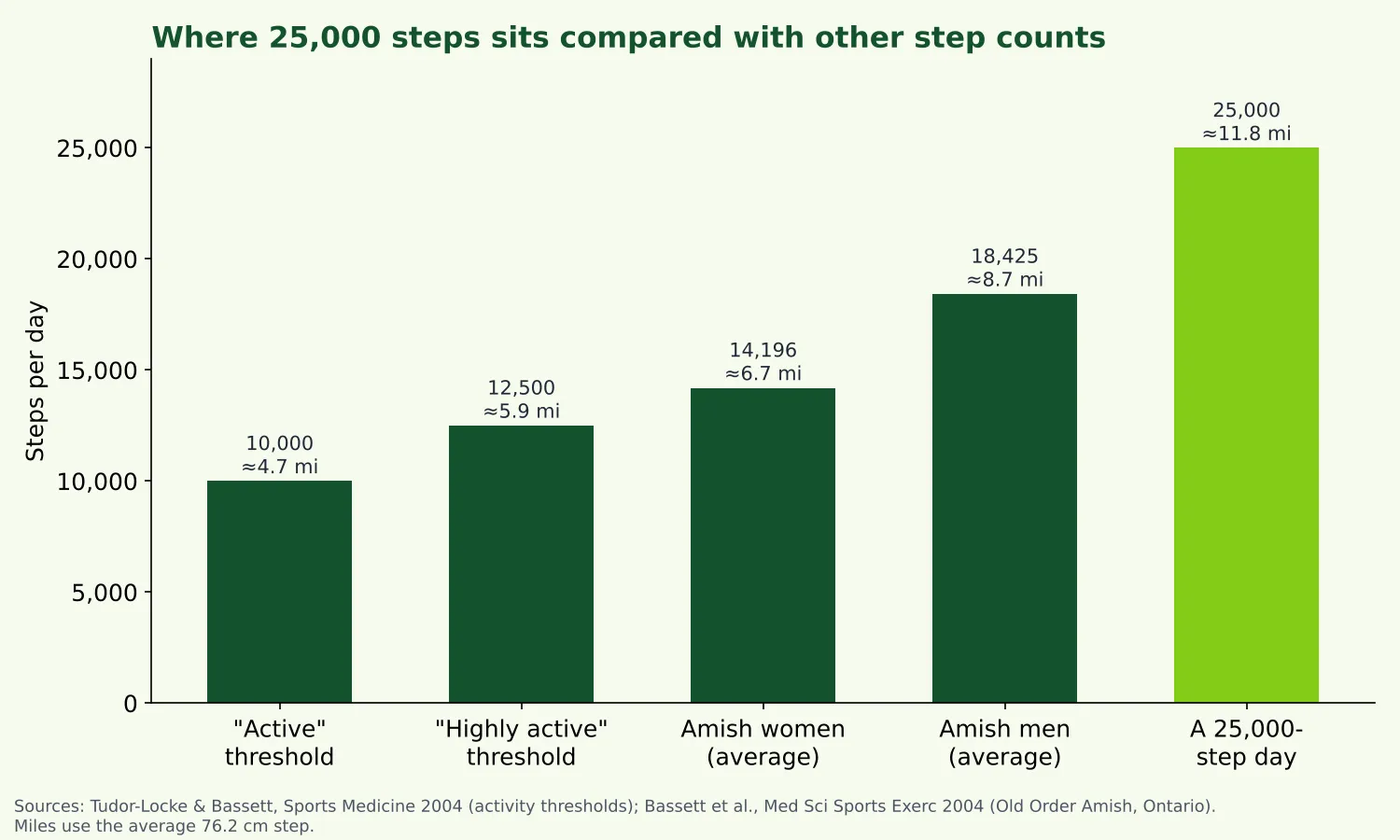
Researchers have used rough bands to describe daily step counts. In a widely cited review, Catrine Tudor-Locke and David Bassett suggested that under 5,000 steps a day is “sedentary”, 10,000 or more is “active”, and more than 12,500 is “highly active” (Sports Medicine, 2004). By that measure, 25,000 steps is double the top band.
For a real-world comparison, a 2004 pedometer study of an Old Order Amish community in Ontario, people who farm largely without modern machinery, found that men averaged 18,425 steps a day and women 14,196 (Medicine & Science in Sports & Exercise). Even this very active group averaged well under 25,000.
Do you need 25,000 steps a day to be healthy?
No, and this is worth being honest about.
A 2022 analysis in The Lancet Public Health pooled data from 15 studies and nearly 47,500 adults. The risk of dying early fell as daily steps rose, but the benefit levelled off at around 6,000–8,000 steps a day for people aged 60 and over, and 8,000–10,000 for younger adults (Paluch et al., 2022).
A 2023 analysis in the European Journal of Preventive Cardiology, covering more than 226,000 people, linked each extra 1,000 steps a day with a 15% lower risk of death from any cause (Banach et al., 2023). But the most active groups in that analysis averaged roughly 11,500 steps a day, so there is very little data on people who do 25,000 every day. These are also observational studies: they show links, not proof that steps alone cause the benefit.
The UK and US guidelines focus on minutes rather than steps: at least 150 minutes of moderate activity a week, such as brisk walking (CDC). That is just over 20 minutes a day.
So think of 25,000 steps as a big, occasional adventure, not a daily target you must hit. If you enjoy it and your body handles it well, great. If your usual is 6,000, adding a couple of thousand steps is likely to do you more good than forcing a 25,000-step day and feeling wrecked the next morning.
How to make a 25,000-step day feel good

- Build up first. If 8,000 steps is normal for you, try 12,000, then 15,000, then 20,000 on separate weekends before going for 25,000. Our 15,000 steps to miles and 20,000 steps to miles pages show what those stepping stones look like.
- Wear shoes you have already walked in. Brand-new shoes and a 12-mile day are a recipe for blisters. The NHS advises wearing well-fitting shoes and comfortable socks to help prevent them (NHS, Blisters).
- Plan the route backwards from distance. Decide roughly how many miles you want, check the route length on a map, and use the calculator to turn it into steps for your height.
- Break it up. Two or three walks with rests in between are much kinder on your legs than one non-stop push.
- Take water and a snack. Four to six hours is a long time on your feet, especially in warm weather.
- Listen to your body. Pain in a joint, or pain that makes you limp, is a signal to stop, not to push through.
Why your tracker might show a different distance
If your watch says 25,000 steps but a different distance from ours, that is normal. Phones and fitness trackers estimate your stride too, often from your height, and some adjust it using GPS. Your step length also changes during the day: steps tend to be shorter uphill, in crowds, and on a treadmill than on open, flat ground.
For example, if your treadmill step is 70 cm instead of 76.2 cm, 25,000 steps covers about 10.9 miles rather than 11.8.
Want a more accurate number? Measure your own stride. Walk a known distance at your normal pace (a 400 m running track is ideal), count your steps, then divide the distance by the steps. For example, 400 m ÷ 540 steps = 0.74 m per step. Pop that into the Exact mode of the calculator and every result will be tailored to you.
Keep a record of your big days

If you are working up to 25,000 steps, it really helps to see your progress. The My Walks log on MyStepsToMiles lets you save each walk, build up a streak, and reach the 30-day milestone, with no app and no sign-up. Seeing “12 miles” written down after your first 25,000-step day is a lovely feeling.
Frequently asked questions
How many km is 25,000 steps?
About 19 km (19.05 km) using the average 76.2 cm step. For most people it falls between roughly 15.5 km and 19.7 km, depending on height.
How long does it take to walk 25,000 steps?
About 4 hours at 3 mph with no stops, 3 hours at a brisk 4 mph, or close to 6 hours at an easy 2 mph. Allow extra time for breaks.
Is 25,000 steps a day too much?
For a fit, healthy person used to walking, an occasional 25,000-step day is usually fine. As a daily habit it is a lot, and research suggests most of the health benefits of steps appear at much lower levels. Build up gradually and check with a doctor if you have a health condition.
How many steps is 10 miles?
At about 2,112 steps per mile (average 76.2 cm step), 10 miles is roughly 21,100 steps. A shorter walker (around 160 cm tall) might need about 24,000.
How many calories does 25,000 steps burn?
It depends a lot on your body weight, pace and terrain, so any single number would be a guess. Heavier people and faster or hillier walks burn more.
Find your own 25,000-step distance
The numbers above are a great starting point, but your stride is your own. Pop your steps into the steps to miles calculator, choose Better mode to use your height (or Exact if you know your stride), pick your pace, and you will have your distance and walking time in seconds. Then go and enjoy the walk.
This article is general information, not medical advice. Talk to a doctor before a big change in how active you are.
Sources
- Paluch AE et al. Daily steps and all-cause mortality: a meta-analysis of 15 international cohorts. Lancet Public Health, 2022. https://doi.org/10.1016/S2468-2667(21)00302-9
- Banach M et al. The association between daily step count and all-cause and cardiovascular mortality: a meta-analysis. Eur J Prev Cardiol, 2023. https://doi.org/10.1093/eurjpc/zwad229
- Tudor-Locke C, Bassett DR. How many steps/day are enough? Sports Medicine, 2004. https://doi.org/10.2165/00007256-200434010-00001
- Bassett DR et al. Physical activity in an Old Order Amish community. Med Sci Sports Exerc, 2004. https://pubmed.ncbi.nlm.nih.gov/14707772/
- CDC, Adult activity guidelines: https://www.cdc.gov/physical-activity-basics/guidelines/adults.html
- NHS, Blisters: https://www.nhs.uk/conditions/blisters/