
You finish dinner. The plates are pushed aside, the sofa is calling, and the next sensible move seems to be “nothing at all”.
Here’s a small idea that might change that habit: get up and walk for 10 minutes instead.
The short answer: a gentle walk after eating helps your leg muscles use some of the sugar from your meal, so your blood sugar rises and falls more gently. Research also suggests it can ease bloating. Even a few minutes is better than sitting; 10–15 minutes is the amount most studies test. At an easy 3 mph, a 10-minute walk is about half a mile, roughly 1,056 steps.
You don’t need to walk fast or far. Here’s what’s happening inside you, how long to walk, and how to make it stick.

What happens in your body when you walk after eating
When you eat, especially foods with carbohydrates (rice, bread, pasta, potatoes, sweets), your body breaks them down into glucose, a type of sugar, which moves into your blood. Your blood sugar usually climbs to its highest point in the hour or so after a meal.
Your muscles burn glucose for fuel. When you walk, the big muscles in your legs and hips start pulling sugar out of your blood to power each step. Think of them as a sponge soaking up some of that after-meal sugar before it can pile up.
Blood sugar: the best-studied benefit
This is where the evidence is strongest.
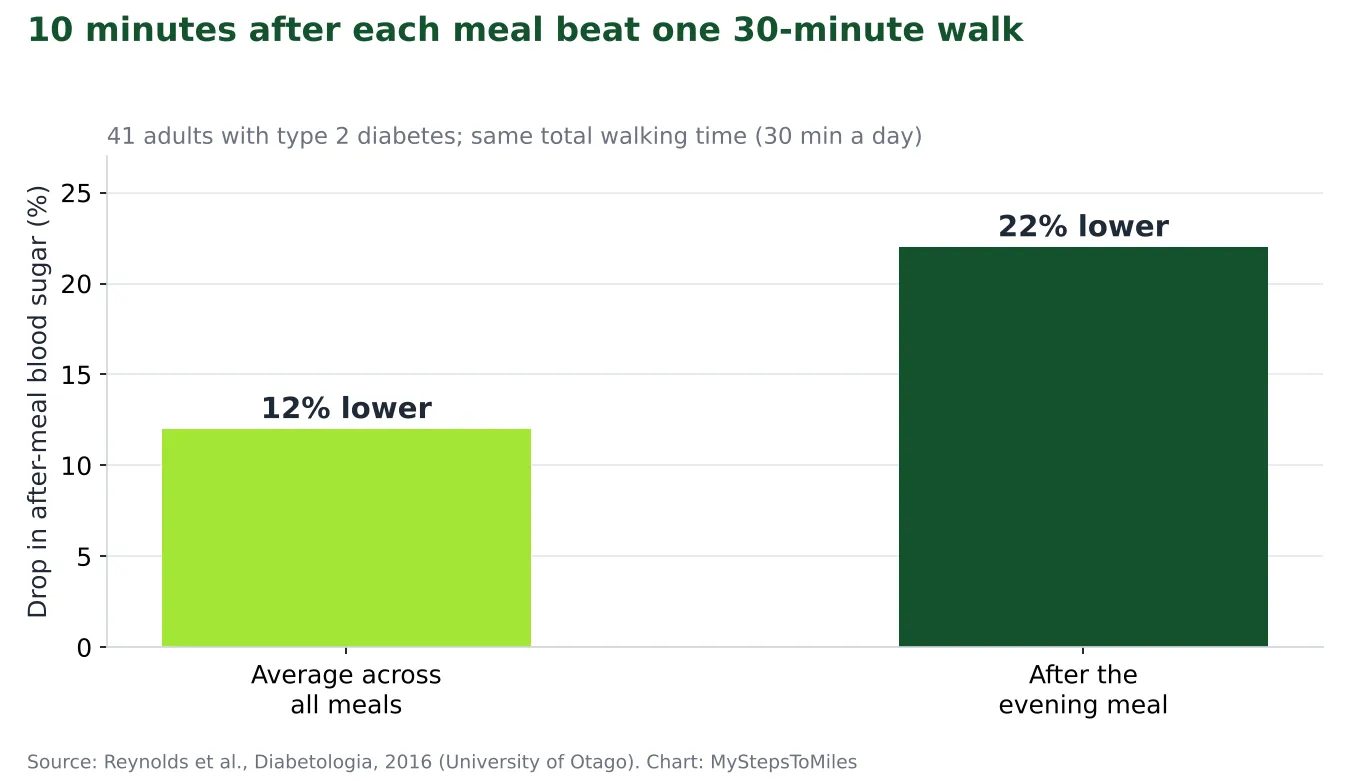
In a 2016 study from the University of Otago, published in Diabetologia, 41 adults with type 2 diabetes tried two plans. In one, they walked 30 minutes once a day. In the other, they walked 10 minutes after each main meal. Same total time, different timing.
Walking after meals won. After-meal blood sugar was 12% lower on average, and after the evening meal it was 22% lower. The researchers pointed out that dinner tended to be the most carb-heavy meal and was followed by the most sitting, so that’s where a walk made the biggest difference.
A 2022 review in Sports Medicine pulled together seven studies on breaking up long periods of sitting. In those studies, people took 2–5 minute breaks of light walking every 20–30 minutes. Those mini-walks lowered blood sugar and insulin after meals more than standing or sitting did. Standing helped a little; walking helped more. As Healthline’s report on the review notes, walking within 60–90 minutes of eating lines up with when blood sugar tends to peak.
An honest note: these studies are small and mostly short (a day to a few weeks). The clearest results are in people with type 2 diabetes or at risk of it. If your blood sugar is already healthy, the effect will be smaller. And a walk is a helpful habit, not a replacement for any treatment your doctor has given you.
Digestion, bloating and that “too full” feeling
Ever felt so stuffed after a meal that lying down feels like the only option? A walk may help more.
A small 2008 study of 10 healthy men found that slow treadmill walking after a meal, for a long stretch (much longer than a typical stroll), helped the stomach empty about 14% faster. The men didn’t feel any less full, though; the speed-up showed on the scan, not in how they felt.
A bigger 2021 trial looked at people who actually struggled with bloating. In this study of 94 adults with functional bloating, one group walked for 10–15 minutes after each meal for four weeks; the other took standard medicines. Both groups improved on bloating, burping and wind, and the walkers did better on that heavy “too full after eating” feeling.
These are small studies, so treat them as encouraging rather than proven. Still, a stroll costs nothing.
Heartburn: a walk beats the sofa
If you get heartburn, the NHS advises eating smaller meals and not eating within 3–4 hours of going to bed. A gentle walk after dinner fits neatly with that advice: you stay upright instead of slumping on the sofa or heading straight to bed on a full stomach.
Keep it gentle. If a brisk pace on a full stomach feels uncomfortable, slow down. This is a stroll, not a workout.
It quietly adds up for your daily steps
Here’s the bonus most people miss. Three 10-minute walks a day add up to 30 minutes, or about 1.5 miles (2.41 km). That’s roughly 3,168 steps you wouldn’t otherwise have taken.
The World Health Organization recommends adults get 150–300 minutes of moderate activity a week. Brisk walking counts. Walk briskly after every main meal and you’d reach about 210 minutes a week without ever “going to the gym”. (A slow amble is still good for blood sugar; it just may not count as moderate activity.)
How long, and how soon? A simple guide
You don’t need to wait before a gentle walk. Blood sugar usually peaks within the first hour or so after eating. So the simplest rule is: finish eating, then head out within the first hour, sooner if you can.
Here’s what different walk lengths look like at an easy 3 mph, using the average step of 76.2 cm (2.5 ft):
| Walk after eating | Distance at 3 mph | About how many steps | When it fits |
|---|---|---|---|
| 2 minutes | 0.10 mi / 0.16 km | 211 | A busy workday: walk to the far end of the office and back |
| 5 minutes | 0.25 mi / 0.40 km | 528 | Once round the block after breakfast |
| 10 minutes | 0.50 mi / 0.80 km | 1,056 | The amount tested in the Otago study |
| 15 minutes | 0.75 mi / 1.21 km | 1,584 | The amount used in the bloating study |
| 20 minutes | 1.00 mi / 1.61 km | 2,112 | A full mile after dinner |
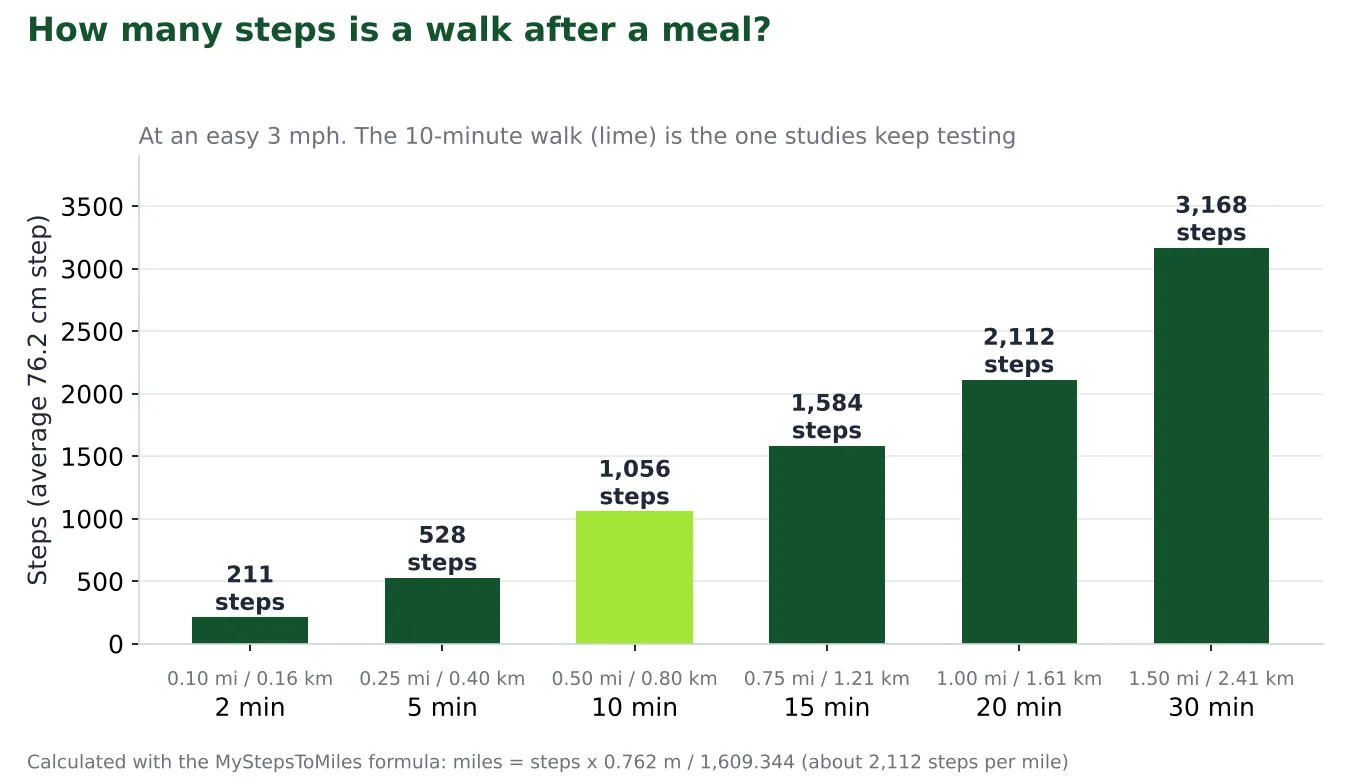
How fast? Easy is fine. Studies used light, comfortable walking. A good test: you can chat in full sentences without puffing. On the MyStepsToMiles calculator you can switch the walking pace between 2, 3 and 4 mph to see how your time changes.
A small catch on step counts: when you walk slowly, your steps get a little shorter, so you take more steps to cover the same distance. The table above uses the average step. For your own numbers, use the calculator’s Better mode (it uses your height) or Exact mode (it uses your own measured stride).
A worked example: three meals, one and a half miles
Let’s put it together. Say you currently walk about 5,000 steps a day and want to add post-meal walks without changing anything else.
- After breakfast: 5 minutes, about 528 steps
- After lunch: 10 minutes, about 1,056 steps
- After dinner: 15 minutes, about 1,584 steps
That’s 30 minutes and about 3,168 extra steps. Your day goes from 5,000 to roughly 8,168 steps, about 3.9 miles (6.22 km) in total, from three short strolls. If you want to see what that bigger daily total looks like, have a look at the 8,000 steps to miles page.
Notice where the biggest walk sits: after dinner. That’s deliberate. Evening is when most of us sit the longest, and it’s where the Otago study saw the biggest drop in blood sugar.

How to make the after-meal walk a habit
The benefit only shows up if you actually do it, most days. These small tricks help:
- Tie it to the last bite. Don’t decide each time. Make the rule “plates in the sink, shoes on, out the door.” A habit hooked onto something you already do sticks far better.
- Protect the dinner walk first. If you can only manage one, make it the evening one.
- Leave your shoes by the door. Remove every small obstacle. If it’s dark, keep a light jacket or reflective band next to them.
- Make it social. Walk with your partner, your kids or the dog. Or make it your phone-call time with a friend or parent.
- Have a rainy-day backup. Laps of the hallway, the garden, or up and down the stairs all count. Pacing while you tidy the kitchen counts too.
- Log it. Track each walk in My Walks on MyStepsToMiles. Watching your streak grow is surprisingly motivating, and the 30-day milestone gives you a clear finish line to aim for.
Who should take a little extra care
For most people, a gentle stroll after eating is about as low-risk as exercise gets. A few situations call for a quick word with your doctor first:
- You take insulin or diabetes tablets that can cause low blood sugar. Ask your doctor or diabetes nurse how extra activity fits with your medicine. Don’t change your medication on your own.
- You have a heart or lung condition, are recovering from surgery, or have been told to limit activity.
- Walking after eating gives you cramps or pain. Try a slower pace or a shorter walk. If it keeps happening, get it checked.
Frequently asked questions
Is it better to walk before or after eating?
For blood sugar, the research points to walking after eating, because that’s when sugar from your meal is rising. Walking at any time of day is still good for you, so if mornings before breakfast suit you better, keep doing them, and add a short stroll after dinner.
How long should I wait to walk after eating?
For a gentle walk, you don’t need to wait. Start soon after your meal, ideally within the first hour. Save harder exercise, like running, for later; many people find it uncomfortable on a full stomach.
Is a 2-minute walk after eating really worth it?
It helps, especially if you repeat it. In the 2022 review, 2–5 minute light walks taken every 20–30 minutes lowered after-meal blood sugar compared with sitting. One 2-minute walk on its own hasn’t been tested as much, and 10–15 minutes is likely to do more, but a short walk beats none.
Does walking after dinner help you lose weight?
On its own, a short walk burns a modest number of calories. Its real value is that it adds steps every single day without much effort. For the bigger picture on steps and weight, see our guide: how many steps a day to lose weight.
How many steps is a 15-minute walk after dinner?
At an easy 3 mph with an average step, about 1,584 steps, or three-quarters of a mile (1.21 km). Your own number depends on your height and stride.

Try it tonight
After your next meal, set a 10-minute timer and walk. Then pop your steps into the MyStepsToMiles calculator to see the distance in miles, kilometres and walking time, no app, no sign-up. Log it in My Walks, and see if you can start a streak.
This article is general information, not medical advice. Talk to a doctor before a big change in how active you are.
Sources
- University of Otago, Short walks after meals may prove important tool in managing diabetes (Reynolds et al., Diabetologia, 2016): https://otago.ac.nz/news/newsroom/short-walks-after-meals-may-prove-important-tool-in-managing-diabetes
- Buffey et al. (2022), review of breaking up sitting time and post-meal glucose, Sports Medicine: https://link.springer.com/article/10.1007/s40279-022-01649-4
- Healthline, How a 2-minute walk after meals can help lower type 2 diabetes risk: https://www.healthline.com/health-news/how-a-2-minute-walk-after-meals-can-help-lower-type-2-diabetes-risk
- Small 2008 study of walking after meals and gastric emptying, Journal of Gastrointestinal and Liver Diseases: https://www.jgld.ro/jgld/index.php/jgld/article/download/2008.1.4/1102
- Study of 94 adults with functional bloating and post-meal walking, 2021, PubMed Central: https://www.ncbi.nlm.nih.gov/pmc/articles/PMC8035544/
- NHS, Heartburn and acid reflux: https://www.nhs.uk/conditions/heartburn-and-acid-reflux/
- World Health Organization, Physical activity fact sheet: https://www.who.int/news-room/fact-sheets/detail/physical-activity