
Here is the short, honest answer: there is no magic step number that makes weight fall off. Walking on its own usually leads to only modest weight loss, because steps burn fewer calories than most people expect. But steps matter a lot for something just as important: keeping weight off once you have lost it. The best recent research points to roughly 8,000–8,500 steps a day as a realistic goal, alongside changes to what you eat.
If that sounds a bit less exciting than “walk 10,000 steps and drop a stone”, stay with me. Once you understand what steps can and can’t do, you can use them far more cleverly, and you’re much less likely to give up in week three because the scales haven’t moved.
Why steps alone rarely cause big weight loss
Weight loss comes down to using more energy than you take in, over weeks and months. Walking helps with the “using more” side, but it is gentle exercise. That is its great strength (almost anyone can do it, every day) and also why it doesn’t burn huge amounts.
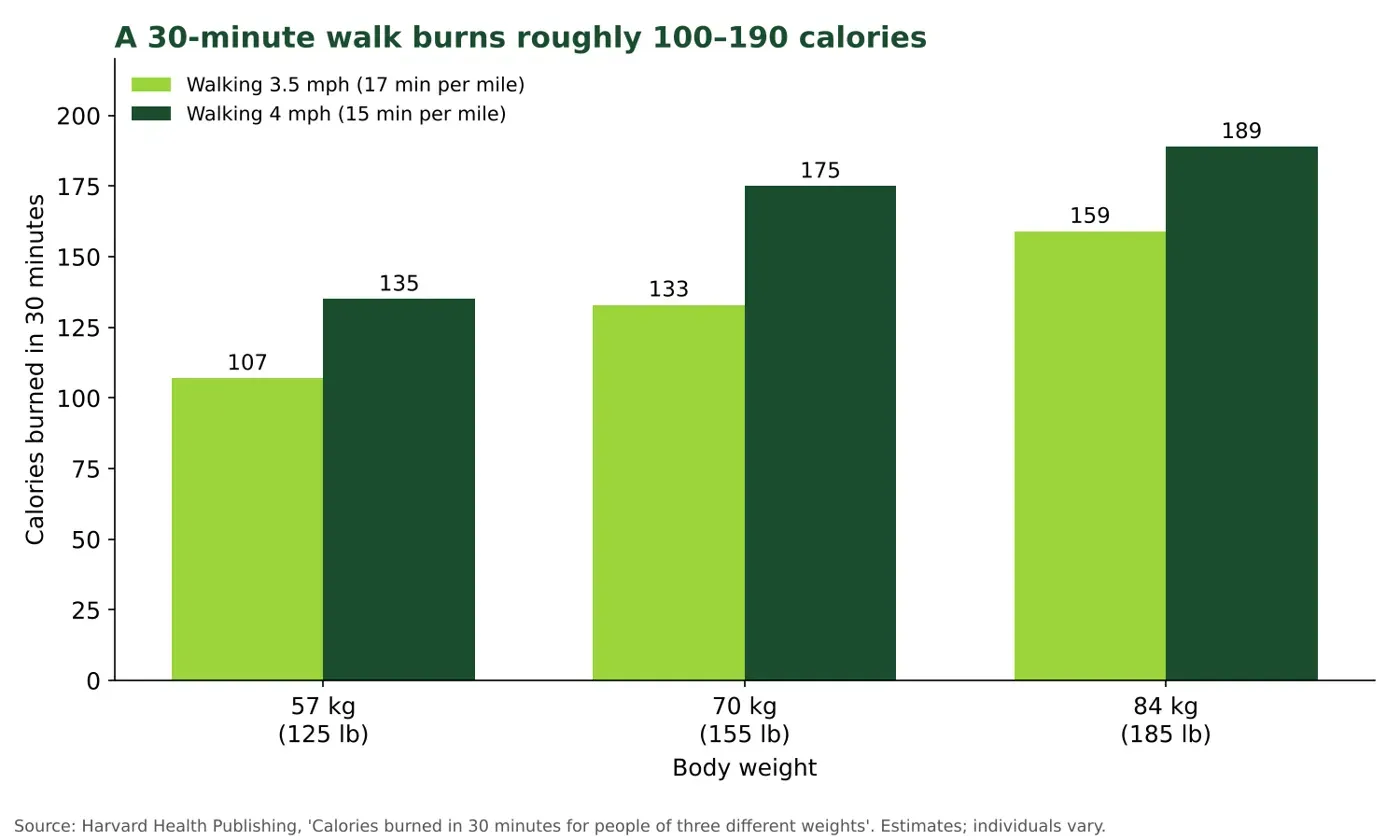
According to Harvard Health Publishing, 30 minutes of walking at 3.5 mph burns about 107 calories for a 57 kg (125 lb) person, 133 calories at 70 kg (155 lb) and 159 calories at 84 kg (185 lb). Pick up the pace to 4 mph and those numbers rise to roughly 135, 175 and 189.
Let’s turn that into steps. At 3.5 mph, a 70 kg person covers about 1.75 miles in 30 minutes, so they burn roughly 76 calories per mile. Using the average step length of 76.2 cm (about 2,112 steps per mile), that works out at roughly 35–40 calories per 1,000 steps for someone of that weight. Heavier people burn a little more; lighter people a little less.
So if you add 3,500 steps to your day, say going from 5,000 to 8,500, you walk about 1.66 miles (2.67 km). That takes around 33 minutes at 3 mph and burns somewhere in the region of 125 calories for a 70 kg walker. Useful? Yes. Enough to undo a large slice of cake? Not quite.
This is exactly what health bodies say. The US Centers for Disease Control and Prevention (CDC) explains that if you want to lose weight through activity alone, “you will need a high amount of physical activity unless you also adjust your diet.” The American College of Sports Medicine’s position stand on weight loss found that 150–250 minutes a week of moderate activity gives only modest weight loss, while more than 250 minutes a week is linked to clinically meaningful loss.
What does 250 minutes a week look like in steps? It’s about 36 minutes a day. At 3 mph, that is roughly 1.8 miles, or about 3,800 extra steps every day, on top of what you already do. Doable for many people, but it shows why a few hundred extra steps won’t move the scales on their own.
Want to see your own numbers? Pop your daily steps into the MyStepsToMiles calculator and choose the Better mode, which uses your height to estimate your step length. Then try the 3 mph pace option to see how long that walk will take.
Where steps really shine: keeping the weight off
Here is the part most articles skip. In May 2026, researchers led by Professor Marwan El Ghoch at the University of Modena and Reggio Emilia presented a review at the European Congress on Obesity. They pooled 14 randomised trials involving 3,758 adults, most of them living with overweight or obesity (summary from News-Medical).
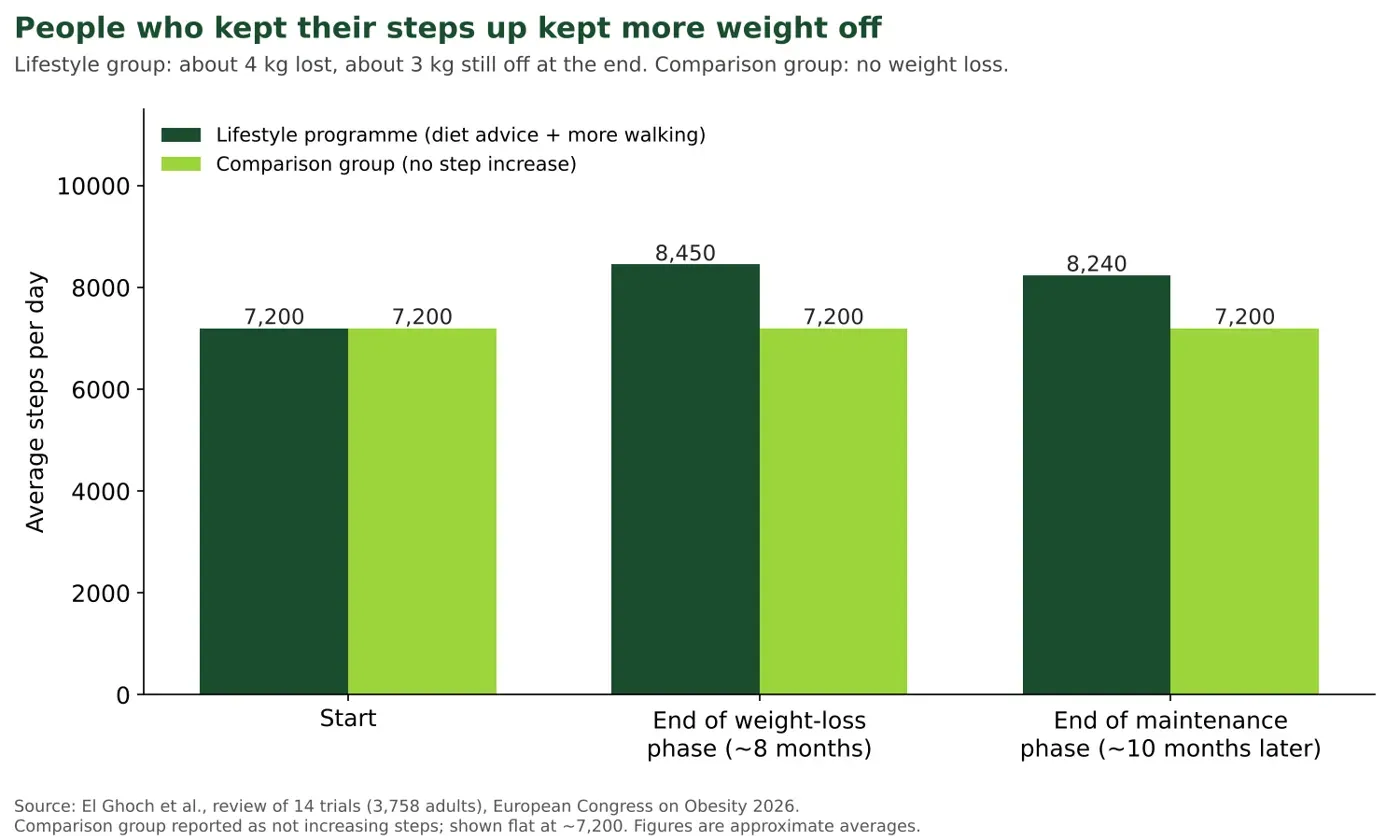
People in lifestyle programmes, which included advice on eating as well as moving more, started at about 7,200 steps a day. By the end of the weight-loss phase (about eight months) they were averaging around 8,450 steps and had lost about 4.4% of their body weight, roughly 4 kg. Over the following ten months or so they kept their steps at around 8,240 a day and kept most of that loss off: about 3 kg on average at the end. The comparison group did not increase their steps and did not lose weight.
Two findings are worth underlining:
- More steps didn’t mean more weight lost during the diet phase. The researchers think food intake mattered more at that stage.
- People who kept their extra steps going regained less weight. That is why the authors suggest aiming for about 8,500 steps a day and holding it there.
In fairness, this is an association across studies, not proof that steps alone stopped the regain, and the programmes mixed walking with diet advice. The 8,500 figure is the average people reached, not a magic line. But it matches what the CDC says too: regular physical activity is key to keeping lost weight off.

So what about 10,000 steps?
Ten thousand steps is a fine goal if it suits you. It’s about 4.73 miles (7.62 km) for an average stride, or roughly 1 hour 35 minutes of walking at 3 mph (see our 10,000 steps to miles page). But it was never a scientifically proven weight-loss number, and you don’t need to hit it to benefit.
A large 2025 review in The Lancet Public Health, led by Professor Melody Ding at the University of Sydney, looked at 57 studies. Compared with 2,000 steps a day, people who walked about 7,000 steps had a 47% lower risk of dying during the study period, almost the same as at 10,000 steps, and a 38% lower risk of dementia (University of Sydney summary). These are links seen in observational studies rather than proof of cause and effect, but they show that the benefits of walking go far beyond the scales.
Put simply: around 7,000–8,500 steps is a sensible, evidence-backed zone for health and for holding on to weight loss. More is fine. Less is still far better than nothing.
A practical step plan for weight loss
Here’s how to put all of this into action, starting today.
- Find your starting point. Check your average steps over the last week on your phone or tracker. Don’t change anything yet; you just want an honest baseline.
- Add 1,000–2,000 steps a day. That’s about 10–20 minutes of extra walking. Hold it for a week or two before adding more. Small jumps are easier to keep.
- Build towards 8,000–8,500. If you start at 5,000 steps, that’s about 3,500 extra, roughly a 33-minute walk at 3 mph. Two 15-minute walks work just as well as one long one.
- Change your food, too. The research is clear that eating less is what drives most of the weight loss. Walking supports it, makes it easier to stick with, and helps protect against regain.
- Walk a little faster when you can. Going from 3.5 mph to 4 mph burns more calories in the same 30 minutes (see the chart above). Try our 4 mph pace option to see how much time it saves.
- Keep going after you reach your goal weight. This is where the extra steps earn their keep. Treat your new step level as your normal, not a temporary diet trick.
A handy way to stay on track is the My Walks log on MyStepsToMiles. Every walk you record builds a streak, and there’s a 30-day milestone to aim for. Seeing a run of logged days is surprisingly motivating, and it gives you a real record of what you’ve done, rather than a guess.

Worked example: what 8,500 steps looks like
Let’s take a 5 ft 6 in (168 cm) woman. Her estimated step length is about 41.3% of her height: 0.413 × 168 cm ≈ 69.4 cm. So 8,500 steps × 0.694 m ÷ 1,609.344 ≈ 3.67 miles (5.9 km). At 3 mph, that’s about 1 hour 13 minutes of walking spread across the day: perhaps a 25-minute morning walk, a 20-minute lunchtime loop and the rest from everyday moving about.
Using the average step of 76.2 cm instead, 8,500 steps is about 4.02 miles (6.48 km). That gap is exactly why the Exact mode in our calculator, which uses your own measured stride, is worth trying if you want accurate numbers. If you’d like to see the in-between targets, our 8,000 steps to miles and 6,000 steps to miles pages break them down too.
Common mistakes that hold people back
- Eating back the steps. It’s easy to reward a walk with a snack that has more calories than the walk burned.
- Trusting the watch’s calorie figure too much. Calorie numbers on trackers are estimates and can be well off. Use them as a rough guide, not a budget.
- Going too hard, too soon. Jumping from 3,000 to 12,000 steps overnight often ends in sore feet and a quick return to the sofa. Build up gradually.
- Quitting when the scales stall. Weight goes up and down day to day. Look at the trend over several weeks, and remember the steps are still helping your heart, mood and sleep.

Frequently asked questions
Will walking 10,000 steps a day make me lose weight?
It can help, but on its own it usually leads to modest weight loss. 10,000 steps burns very roughly 300–400 calories for a 70 kg person, depending on pace. Combine it with eating a little less and you’re far more likely to see a steady drop.
How many calories do 1,000 steps burn?
Roughly 35–40 calories for a 70 kg person walking at about 3.5 mph, based on Harvard Health figures and an average step length. Heavier people and faster walkers burn a little more.
How many steps a day to keep weight off?
A 2026 review of 14 trials suggests aiming for about 8,500 steps a day during weight loss and keeping it up afterwards, as people who did so regained less weight.
Is it better to walk faster or walk for longer?
Both help. Walking faster burns more in the same time; walking longer adds more total steps. Choose whichever you’ll actually do most days.
How far is 8,500 steps?
About 4.02 miles (6.48 km) with an average 76.2 cm step, around 1 hour 20 minutes at 3 mph. Your own distance depends on your stride.
Try it yourself
Curious how far your own steps take you, and how long your new daily goal will really take? Try the free MyStepsToMiles calculator: no app, no sign-up. Pop in your steps, pick your mode and pace, and then log the walk in My Walks to start your streak. Every walk counts.
This article is general information, not medical advice. Talk to a doctor before a big change in how active you are.
Sources
- Harvard Health Publishing, Calories burned in 30 minutes for people of three different weights
- CDC, Physical Activity and Your Weight and Health
- Donnelly et al. (2009), ACSM Position Stand, Medicine & Science in Sports & Exercise
- News-Medical, Walking 8,500 steps daily may help prevent weight regain (ECO 2026)
- University of Sydney, Rethink the 10,000-a-day step goal (Lancet Public Health, 2025)
- Ding et al. (2025), Lancet Public Health, PubMed entry