
Quick answer: 10,000 steps is about 4.73 miles (7.62 km) using the average step of 76.2 cm (2.5 ft). At a steady 3 mph that’s roughly 1 hour 35 minutes of walking.
Your own number is probably a little different. Depending mostly on height, 10,000 steps works out to somewhere between about 3.9 and 4.9 miles for most adults.
And the 10,000 target itself? It most likely comes from a 1965 Japanese pedometer called the manpo-kei, which means “10,000-steps meter”. It was a catchy name, not a figure from a study. Today’s research suggests many of the health benefits arrive earlier, around 7,000 to 8,000 steps a day.
Your watch buzzes. 10,000 steps, done. It feels like a small win, and it is. But two questions often follow that buzz: how far did I actually go? And who decided 10,000 was the finish line in the first place?
10,000 steps in miles, kilometres and minutes
Here’s the simple formula behind every number on MyStepsToMiles:
miles = steps × step length in metres ÷ 1,609.344
With the average step of 0.762 m, that’s 10,000 × 0.762 = 7,620 metres. Divide by 1,609.344 and you get 4.73 miles. It also means about 2,112 steps make one mile.
How long that takes depends on your pace:
| Walking pace | What it feels like | Time for 10,000 steps (4.73 mi) |
|---|---|---|
| 2 mph | Easy stroll, window shopping | About 2 h 22 min |
| 3 mph | Steady, normal walk | About 1 h 35 min |
| 4 mph | Brisk, purposeful walk | About 1 h 11 min |
Want the full breakdown, with yards, metres and more pace options? See our 10,000 steps to miles page.
Why “really” matters: your height changes the answer
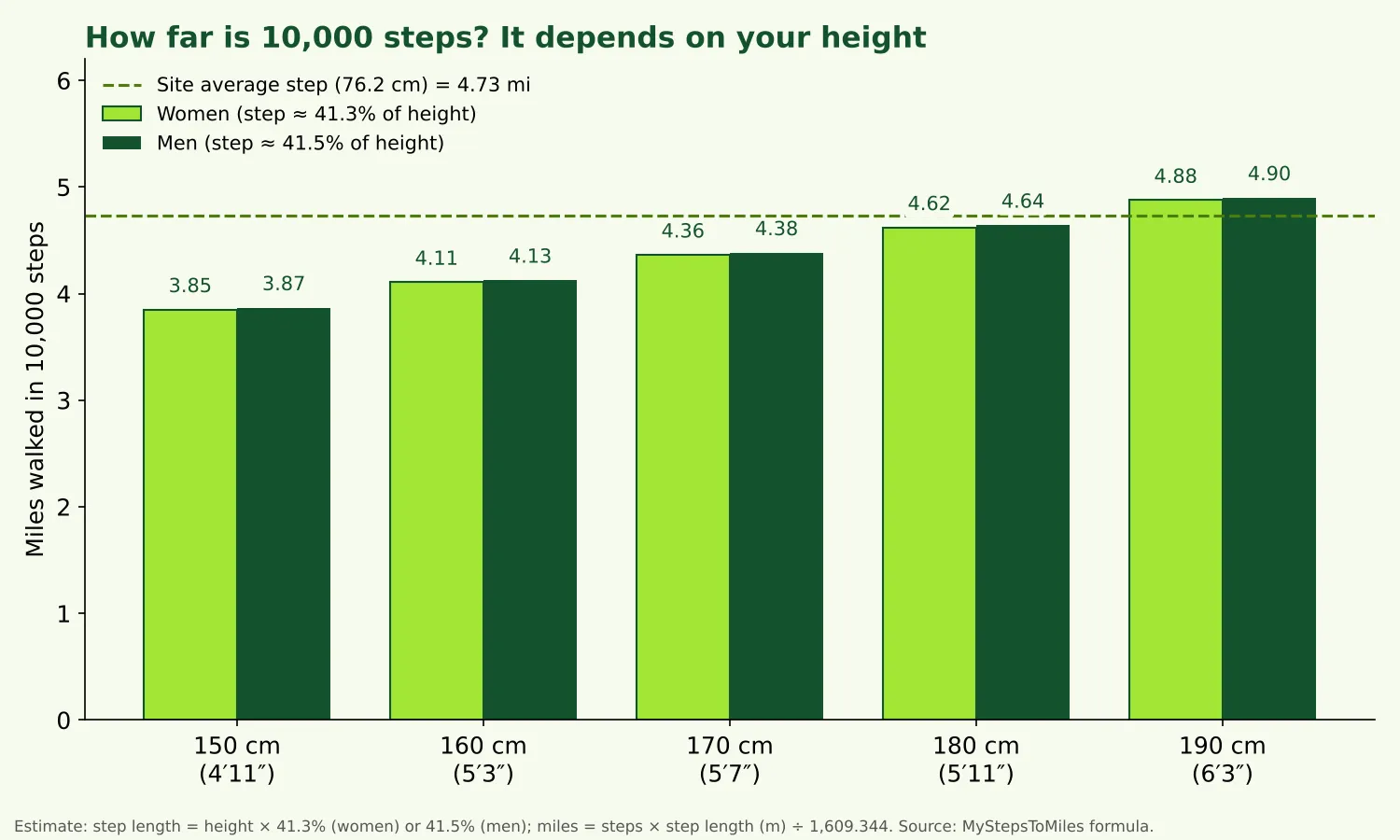
That 76.2 cm figure is a handy round average, but nobody walks with an “average” leg. Taller people take longer steps, so they cover more ground in the same 10,000 steps.
A common way to estimate step length is from height: about 41.3% of your height for women and 41.5% for men. Two quick examples:
- A woman who is 160 cm (5′3″): step ≈ 66.1 cm, so 10,000 steps ≈ 4.11 miles (6.61 km).
- A man who is 180 cm (5′11″): step ≈ 74.7 cm, so 10,000 steps ≈ 4.64 miles (7.47 km).
That’s over half a mile of difference for exactly the same step count. Notice, too, that the 76.2 cm average only fits someone well over 180 cm tall using this formula. So if you’re of average height or shorter, your real 10,000-step distance is probably a bit less than 4.73 miles.
Height isn’t the only thing that changes your stride. You take shorter steps going uphill, in crowds, on a treadmill, or when you’re tired, and longer ones when you walk briskly on open ground.
Find your own number in under two minutes
- Open the MyStepsToMiles calculator and type in your steps.
- Switch to Better mode (“uses your height”) and enter your height. This alone fixes most of the gap.
- For the most accurate result, use Exact mode (“your own stride”). To measure your stride, walk a distance you know (a 400 m running-track lap is ideal), count your steps, then divide the distance by the steps. For example, 400 m ÷ 560 steps = 0.71 m per step.
Where did the 10,000 number come from?

Here’s the part most people don’t know. The 10,000-step goal didn’t come from a medical trial. The best-known explanation goes back to Japan in 1965, when a pedometer was sold under the name manpo-kei. Roughly translated: “man” is 10,000, “po” is step, and “kei” is meter. A “10,000-steps meter”.
Researchers themselves point to this. In a 2019 study in JAMA Internal Medicine, the authors wrote that the origin of the 10,000-step goal is unclear but likely came from that pedometer’s name.
A round, catchy number is great for selling a gadget, and it stuck. None of that makes 10,000 a bad target. It just means it was never chosen by looking at health data. So what happens when scientists actually do look?
What the research says about daily steps
1. 4,400 steps already made a difference (2019)
The JAMA Internal Medicine study followed 16,741 women with an average age of 72. Women who averaged about 4,400 steps a day had a 41% lower death rate during the study than those averaging about 2,700. The benefit kept growing with more steps, then levelled off at about 7,500 steps a day.
2. The sweet spot depends on age (2022)
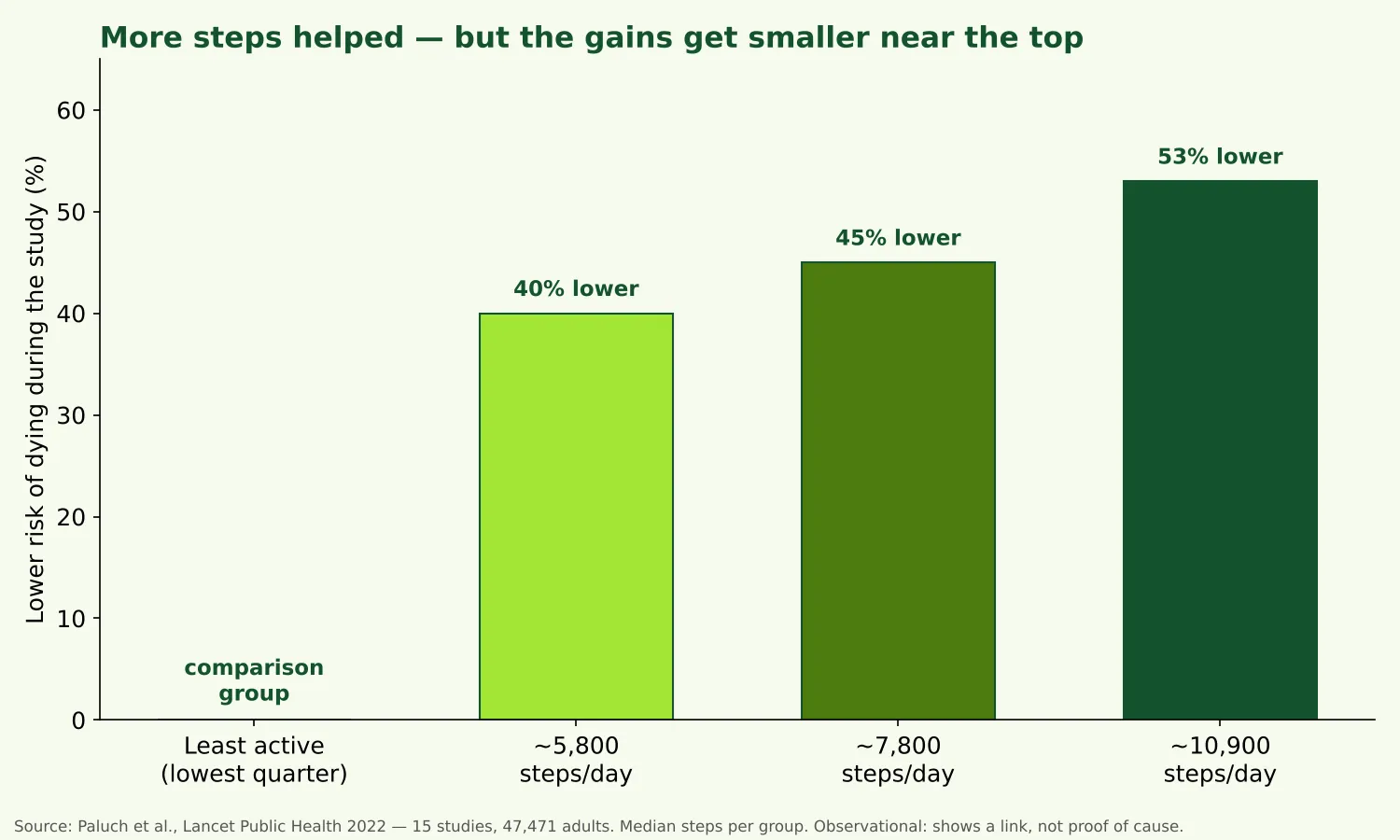
A 2022 analysis in The Lancet Public Health pooled 15 studies covering 47,471 adults. The risk of death stopped falling at around 6,000–8,000 steps a day for people aged 60 and over, and around 8,000–10,000 for adults under 60.
3. 7,000 steps gets you most of the way (2025)
The biggest review so far, published in The Lancet Public Health in 2025, looked at 57 studies. Compared with 2,000 steps a day, walking 7,000 steps was linked to a 47% lower risk of death, close to the benefit seen at 10,000. It was also linked to a 38% lower risk of dementia. As one of the authors put it, “For people who are already active, 10,000 steps a day is great”, but the extra gains beyond 7,000 were modest for most health outcomes.
An honest caveat
These studies are observational: they show people who walk more tend to live longer, but they can’t fully prove the steps are the cause, since active people may be healthier in other ways. Still, the pattern is consistent across countries and age groups. The World Health Organization puts its advice in minutes rather than steps: at least 150–300 minutes of moderate activity, such as brisk walking, each week for adults.
What those step goals look like in real miles

Research talks in steps. Your legs and your diary think in distance and time. Here’s how the key numbers translate, using the average 76.2 cm step and a steady 3 mph:
| Daily steps | Miles | Kilometres | Time at 3 mph |
|---|---|---|---|
| 4,400 | 2.08 | 3.35 | About 42 min |
| 7,000 | 3.31 | 5.33 | About 1 h 06 min |
| 7,500 | 3.55 | 5.71 | About 1 h 11 min |
| 10,000 | 4.73 | 7.62 | About 1 h 35 min |
One important detail: those studies counted all the steps in a day, not one walk. Getting up, cooking, shopping and walking to the bus all count. So you rarely need to walk the whole distance in one go.
Curious about the numbers in between? Our 5,000 steps to miles page, 8,000 steps to miles page and 12,000 steps to miles page break each one down.
So should you still aim for 10,000?
It depends on where you’re starting. Here’s a simple way to decide:
- You already hit 10,000 most days: keep going. There’s no sign it does harm, and some outcomes keep improving a little beyond 7,000.
- You’re around 3,000–5,000: 10,000 can feel like a mountain. A target of 7,000–8,000 is well supported by the evidence and much easier to reach. Building up gradually, for example by adding about 1,000 steps a day and holding it for a week or two, is a gentle way to get there.
- You’re 60 or older: the 2022 analysis found benefits levelled off around 6,000–8,000 steps, so you don’t need to chase 10,000 to do your body a lot of good.
Turn your step goal into a plan you’ll actually stick to
- Check your starting point. Look at your phone’s daily average for the last week. Say it’s 4,000.
- Work out the gap. To reach 10,000 you need 6,000 more. Put 6,000 into the calculator: that’s about 2.84 miles, or 57 minutes at 3 mph. Aiming for 7,000 instead? Only 3,000 more, about 1.42 miles.
- Pick your pace. Use the 2, 3 or 4 mph options to see how long it will take at the speed you actually walk.
- Split it up. Two or three shorter walks (morning, lunchtime, after dinner) are much easier to fit in than one long one.
- Log it. Add each walk to My Walks. Your streak grows every day you show up, and the 30-day milestone gives you something to aim for.
The real win isn’t hitting a magic number once. It’s walking most days for months and years.

Frequently asked questions
How many km is 10,000 steps?
About 7.62 km with an average 76.2 cm step. Depending on your height, it’s usually somewhere between about 6.2 and 7.9 km.
How long does it take to walk 10,000 steps?
About 1 hour 35 minutes at a steady 3 mph, 1 hour 11 minutes at a brisk 4 mph, or 2 hours 22 minutes at an easy 2 mph.
Is 10,000 steps a day a myth?
Not a myth, but not a scientific rule either. The number most likely came from a 1960s pedometer name. Walking more is clearly linked to better health, but for many people the biggest gains come by about 7,000–8,000 steps.
Is 7,000 steps a day enough?
For many adults, a large 2025 review found 7,000 steps a day was linked to most of the benefit seen at 10,000. If you’re already doing more, there’s no reason to cut back.
Do my 10,000 steps have to be in one walk?
No. The studies counted total daily steps, so every bit of movement through the day adds up.
Find out how far YOUR 10,000 steps go
The 4.73-mile figure is a good starting point, but your legs are your own. Pop your steps and height into the MyStepsToMiles calculator. It’s free, there’s no app to download and no sign-up. You’ll see your real distance in miles and kilometres, and how long it takes at your pace. Then log today’s walk in My Walks and start your streak.
This article is general information, not medical advice. Talk to a doctor before a big change in how active you are.
Sources
- Lee IM et al., JAMA Internal Medicine (2019), steps and mortality in older women: https://whish.stanford.edu/wp-content/uploads/2019/10/Step-Volume-Intensity-Mortality_JAMA-IntMedicine-2019-.pdf
- Paluch AE et al., The Lancet Public Health (2022), daily steps and all-cause mortality: https://pmc.ncbi.nlm.nih.gov/articles/PMC9289978
- Ding D et al., The Lancet Public Health (2025), steps and health outcomes: https://pubmed.ncbi.nlm.nih.gov/40713949/
- University of Sydney news release on the 2025 review: https://www.sydney.edu.au/news-opinion/news/2025/07/24/rethink-the-10000-a-day-step-goal-study-suggests.html
- World Health Organization, physical activity: https://www.who.int/initiatives/behealthy/physical-activity