
Here is the short answer: buy walking shoes late in the day, try both on with the socks you walk in, leave about a thumb’s width of space in front of your longest toe, and pick the pair that feels comfortable the moment you stand up, not the one you hope will “break in”. Then replace them before the cushioning gives up, which for most people is somewhere between 300 and 500 miles.
That last number sounds like a lot. It isn’t. At the site’s average step of 76.2 cm, 300 miles is about 634,000 steps and 500 miles is just over a million. If you’re walking 10,000 steps a day, you can wear through that in three or four months.
So your shoes are doing more work than you think. Let’s make sure they’re the right ones.
Why the right shoe matters more than the price tag
Every step you take sends a small jolt up through your foot, ankle and knee. A good walking shoe softens that jolt, holds your heel steady and gives your toes room to spread as you push off. A poor one rubs, pinches and slowly turns a pleasant walk into something you want to finish quickly.
Spending more doesn’t guarantee you’ll get it right. NHS podiatry advice is blunt about this: a higher price does not mean better support, comfort or fit. What matters is how the shoe fits your foot, and the only way to know that is to try it properly.
Step 1: Shop at the right time, with the right socks
Your feet are not the same size all day. They swell a little as you move about, so the NHS and Mayo Clinic Health System both suggest trying on shoes in the afternoon or evening, when your feet are at their largest. A shoe that fits at 9 am can feel tight by 4 pm, and by mile three of a long walk.
Take the socks you actually walk in. A thick sports sock and a thin office sock can change the fit by close to half a size. If you use insoles or orthotics, bring those too.
And get your feet measured, even if you’re “always a size 8”. Feet can get longer and wider over the years, and sizes vary from brand to brand, so the number on the box is only a starting point.
Step 2: The five-point fit check
Once the shoes are on and laced, stand up and run through these checks. They come from NHS podiatry and Mayo Clinic fitting advice, and they take about two minutes.
- Toe room. Press down in front of your longest toe (which isn’t always your big toe). You want roughly a thumb’s width, about 1 to 1.5 cm or half an inch, of space. Your foot slides forward slightly with every step, and that gap stops your toes hitting the front.
- Toe box shape. Wiggle your toes. The front of the shoe should be rounded and deep enough for them to move freely, not squeezed into a point.
- Width at the ball of the foot. Feel across the widest part of your foot. It should be snug side to side, but not tight. If the edge of your foot is spilling over the sole, go wider.
- Heel grip. Your heel should feel held. You should just about be able to slip a finger between your heel and the back of the shoe, and when you walk, your heel shouldn’t lift out.
- Fastening. Laces, Velcro or buckle straps hold your foot in place and stop it sliding about. Slip-ons make your toes grip to keep the shoe on, which tires them out.
Always try both shoes. Most people have one foot slightly bigger than the other, and you should fit the bigger one.
Step 3: Walk in them before you decide
Don’t judge a shoe sitting down. Walk a few laps of the shop, on a hard floor if you can, not just the carpet. Notice anything that rubs, presses or slips.
Here’s the most important rule: a good shoe should feel comfortable straight away. Both NHS and Mayo Clinic advice say well-fitting shoes shouldn’t need a long break-in period. If something niggles in the shop after two minutes, it will nag you after two miles.
There’s research behind trusting that feeling, too. In a 2015 review in the British Journal of Sports Medicine, biomechanics researcher Benno Nigg and colleagues proposed a “comfort filter”: that people who pick the shoe that feels most comfortable to them may naturally be choosing one that suits the way their body moves. That idea came from running research and it’s a proposal rather than settled fact, but it lines up neatly with what podiatrists have been saying for years. Comfort is a useful signal, not a luxury.
What to look for in the shoe itself
Once the fit is right, turn the shoe over and give it a quick inspection. These are the features that matter most for walking:
- Flex in the right place. Hold the heel and push the toe up. A walking shoe should bend at the ball of the foot, where your foot bends, not in the middle of the arch, and it shouldn’t be stiff as a board. Harvard Health highlights this as one of the key things to check.
- A low heel. Look for a low heel. NHS guidance suggests no higher than about 4 cm for everyday shoes.
- A grippy, cushioned sole. A thick, shock-absorbing, non-slip rubber sole will be kinder on pavements and safer on wet ground. Very thin, hard soles give little cushioning.
- A soft, breathable upper. Mesh or other breathable materials let sweat escape, which helps prevent blisters. Avoid hard seams or ridges inside the shoe.
- A firm heel counter. Press the back of the shoe around the heel. It should feel firm enough to hold your heel steady.
Some walking shoes also have a gentle upward curve at the toe (sometimes called a rocker or toe spring). NHS podiatry leaflets note this can reduce strain as you roll through each step, which is useful if you have stiff toes or plan long walks.

Walking shoes or running shoes?
You don’t need a shoe labelled “walking” to walk comfortably. Plenty of people walk happily in running shoes, especially road-running shoes, which tend to have flatter, smoother soles and lots of cushioning. Mayo Clinic Health System suggests asking for road-running shoes if you’re shopping in a specialist running shop.
The difference is mostly about how each activity loads your foot. When you walk, you land on your heel and roll smoothly through to your toes. When you run, you land harder and your step is different, which is why your step count per mile changes when you speed up. Running shoes are usually built with more cushioning for that harder landing; walking shoes often focus on flexibility at the front and a steady heel.
The practical answer: if a running shoe passes the fit check, bends at the ball of the foot and feels comfortable when you walk in it, it’s a perfectly good walking shoe. It doesn’t really work the other way round: if you plan to run as well, get a shoe made for running.
Got bunions, wide feet or foot pain?
A few common foot problems have simple footwear fixes. Bradford District Care NHS Trust’s podiatry advice suggests:
- Bunions: look for a wider shoe with a softer upper.
- Hammer or claw toes: look for a deeper toe box with a soft upper.
- Pain in the ball of the foot: a thicker sole and a wider toe area, and avoid pointed shoes.
- Diabetes: check shoes daily and take extra care with fit, because badly fitting shoes are a common cause of foot wounds. Get any wound looked at by a professional.
If you have ongoing pain when you walk, it’s worth seeing a GP or podiatrist rather than guessing with shoes.
When to replace your walking shoes
Shoes rarely fall apart before they stop doing their job. The foam in the sole compresses slowly, so you can lose much of the cushioning while the shoes still look fine from above. Harvard Health Publishing notes that experts suggest replacing walking shoes every 300 to 500 miles.
Most of us don’t track miles on our shoes, but we do track steps. So here’s that guideline turned into months, using the site’s average step length:
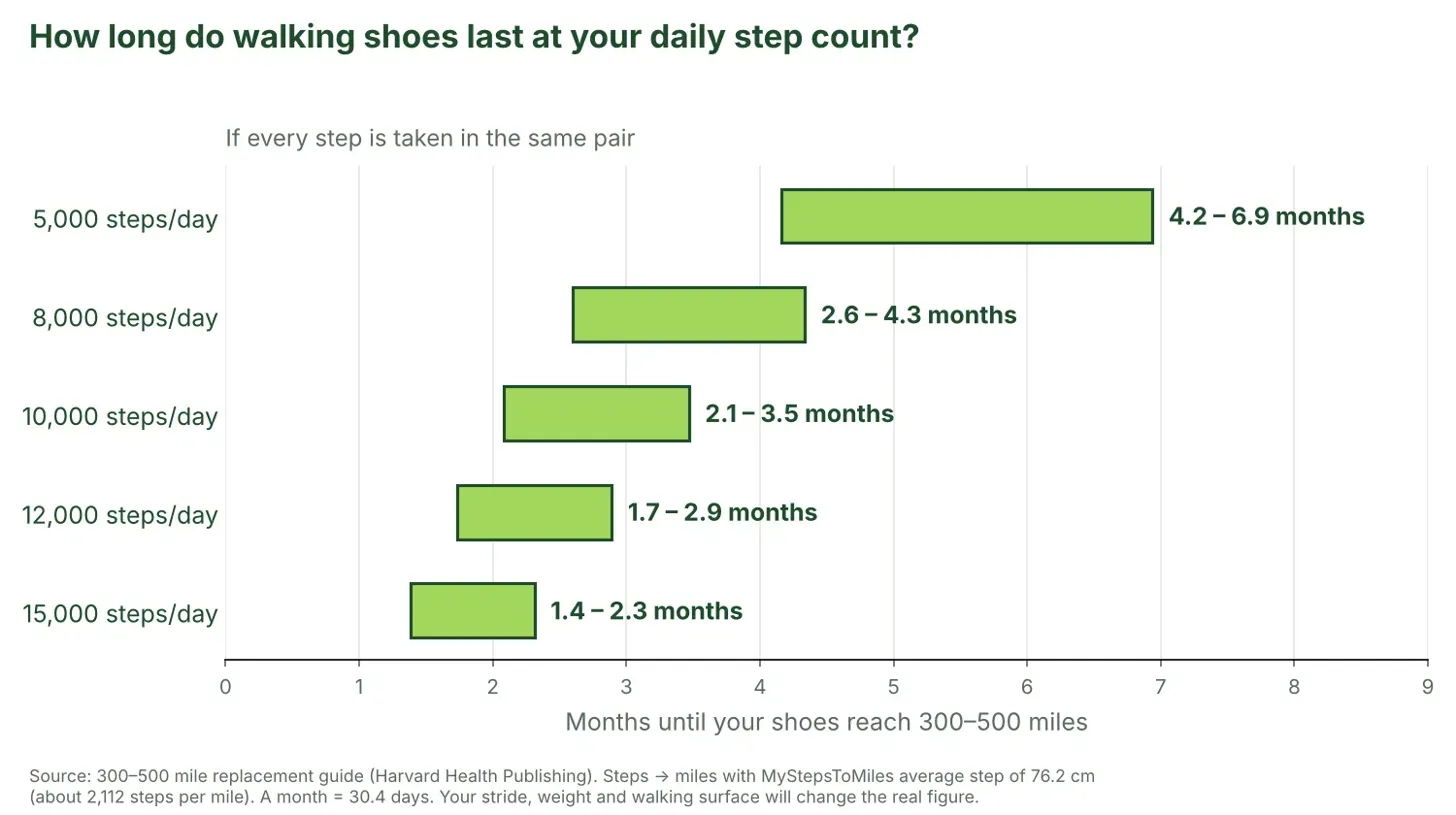
If you average 5,000 steps a day, a pair might last roughly four to seven months. At 10,000 steps, it’s more like two to three and a half months. That assumes every step is in the same shoes, so if you swap between pairs, or wear slippers at home, your shoes will last longer.
For a more accurate answer, use the MyStepsToMiles calculator in Better mode (it uses your height) or Exact mode (your own stride), and log your daily walks in My Walks. Note the date you start a new pair, and when your total passes 300 miles, start checking the shoes closely.

Whatever the mileage, replace them sooner if you notice:
- Soles: worn smooth, cracked or coming loose.
- Midsoles: deep creases or a squashed look in the midsole foam.
- Heel counter: the back of the shoe has gone soft and floppy, so your heel no longer feels held.
- New aches: your feet, knees or shins ache after walks that used to feel easy.
A quick shopping checklist
- Shop in the afternoon or evening.
- Take your walking socks (and insoles, if you use them).
- Get both feet measured.
- Leave a thumb’s width in front of your longest toe.
- Check the heel stays put when you walk.
- Choose a shoe that bends at the ball of the foot and has a low heel.
- Walk around the shop: it should feel good straight away.
- Note the date and start tracking the miles.
Frequently asked questions
How should walking shoes fit?
Snug at the heel, roomy at the toes. You want about a thumb’s width (around 1–1.5 cm) between your longest toe and the end of the shoe, enough width that the sides feel snug but not tight, and a heel that doesn’t slip when you walk. They should feel comfortable from the first step.
Should walking shoes be a size bigger?
Not automatically. Many people do end up half a size bigger than their everyday shoes, because they’re trying them on in the evening with thicker socks. Go by the fit check, not the number: sizes vary between brands.
How many miles do walking shoes last?
A common guide is 300 to 500 miles. That’s roughly 634,000 to just over a million steps at an average step length, or about two to three and a half months at 10,000 steps a day if you wear the same pair every day.
Can I use running shoes for walking?
Yes. If they fit well, bend at the ball of the foot and feel comfortable when you walk, running shoes make good walking shoes. Road-running shoes, with flatter soles, are usually the best fit for pavements.
Do expensive walking shoes make a difference?
Not by themselves. NHS podiatry advice notes that a higher price doesn’t guarantee better support, comfort or fit. A mid-priced shoe that fits your foot well will beat an expensive one that doesn’t.
Ready for your next walk?
Good shoes make every step easier, and once you’ve got them, you’ll want to know how far they’re taking you. Pop your step count into the MyStepsToMiles calculator to see your distance in miles and kilometres, and how long it took at a 2, 3 or 4 mph pace. Start with a gentle 5,000-step walk, build up to 8,000, and see where your new shoes take you.
This article is general information, not medical advice. Talk to a doctor before a big change in how active you are.
Sources
- NHS Lanarkshire Podiatry, Footwear advice: https://www.nhslanarkshire.scot.nhs.uk/services/podiatry/footwear-advice/
- Bradford District Care NHS Foundation Trust, Footwear advice: https://www.bdct.nhs.uk/footwear-advice/
- Mayo Clinic Health System, Expert advice on finding the best shoe fit: https://www.mayoclinichealthsystem.org/hometown-health/speaking-of-health/expert-advice-on-finding-the-best-shoe-fit
- Harvard Health Publishing, Tips for choosing walking shoes: https://www.health.harvard.edu/blog/tips-for-choosing-walking-shoes
- Nigg BM, Baltich J, Hoerzer S, Enders H. Running shoes and running injuries: mythbusting and a proposal for two new paradigms: ‘preferred movement path’ and ‘comfort filter’. British Journal of Sports Medicine 2015;49(20):1290–1294: https://bjsm.bmj.com/content/49/20/1290