
Most people don’t give up on walking because they’re lazy. They give up because they start too big, rely on willpower, and never decide exactly when the walk is going to happen. Then one busy Tuesday knocks the whole plan over.
The good news: if you want to build a daily walking habit, habits follow fairly predictable rules. Get the rules on your side and a daily walk stops being a decision you have to make. It just becomes the thing you do after breakfast, like brushing your teeth.
The short answer:
- Start tiny: a 10-minute walk (about half a mile, or roughly 1,000 steps) is enough to begin.
- Attach it to something you already do every day, such as “after my morning tea, I walk”.
- Keep the same time and place for the first few weeks so your brain links the cue to the walk.
- Track it so you can see your streak growing.
- Missed a day? Walk the next day. One slip doesn’t undo a habit.
- Give it about two months. In one well-known study, a new daily habit typically took 66 days to feel automatic.
Why most walking plans fizzle out
A habit, in the psychology sense, is something you do almost automatically because a familiar situation triggers it. Researchers at UCL describe the recipe very simply: repeat a chosen behaviour in the same context until it becomes automatic.
Notice what is missing from that recipe: motivation. Motivation is great for getting you out of the door on day one. It is far less reliable on a cold, grey day three weeks later. A habit does the heavy lifting for you once it forms, and that is why the steps below focus on cues, size and repetition rather than on psyching yourself up.
Step 1: Start smaller than you think you need
The most common mistake is aiming for an hour a day from the start. It feels impressive for a week, then life gets in the way. Begin with a walk so short it feels almost too easy. Ten minutes is plenty.
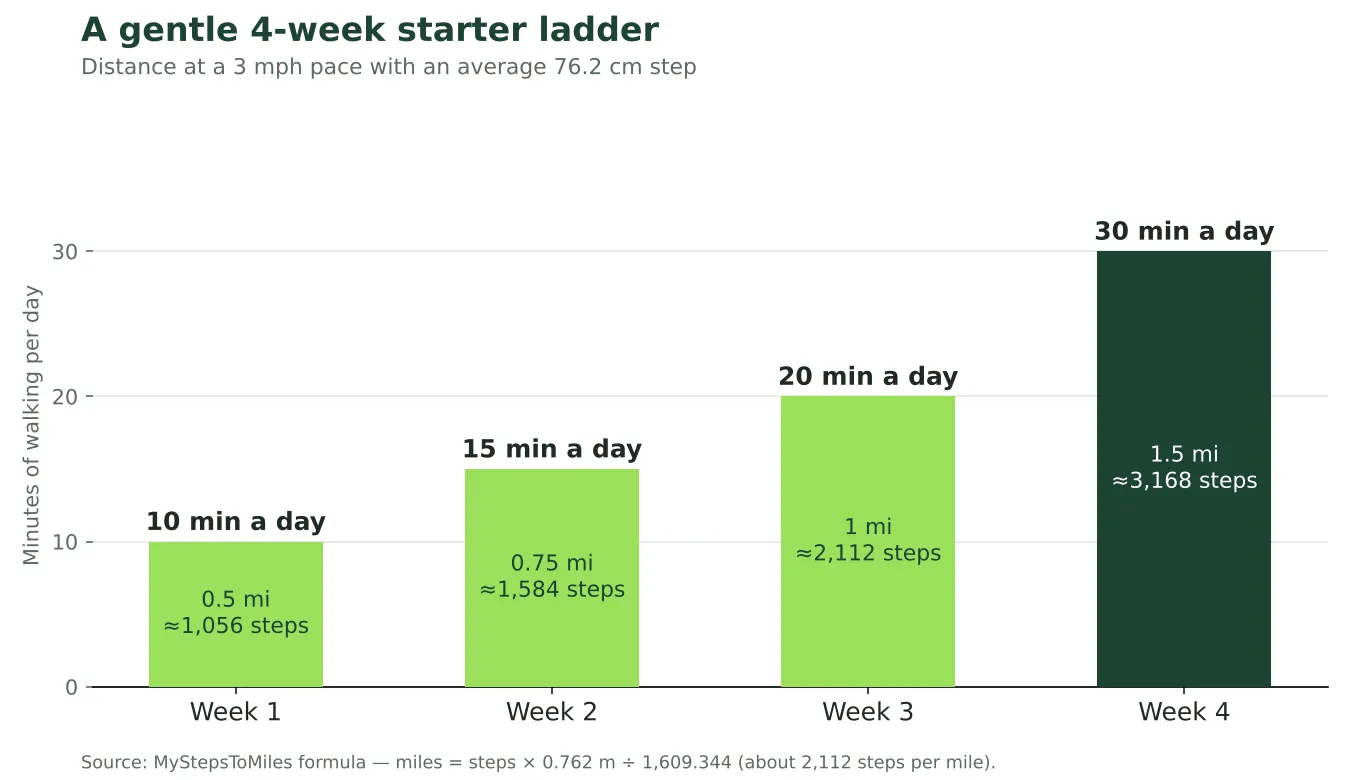
Here’s what that looks like in real numbers. At a steady 3 mph, 10 minutes covers half a mile. With an average step of 76.2 cm, that’s about 1,056 steps (roughly 0.8 km). Small, but it counts: the NHS says a brisk 10-minute daily walk counts towards the 150 minutes of weekly activity recommended for adults, and the CDC points out that even small amounts of activity bring some health benefits.
Once 10 minutes feels normal, add five more. The chart below shows a gentle four-week ladder. By week four you are walking 30 minutes a day, which works out at about 1.5 miles.
Want to see what your own walk adds up to? Pop your steps into the MyStepsToMiles calculator. Quick mode uses the average step, Better mode uses your height, and Exact mode uses your own stride if you’ve measured it.
Step 2: Hook your walk onto something you already do
Your day is already full of habits: the morning cup of tea, the school run, lunch, the evening meal. Each one is a ready-made trigger. Psychologists call the trick an if–then plan: “If it’s X, then I do Y.”
A review of 26 studies found that making these specific plans gave a small-to-medium boost to how active people were. Some examples you can borrow:
- “After I drop the kids at school, I walk one lap of the park before going home.”
- “After I finish lunch, I walk to the end of the road and back.”
- “When I get off the bus, I get off one stop early and walk the rest.”
- “After dinner, before I sit down with my phone, I walk around the block.”
Plan for the obstacles too
The same review found that the plans worked better when they included how to handle barriers. So write a back-up line as well: “If it’s pouring with rain, I walk 10 minutes around the house or the shopping centre instead.” Now bad weather has an answer before it arrives.
Step 3: Keep the same time and place (at least at first)
It’s tempting to keep things fresh with a new route every day. Later on, that’s great. In the early weeks, though, sameness is your friend. The UCL researchers note that changing the behaviour too much works against it becoming automatic. The cue (“it’s 8 am and I’ve finished breakfast”) and the action (“shoes on, out of the door”) need to show up together again and again.
So pick one time, one starting point and one simple route for the first three or four weeks. Leave your walking shoes by the door so there’s nothing to hunt for. Once the walk happens without much thought, start exploring.

Step 4: Make your progress visible
Seeing your progress is surprisingly powerful. A Stanford-led review of 26 studies with 2,767 people found that people using pedometers walked roughly 2,000 to 2,500 more steps a day than before or than people without one. Having a step goal was one of the key ingredients. Those extra 2,491 steps a day in the trials work out at about 1.2 miles (1.9 km), close to what you’ll see on our 2,500 steps to miles page.
You don’t need a fancy gadget. A tick on a calendar works, or log each walk in My Walks on MyStepsToMiles. It keeps your streak going and marks your 30-day milestone, which is a nice moment to aim for: about halfway to the 66-day point where many habits settle in.
One tip: track something you control. “I walked today” is better than “I hit 10,000 steps”, especially at the start. The step number can grow later.
Step 5: Bring someone along
Walking with a friend, a partner, the dog, or a local group adds a gentle sense of commitment. It’s harder to skip when someone is waiting at the corner. A review of 42 walking-group studies found that, where it was reported, people stuck with the groups about 75% of the time on average, and the walkers saw improvements in blood pressure, resting heart rate and depression scores.
To be fair to the evidence, many of those studies were small and most included people with existing health conditions, so the results may not apply to everyone in the same way. Still, if you know you’re someone who keeps promises to others more easily than to yourself, a walking buddy is worth a try. The NHS points to group walks run by organisations such as the Ramblers as a good place to start.

Step 6: Expect to miss a day, and plan your comeback
You will miss a day. Everyone does. What matters is what happens next. In the best-known habit study, missing a single day did not meaningfully set people back. The people who struggled were the ones who were very inconsistent overall.
A handy rule of thumb (it’s practical advice, not a research finding): try not to miss two days in a row. And on a day when everything goes wrong, shrink the walk instead of skipping it. Five minutes up and down the street still keeps the cue and the action linked.
How long until walking feels automatic?
You may have heard that it takes 21 days to form a habit. The research tells a different story. In a UCL study of 96 volunteers who picked a daily healthy behaviour, the typical (median) time for it to feel automatic was 66 days. But the spread was huge: the estimates ran from 18 days to 254 days.
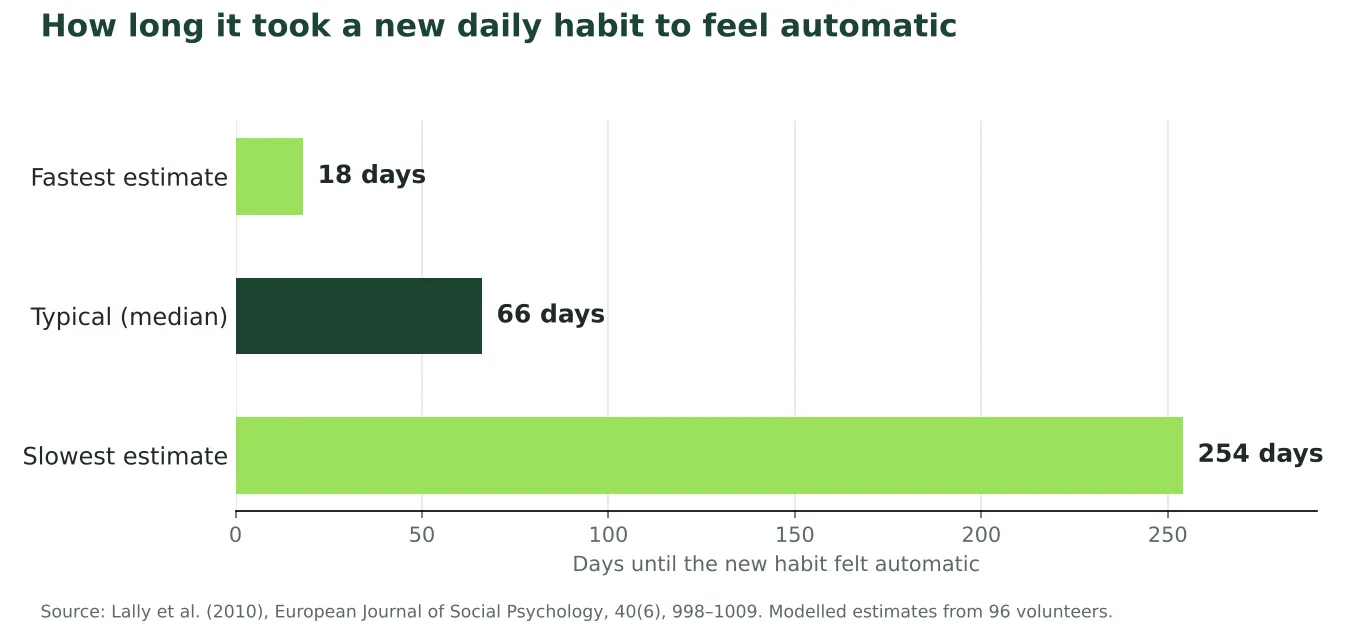
Those numbers are modelled estimates from a fairly small group, so treat them as a rough guide, not a deadline. The real lesson is kinder: if walking still feels like effort in week three, nothing is wrong with you. Keep going. Most people need around two months, and some need longer.
When (and how) to level up
You’ll know the habit has taken root when skipping the walk feels odd. That’s the moment to grow it, one change at a time:
- Add time. Five extra minutes a week is plenty.
- Add pace. Our calculator has 2, 3 and 4 mph pace options. A 30-minute walk at 4 mph covers 2 miles (about 4,224 steps), compared with 1.5 miles at 3 mph.
- Add a second walk. A short stroll after dinner on top of your morning walk.
- Add variety. New routes, hills, a weekend walk somewhere green.
If you build up to 10,000 steps one day, that’s around 4.73 miles (7.62 km) and about 1 hour 35 minutes at 3 mph. See the 10,000 steps to miles page for the full breakdown. If that feels far off, the 5,000 steps to miles page is a friendlier middle target.
Your walking habit card
Before you close this page, fill in these four lines. Writing them down turns a vague intention into a plan:
| Line | Fill it in |
|---|---|
| My cue | After I ________, I will walk. |
| Where and how long | I’ll walk ________ for ____ minutes. |
| My back-up plan | If ________, I’ll ________ instead. |
| How I’ll track it | I’ll log it in My Walks / on my calendar. |

Frequently asked questions
How long does it take to make walking a habit?
There’s no fixed number. In a UCL study, a new daily habit took a median of 66 days to feel automatic, with a range of 18 to 254 days. Plan for about two months and don’t be discouraged if it takes longer.
Is it better to walk every day or a few times a week?
For health, the guideline is about 150 minutes of moderate activity a week, which you can spread however suits you. For building a habit, a short daily walk is often easier because the same cue repeats every day.
What happens if I miss a day of walking?
Not much. Research suggests one missed day doesn’t meaningfully slow habit formation. Just walk the next day, and try not to let one missed day become two.
Does a 10-minute walk really count?
Yes. The NHS says a brisk 10-minute daily walk counts towards your 150 weekly minutes. Brisk means about 3 mph: you can still talk, but you couldn’t comfortably sing.
How many steps should a beginner aim for?
Start from where you are, not from 10,000. Adding a 10-minute walk adds roughly 1,000 steps to your day. Increase it gradually as the habit settles.
Ready for your first walk?
Pick your cue, keep it short, and go today. When you’re back, pop your steps into the MyStepsToMiles calculator to see how far you went (no app, no sign-up) and log it in My Walks to start your streak.
This article is general information, not medical advice. Talk to a doctor before a big change in how active you are.
Sources
- Gardner B, Lally P, Wardle J (2012), Making health habitual, British Journal of General Practice: https://pmc.ncbi.nlm.nih.gov/articles/PMC3505409/
- NHS, Walking for health: https://www.nhs.uk/live-well/exercise/walking-for-health/
- CDC, Getting more active minutes: https://www.cdc.gov/physical-activity/features/getting-more-active-minutes.html
- McMaster Optimal Aging Portal, review of implementation intentions and physical activity (Bélanger-Gravel et al., 2013): https://www.mcmasteroptimalaging.org/full-article/HE/meta-analytic-review-effect-implementation-intentions-physical-activity-25322
- Stanford Medicine, Pedometers help people count steps to get healthy (Bravata et al., 2007): https://med.stanford.edu/news/all-news/2007/11/pedometers-help-people-count-steps-to-get-healthy.html
- Hanson S, Jones A (2015), walking groups review, British Journal of Sports Medicine: https://bjsm.bmj.com/content/49/11/710
- The Behavioral Scientist, How long does it take to form a habit? (Lally et al., 2010): https://www.thebehavioralscientist.com/articles/how-long-to-form-a-habit
- UCL News, How long does it take to form a habit? (2009): https://www.ucl.ac.uk/news/2009/aug/how-long-does-it-take-form-habit