
Quick answer: 24,000 steps is about 11.4 miles (18.3 km) for someone with an average step of 76.2 cm (2.5 ft). At a steady 3 mph, that is roughly 3 hours and 47 minutes of walking.
That is a big number. It is more than twice the famous 10,000-step target, and only a few kilometres short of a half marathon. But your own figure could be anywhere from about 9 to 12 miles, depending mostly on how tall you are and how long your steps are.
Below, we will show you the simple maths, how your height changes the answer, how long it really takes, and what a 24,000-step day looks like in real life, plus an honest look at whether you need to walk that much at all.
The simple maths behind 24,000 steps
Every steps-to-miles conversion comes down to one idea: how far you travel with each step. Multiply that by the number of steps, and you have your distance.
The formula: miles = steps × step length in metres ÷ 1,609.344
(1,609.344 is simply the number of metres in one mile.)
Here is the worked example using the average step of 0.762 m:
- 24,000 × 0.762 = 18,288 metres
- 18,288 ÷ 1,609.344 = 11.36 miles
- 18,288 ÷ 1,000 = 18.29 km
Another way to think about it: with an average step, one mile takes about 2,112 steps. So 24,000 steps is just over 11 of those miles stacked end to end.
If you already know the 12,000-step figure, there is a neat shortcut here: 24,000 is exactly double, so the distance doubles too. You can see the half-way point on our 12,000 steps to miles page, and the nearest neighbour on the 20,000 steps to miles page.
Why your 24,000 steps may not be 11.4 miles
The 76.2 cm step is a helpful average, but nobody walks with an “average” leg. Taller people naturally take longer steps, so they cover more ground with the same number of steps. Shorter walkers cover less.
A widely used rule of thumb puts step length at about 41.3% of height for women and 41.5% for men. Here is what that means for 24,000 steps:
| Height | Women: step / distance | Men: step / distance |
|---|---|---|
| 150 cm (4 ft 11 in) | 61.9 cm → 9.2 mi (14.9 km) | 62.3 cm → 9.3 mi (14.9 km) |
| 160 cm (5 ft 3 in) | 66.1 cm → 9.9 mi (15.9 km) | 66.4 cm → 9.9 mi (15.9 km) |
| 170 cm (5 ft 7 in) | 70.2 cm → 10.5 mi (16.8 km) | 70.5 cm → 10.5 mi (16.9 km) |
| 180 cm (5 ft 11 in) | 74.3 cm → 11.1 mi (17.8 km) | 74.7 cm → 11.1 mi (17.9 km) |
| 190 cm (6 ft 3 in) | 78.5 cm → 11.7 mi (18.8 km) | 78.8 cm → 11.8 mi (18.9 km) |
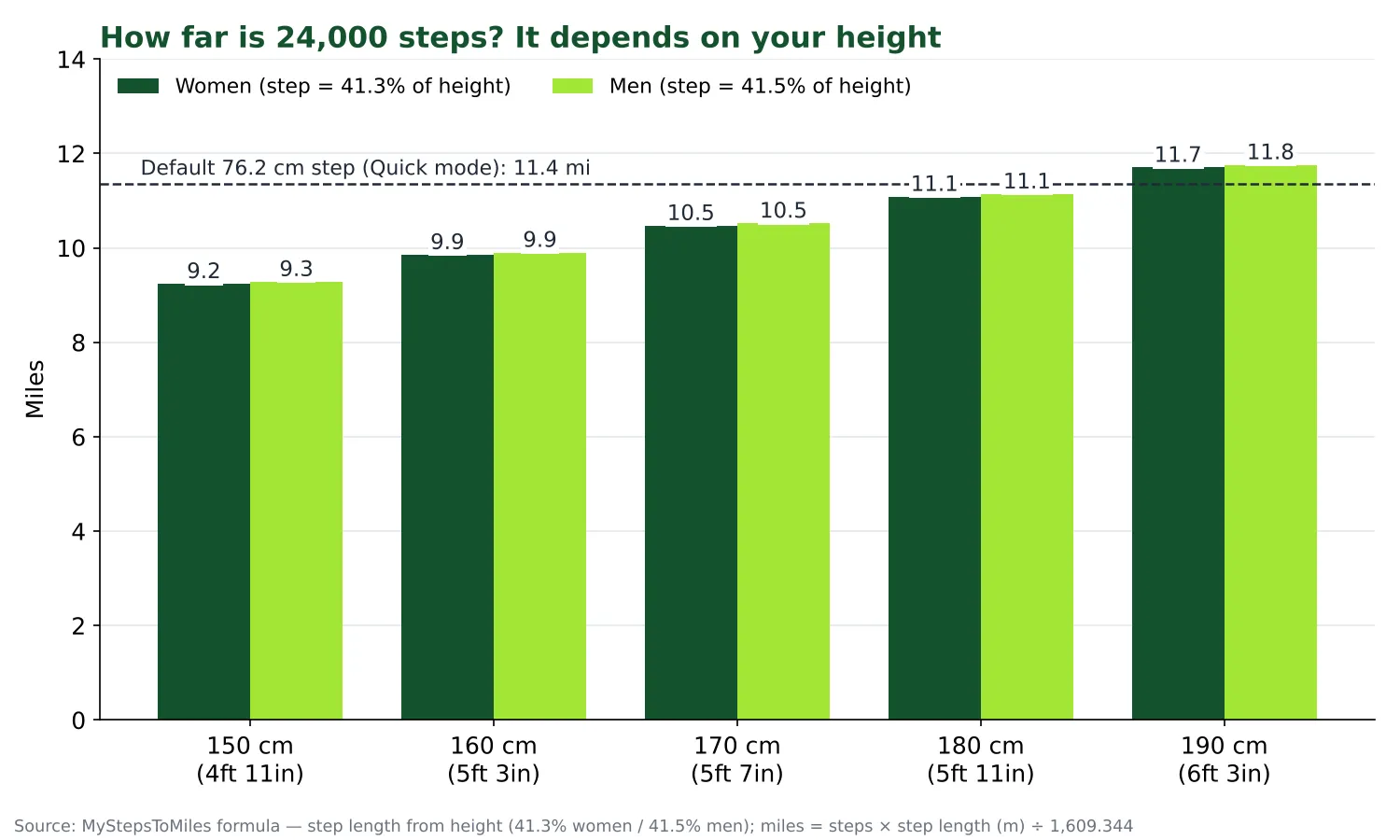
That is a gap of more than 2.5 miles between a 150 cm walker and a 190 cm walker, for exactly the same step count. It is the main reason two friends wearing trackers on the same walk can see different distances.
Other things nudge your step length up or down too:
- Speed. Brisk walking stretches your stride; strolling shortens it.
- Hills and stairs. Steps uphill and on stairs are shorter, so they add steps without adding much distance.
- Treadmills. Treadmill steps tend to be a little shorter than steps over ground. With a 70 cm step, 24,000 steps would be about 10.4 miles rather than 11.4.
- Tiredness. Late in a long day, most people’s steps get shorter.
This is why our steps to miles calculator has three modes. Quick uses the 76.2 cm average. Better uses your height to estimate your step. Exact uses your own measured stride, the most accurate choice if you want your 24,000 steps to mean something specific.
Tip: Want to measure your own stride? Walk 10 normal steps on a flat path, measure the distance, and divide by 10. Pop that number into Exact mode and you are done.
How long does it take to walk 24,000 steps?
Time depends on pace. Using the average 11.36 miles:
| Walking pace | What it feels like | Time for 24,000 steps |
|---|---|---|
| 2 mph | Gentle stroll, window shopping | about 5 h 41 min |
| 3 mph | Normal, comfortable walk | about 3 h 47 min |
| 4 mph | Brisk: you can talk, but not sing | about 2 h 50 min |
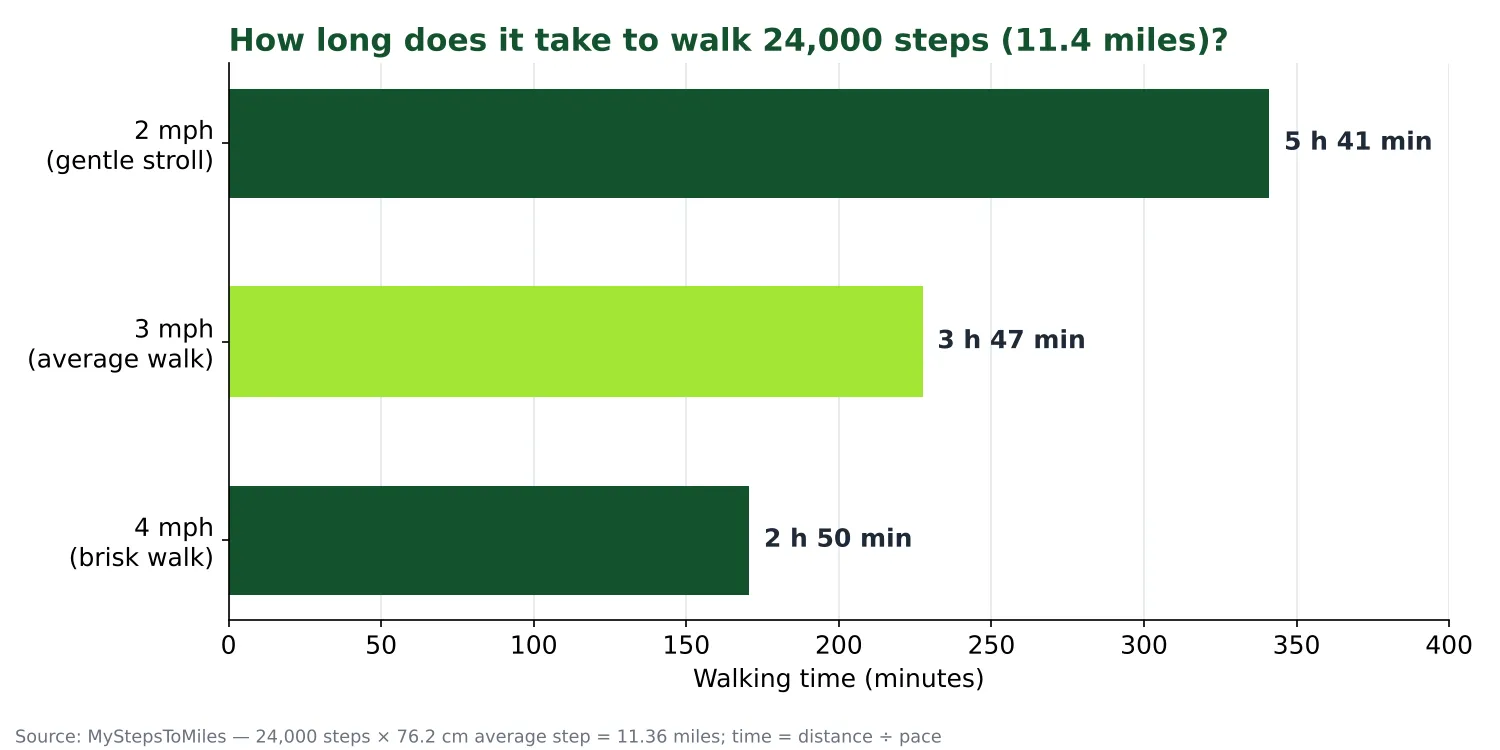
You can switch between 2, 3 and 4 mph in the calculator to see your own time. Most people find 3 mph is a natural pace on flat ground.
What a 24,000-step day really looks like
Very few people hit 24,000 steps by accident. In practice, it usually means a long hike, a city-sightseeing day, a job that keeps you on your feet, or a deliberate plan with several walks.
Here is one realistic way to build it, at a 3 mph pace (about 106 steps per minute with an average step):
| Part of the day | Time | Approx. steps |
|---|---|---|
| Everyday movement (house, shops, work) | – | 5,000 |
| Morning walk | 60 min | 6,336 |
| Lunchtime walk | 30 min | 3,168 |
| Evening walk | 90 min | 9,504 |
| Total | 3 hours of walking + normal day | about 24,000 |
So the honest picture is this: a 24,000-step day means roughly three hours of purposeful walking on top of normal life. That is very doable on a holiday or a free weekend. As a daily routine, it takes real commitment.
Splitting it up helps. Three shorter walks are kinder on your feet and much easier to fit around work than one marathon session. Another option is to save 24,000-step days for weekends and aim for a lower, steady number on weekdays.

Is 24,000 steps a day good, or too much?
For context, researchers often sort people by daily steps. One widely cited scheme from walking researcher Catrine Tudor-Locke describes fewer than 5,000 steps as “sedentary” and more than 12,500 as “highly active” (Tudor-Locke & Bassett, Sports Medicine, 2004). At 24,000 steps, you are well past that top band.
But more steps do not automatically mean more health benefit. A 2022 analysis in The Lancet Public Health pooled 15 studies covering 47,471 adults (Paluch et al., 2022). It found that the risk of dying early fell as daily steps rose, but the benefit levelled off at about 6,000–8,000 steps a day for adults aged 60 and over, and about 8,000–10,000 for younger adults.
In plain words: if your main goal is long-term health, you probably do not need 24,000 steps every day. The research simply does not show clear extra benefit for that particular measure at very high step counts. That said, long walks can still be great for fitness, mood, time outdoors and burning extra energy; they are just not a requirement.
The NHS recommends adults do at least 150 minutes of moderate activity a week, such as brisk walking (NHS physical activity guidelines). A single 24,000-step day at a brisk pace covers more than that in one go.

If you want to try 24,000 steps, a few sensible precautions:
- Build up gradually. If you normally walk 5,000 steps, jumping straight to 24,000 is a big leap for your feet, knees and hips. Add a little each week.
- Wear comfortable, supportive shoes and good socks. A blister can cut a long walk short very quickly.
- Carry water and a snack, especially on walks of three hours or more.
- Listen to your body. Ongoing pain is a signal to rest, not push through.
How to track your 24,000 steps (and stay motivated)

Big step goals feel much more achievable when you can see your progress. In MyStepsToMiles, you can save each walk to My Walks, with no app or sign-up needed. It keeps a running log of your distances, builds a streak as you walk on consecutive days, and celebrates when you reach the 30-day milestone.
A nice way to use it: log your step count each evening, check the miles, and watch the total grow across the week. If 24,000 steps feels too much right now, start with the 10,000 steps to miles page or 15,000 steps to miles page and work up.
Frequently asked questions
How many km is 24,000 steps?
About 18.3 km with an average 76.2 cm step. Depending on your height, it usually falls somewhere between about 15 and 19 km.
How long does it take to walk 24,000 steps?
About 3 hours 47 minutes at 3 mph, 2 hours 50 minutes at a brisk 4 mph, or 5 hours 41 minutes at a gentle 2 mph.
Is 24,000 steps a day too much?
Not for everyone, but it is far more than most people need for health. Research suggests the benefit for early-death risk levels off around 6,000–10,000 steps a day, depending on age. If you want to walk more, build up slowly and listen to your body.
How many steps is 12 miles?
About 25,344 steps with an average step (12 × 2,112). Taller walkers will need fewer steps; shorter walkers will need more.
Is 24,000 steps a half marathon?
Close, but not quite. A half marathon is 21.1 km, which takes about 27,700 steps with an average walking step. 24,000 steps gets you around 18.3 km.
Work out your own number
11.4 miles is a good starting point, but your 24,000 steps are personal. Pop your steps into the free steps to miles calculator, choose Better mode and add your height (or Exact mode with your own stride), pick your pace, and you will see your real distance and walking time in seconds. Then save it to My Walks and start your streak.
This article is general information, not medical advice. Talk to a doctor before a big change in how active you are.
Sources
- Paluch AE et al. Daily steps and all-cause mortality: a meta-analysis of 15 international cohorts. The Lancet Public Health, 2022: https://discovery.ucl.ac.uk/id/eprint/10170017/1/1-s2.0-S2468266721003029-main.pdf
- Tudor-Locke C, Bassett DR. How many steps/day are enough? Sports Medicine, 2004: https://www.doi.org/10.2165/00007256-200434010-00001
- NHS, Physical activity guidelines for adults aged 19 to 64: https://www.nhs.uk/live-well/exercise/physical-activity-guidelines-for-adults-aged-19-to-64/