
The short answer
For most adults, one mile is somewhere between about 2,000 and 2,500 walking steps.
If you take the standard “average” step of 76.2 cm (2.5 feet), the maths gives a neat figure: about 2,112 steps per mile. That’s the number our calculator uses in Quick mode.
But here’s the thing: you are not average. Nobody is, exactly. A shorter walker strolling to the shops might need 2,500 steps to cover a mile, while a tall runner might do it in well under 1,500. Same mile, very different step counts.
So let’s look at why your number is different, how big the difference really is, and how to find your steps per mile in about five minutes.
Where the 2,112 figure comes from
A mile is exactly 1,609.344 metres. To find how many steps fit into it, you simply divide that distance by the length of one step:
Steps per mile = 1,609.344 ÷ your step length in metres
With the average step of 0.762 m:
1,609.344 ÷ 0.762 = 2,112 steps
You’ll often hear people round this to “2,000 steps a mile”. It’s a handy rule of thumb, but it slightly flatters you. At an average stride, 2,000 steps is actually about 0.95 of a mile, not a full one.
And when researchers actually counted steps, real walkers tended to need more than 2,112, not fewer. More on that in a moment.
The three things that change your steps per mile
1. Your height
Taller people have longer legs, and longer legs mean longer steps. A widely used rule of thumb says your walking step is roughly 41.3% of your height if you’re a woman and 41.5% if you’re a man. It’s an estimate, not a law of nature, but it gets most people much closer than the one-size-fits-all figure.
Here’s what that looks like in practice:
- A woman who is 157.5 cm (5’2”) has an estimated step of about 65 cm. That’s roughly 2,474 steps per mile.
- A man who is 183 cm (6’0”) has an estimated step of about 76 cm. That’s roughly 2,119 steps per mile, almost exactly the “average”.
That’s a gap of more than 350 steps for every single mile. Over a 5-mile walk, it adds up to nearly 1,800 steps.
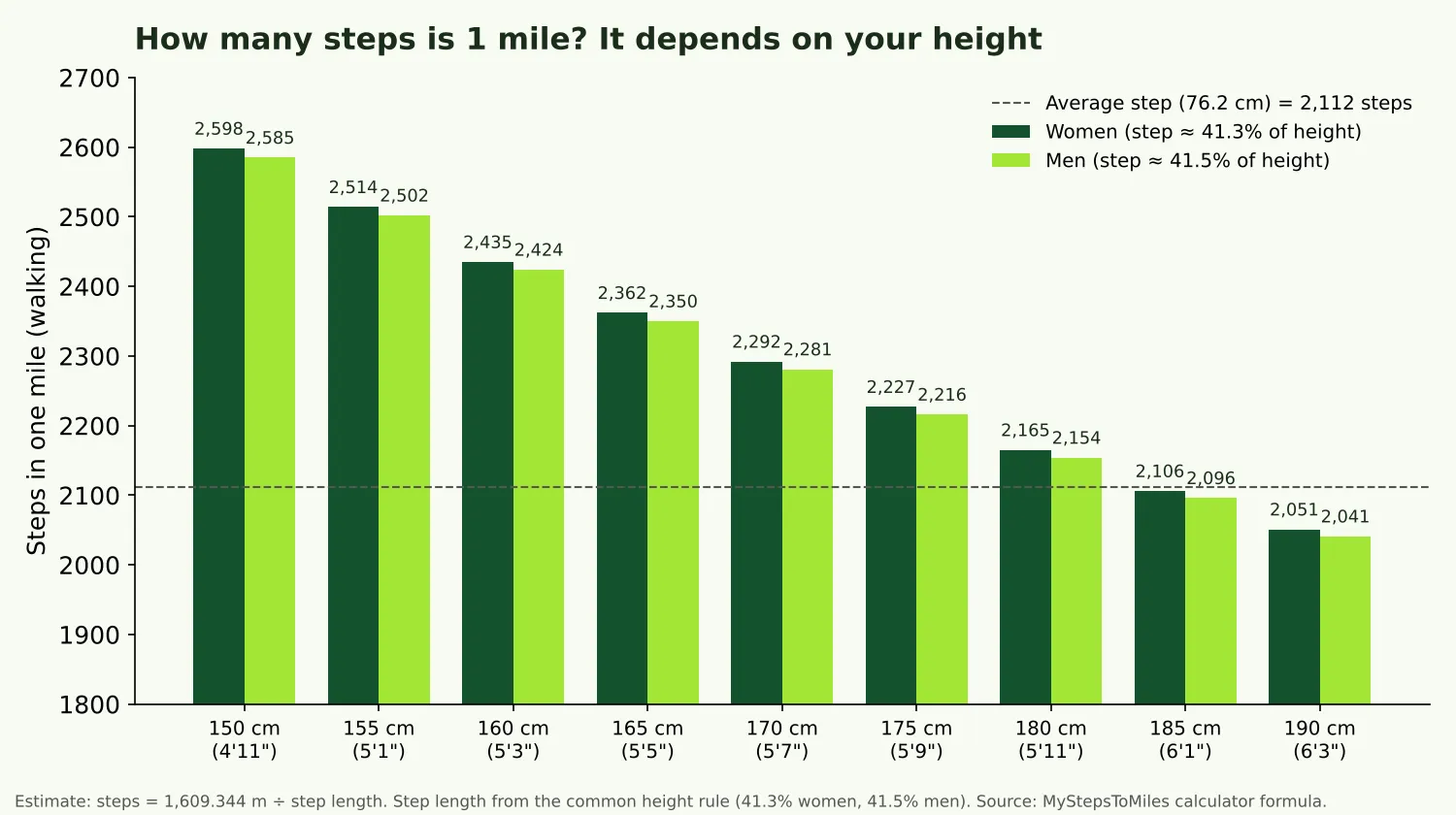
This is exactly why our calculator has a Better mode that uses your height. Pop your height into the steps to miles calculator and it swaps the generic 76.2 cm step for one that fits you.
2. Your speed
This one surprises people. The faster you move, the longer each step becomes, so you need fewer of them to cover the same ground.
The best-known study on this was published in 2008 in the American College of Sports Medicine’s Health & Fitness Journal (Hoeger and colleagues, “One-mile step count at walking and running speeds”). The researchers counted the steps people took to cover a mile at different speeds on a treadmill. Their averages, as reported by the study and summarised by Mental Floss, look like this:
- Walking at a 20-minute mile (3 mph): about 2,252 steps (women 2,310, men 2,176)
- Brisk walking at a 15-minute mile (4 mph): about 1,935 steps (women 1,987, men 1,868)
- Running at an 8-minute mile (7.5 mph): about 1,400 steps (women 1,469, men 1,360)
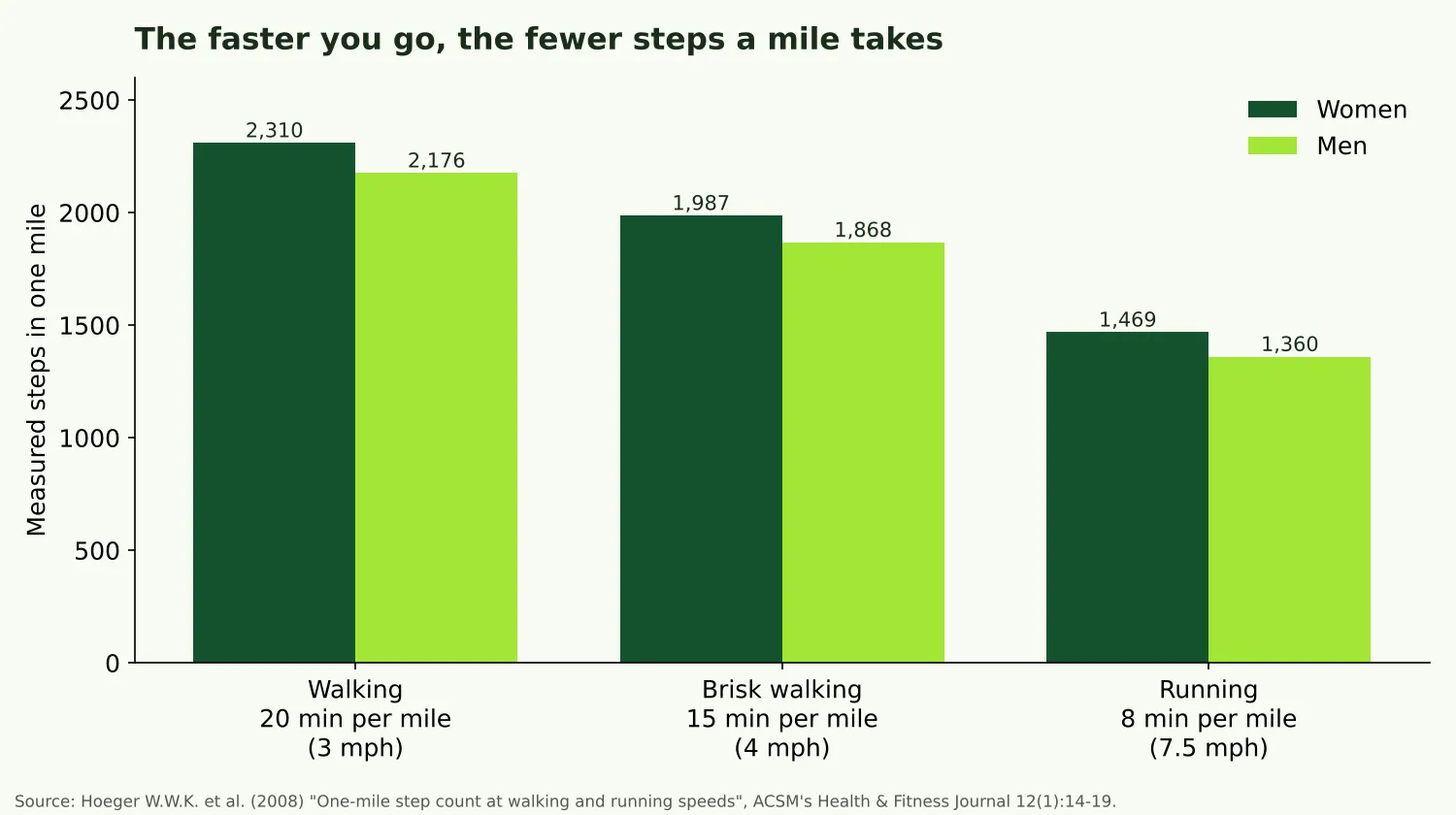
Two things jump out. First, running a mile can take nearly 40% fewer steps than walking it. Second, at a normal 3 mph walking pace, the people in this study took about 2,252 steps per mile. That works out to a step of roughly 71.5 cm, a bit shorter than the 76.2 cm “average”.
One honest caveat: this was a treadmill study, and steps on a treadmill tend to be a little shorter than steps over ground. So treat these numbers as a good guide rather than a perfect match for your morning walk.

3. Everything else
Height and speed do most of the work, but plenty of smaller things nudge your step count too:
- Hills and stairs shorten your stride, especially going up.
- Rough ground (sand, grass, mud, snow) makes you take shorter, more careful steps.
- Crowds, dogs and pushchairs break your rhythm.
- Shoes and comfort matter: stiff or ill-fitting shoes can shorten your stride.
- Age, fitness and injuries can all change how long your natural step is.
That’s why your fitness tracker’s distance can disagree with a map. It’s usually estimating your stride, not measuring it.
How to find your own steps per mile (5-minute method)
If you want a number that really is yours, measure it. You don’t need any special kit.
Option A: the measured-distance method
- Find a stretch of path you can measure, such as the length of a car park, a hallway or a sports pitch. A tape measure or a map app works.
- Walk at your normal, comfortable pace and count your steps over a set distance. For example, 20 steps.
- Measure how far you went. Say it was 15 metres.
- Divide distance by steps: 15 ÷ 20 = 0.75 m per step.
- Divide a mile by your step: 1,609.344 ÷ 0.75 = about 2,146 steps per mile.
The longer the distance you measure, the more accurate the result. Walking 20–30 steps is fine; walking 50 is better.
Option B: the running track method
A standard outdoor track is 400 metres around the inside lane. A mile is 1,609 metres, which is just over 4 laps (about 4.02).
- Walk one lap in the inside lane at your normal pace, counting your steps.
- Multiply that number by 4.02.
So if one lap took you 550 steps, your mile is about 550 × 4.02 = 2,213 steps.
Once you know your step length, put it into the calculator’s Exact mode, which uses your own stride. From then on, every conversion is tailored to you.

How long does a mile take to walk?
Steps tell you distance, but most of us also want to know time. A mile takes about:
- 30 minutes at an easy 2 mph stroll
- 20 minutes at a steady 3 mph walk
- 15 minutes at a brisk 4 mph walk
You can switch between these 2, 3 and 4 mph pace options in the calculator to see how long any step count will take you.
Putting it to work: quick conversions
Here’s how the average 2,112-steps-per-mile figure plays out for some popular step targets:
| Steps | Miles (average 76.2 cm step) | Kilometres |
|---|---|---|
| 1,000 | about 0.47 miles | 0.76 km |
| 5,000 | about 2.37 miles | 3.81 km |
| 10,000 | about 4.73 miles | 7.62 km |
Want the details for a particular number? We have pages that break each one down, including walking time:
- 1,000 steps to miles
- 5,000 steps to miles
- 10,000 steps to miles (about 4.73 miles, or roughly 1 hour 35 minutes at 3 mph)
And if you’re walking regularly, the My Walks log keeps a record for you, tracks your streak, and celebrates when you hit the 30-day milestone. It’s a nice way to watch the miles add up without downloading an app.
The bottom line
“How many steps is a mile?” has a simple answer and a true answer.
The simple answer: about 2,000 to 2,500 steps for most walkers, with 2,112 as the average-stride figure.
The true answer: it depends on your height, your speed and the ground under your feet. A short, relaxed walker might need 2,500 steps or more. A tall, brisk walker might need fewer than 2,000. A runner could need closer to 1,400.
The good news is that you don’t have to guess. Measure your stride once, plug it in, and your step count turns into a distance you can trust.
Frequently asked questions
Is 2,000 steps a mile?
Roughly, but it’s a slight underestimate for most people. With an average 76.2 cm step, a mile is about 2,112 steps, and 2,000 steps is about 0.95 miles. Shorter walkers may need 2,400 or more.
How many steps is a mile for a woman?
It depends on height and pace. In the 2008 ACSM study, women walking at 3 mph averaged about 2,310 steps per mile. Using the height rule, a 160 cm (5’3”) woman needs roughly 2,435 steps.
How many steps is a mile running?
Far fewer than walking. In the same study, runners at an 8-minute-mile pace averaged about 1,400 steps per mile. Faster runners with longer strides take even fewer.
How many steps is half a mile?
Simply halve your steps per mile. At the average stride, half a mile is about 1,056 steps.
Why does my watch say a different distance from my map app?
Most step counters estimate distance by multiplying your steps by an estimated stride length, often based on your height. If that estimate is off, your distance will be too. Setting your measured stride in the device (or using our Exact mode) usually helps.
Ready to find your number? Try the free MyStepsToMiles steps to miles calculator. Start with Quick mode, switch to Better mode with your height, or go Exact with your own stride. No app, no sign-up, just your steps turned into miles, kilometres and walking time.
Sources
- Hoeger W.W.K., Bond L., Ransdell L., Shimon J.M., Merugu S. (2008). “One-mile step count at walking and running speeds.” ACSM’s Health & Fitness Journal, 12(1), 14–19. https://doi.org/10.1249/01.FIT.0000298459.30006.8d
- Mental Floss, “How Many Steps Are in a Mile?” (summary of the study’s per-sex figures): https://www.mentalfloss.com/article/655905/how-many-steps-are-mile
- Texas A&M Howdy Health, “How to Count Steps Without a Pedometer, Watch, or Phone”: https://howdyhealth.tamu.edu/how-to-count-steps-without-a-pedometer-watch-or-phone/
- Height-to-step rule (41.3% / 41.5%) and the 76.2 cm average step: MyStepsToMiles calculator figures.