
Here is the quick answer: multiply the miles by 2,112 and you have an average step count. So 1 mile is about 2,112 steps, 3 miles is about 6,336 steps and 5 miles is about 10,560 steps.
That number comes from an average step of 76.2 cm (2.5 feet). If your step is shorter or longer than that, your own number will be different, sometimes by a few hundred steps a mile. Below, I’ll show you how to get a figure that fits you, and how to use it to plan a walk from the finish line backwards.
Why bother? Because most of us think in two different languages. Our step counter speaks in steps. Maps, park signs and charity walks speak in miles or kilometres. Being able to translate between them means you can look at a route and know straight away whether it will get you to your goal for the day.
The simple formula
Every miles-to-steps conversion is the same calculation underneath:
Steps = miles × 1,609.344 ÷ your step length in metres
The 1,609.344 is simply the number of metres in one mile. You divide by your step length because each step covers that much ground.
Plug in the average step of 0.762 metres and you get 1,609.344 ÷ 0.762 = 2,112 steps per mile. That’s where our shortcut comes from.
One word that trips people up: a step is one foot landing in front of the other. A stride is usually two steps (left and right). Some websites and fitness apps use “stride” when they mean a single step, so check which one you are measuring before you do the maths.
Common distances in steps
Here are the distances people ask about most often, worked out with the average 76.2 cm step, along with roughly how long each one takes at three walking speeds.
| Distance | Steps (average) | Gentle 2 mph | Steady 3 mph | Brisk 4 mph |
|---|---|---|---|---|
| ½ mile | 1,056 | 15 min | 10 min | 8 min |
| 1 mile | 2,112 | 30 min | 20 min | 15 min |
| 2 miles | 4,224 | 1 h | 40 min | 30 min |
| 3 miles | 6,336 | 1 h 30 min | 1 h | 45 min |
| 5K (3.1 miles) | 6,562 | 1 h 33 min | 1 h 2 min | 47 min |
| 5 miles | 10,560 | 2 h 30 min | 1 h 40 min | 1 h 15 min |
| 10K (6.2 miles) | 13,123 | 3 h 6 min | 2 h 4 min | 1 h 33 min |
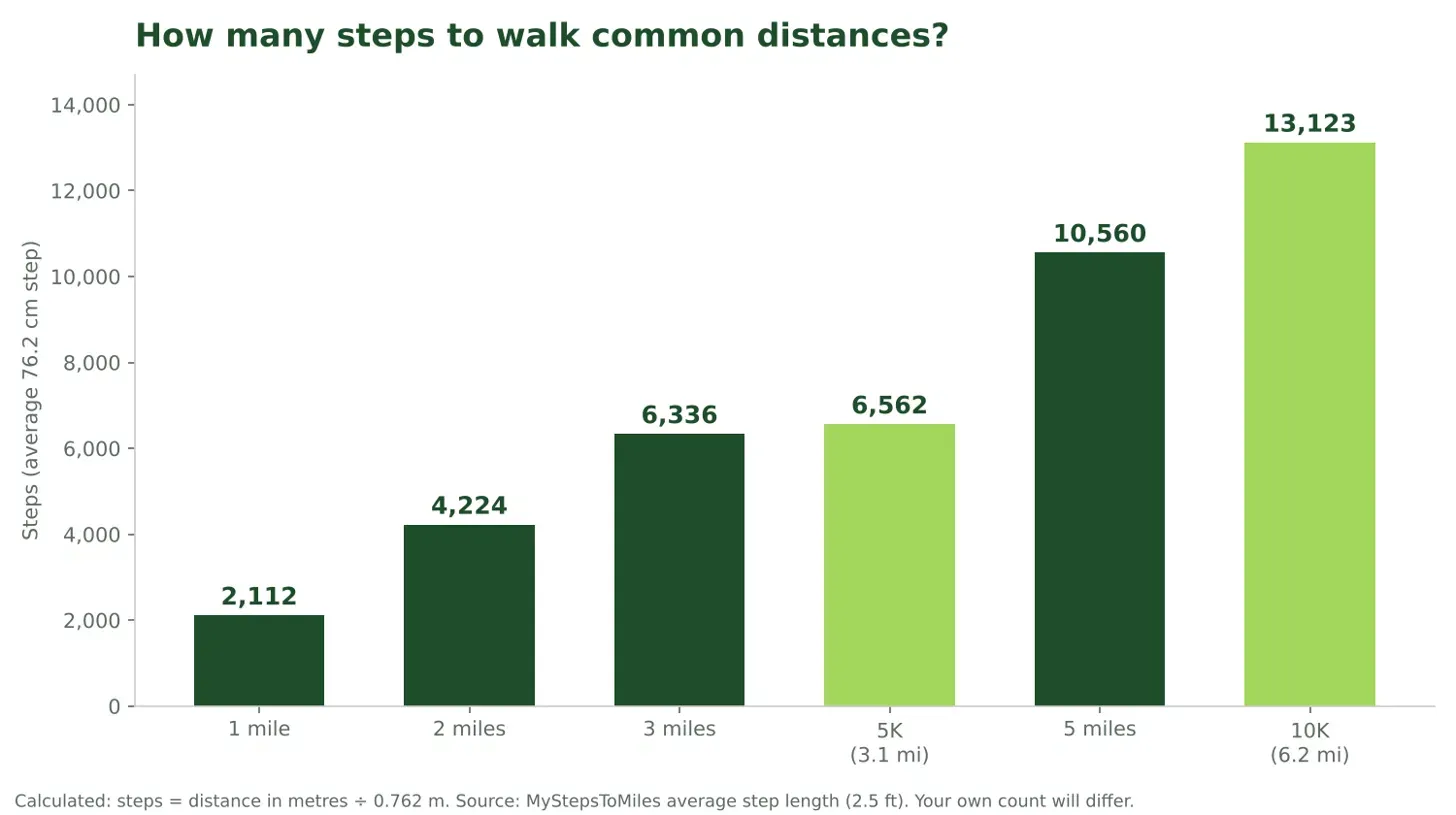
Notice that 5 miles lands just above 10,000 steps. If you have ever wondered how far 10,000 steps actually takes you, it works out at about 4.73 miles (7.62 km) for an average step. We go into that in more detail on our 10,000 steps to miles page.
Why your number might be different
The 2,112 figure is a good starting point, but it is an average. Real people come in all heights and walk in all sorts of ways. The biggest things that change your step length are:
- Height. Taller people usually have longer legs and longer steps, so they need fewer steps to cover a mile.
- Speed. When you walk faster, your steps tend to get longer. When you stroll, they shorten.
- The ground. Hills, sand, crowded pavements and stairs all shorten your step.
- Treadmills. People often take shorter steps on a treadmill than outdoors, so a treadmill mile can take more steps.
- Running. A running step is much longer than a walking step, so a running mile takes fewer steps. (We’ll compare the two properly later in this series.)
Height is the easiest one to adjust for. A common estimate is that your step is about 41.3% of your height if you are a woman and 41.5% if you are a man. That’s the rule our calculator’s “Better” mode uses when you enter your height.
Here’s what that does to the steps in a single mile:
| Height | Estimated step | Steps per mile | Steps for 5K |
|---|---|---|---|
| 152 cm (5’0”) woman | 62.8 cm | 2,564 | 7,965 |
| 160 cm (5’3”) woman | 66.1 cm | 2,435 | 7,567 |
| 165 cm (5’5”) woman | 68.1 cm | 2,362 | 7,337 |
| 170 cm (5’7”) man | 70.5 cm | 2,281 | 7,087 |
| 178 cm (5’10”) man | 73.9 cm | 2,179 | 6,769 |
| 188 cm (6’2”) man | 78.0 cm | 2,063 | 6,409 |
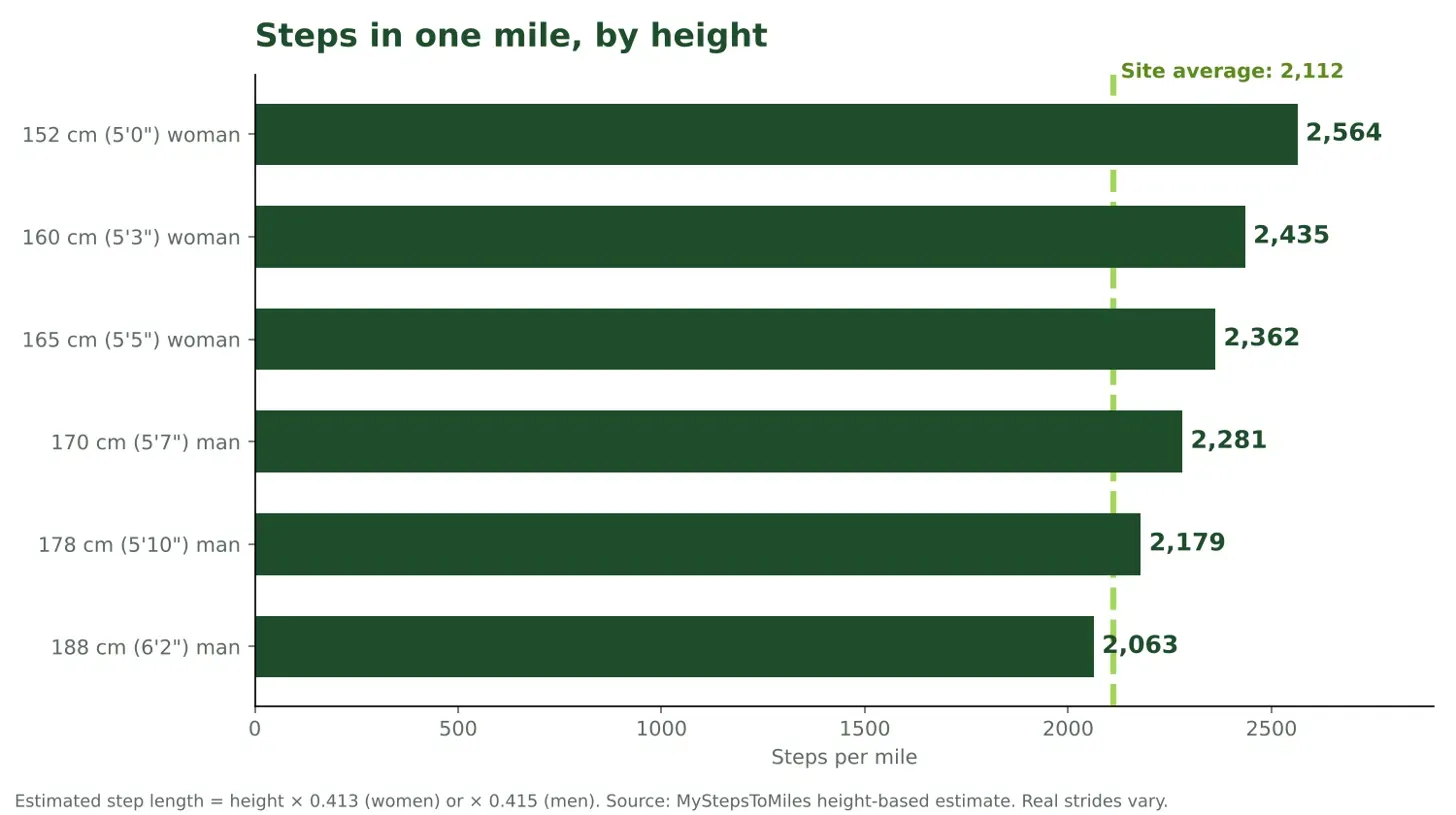
That’s a gap of around 500 steps a mile between a 5-foot woman and a 6-foot-2 man. Over a 5-mile walk, that adds up to well over 2,000 steps, a fair chunk of a short walk on its own. So if your tracker never seems to agree with the “standard” numbers, this is very likely why.
How to measure your own step length (5 minutes, no gadgets)
Height-based estimates are good. Your real step length is better. Here are two simple ways to find it.
Method 1: the 20-step test
- Find a flat stretch of pavement or a long hallway.
- Mark your starting point (a chalk line or a coin works).
- Walk 20 normal steps at your usual pace. Don’t try to stretch.
- Measure the distance from the start to the toe of your front foot.
- Divide that distance by 20. That’s your step length.
Example: if 20 steps cover 14 metres, your step is 14 ÷ 20 = 0.70 m, or 70 cm.
Method 2: the running track
A standard outdoor running track is 400 metres around the inside lane. Walk one lap at your normal pace and count your steps. Then divide 400 by your step count. If you take 525 steps, your step is 400 ÷ 525 = 0.762 m, right on the average.
Once you know your number, pop it into the “Exact” mode on the steps to miles calculator. Every result after that will be tailored to you.
Planning a walk backwards from distance

This is where converting miles to steps gets useful. Instead of walking and then checking what you did, you decide the goal first and work backwards. There are three common ways people do this.
1. “I have a route. How many steps will it give me?”
Say there’s a 3-mile loop around your local park. You are a 165 cm woman, so your estimated step is about 68.1 cm.
- 3 miles × 1,609.344 = 4,828 metres
- 4,828 ÷ 0.681 ≈ 7,085 steps
- At a steady 3 mph, that’s about 1 hour.
Using the average step, you’d have expected 6,336. Knowing your own number tells you that the loop is worth roughly 750 more steps to you.
2. “I want to hit a step goal. How far do I need to go?”
This is the reverse calculation: miles = steps × step length in metres ÷ 1,609.344.
Suppose it’s 6 pm and your tracker says 4,000 steps. You want 10,000. That leaves 6,000 steps.
- 6,000 × 0.762 = 4,572 metres
- 4,572 ÷ 1,609.344 ≈ 2.84 miles
- At 3 mph, that’s about 57 minutes of walking.
Now you know: a walk of a bit under 3 miles, or just under an hour, will close the gap. That’s much easier to plan than “walk until the number goes up”.
3. “I only have 30 minutes. What can I fit in?”
Start from time instead. At 3 mph, 30 minutes covers 1.5 miles, which is about 3,168 average steps. At a brisk 4 mph, you’d cover 2 miles and about 4,224 steps.
A handy check is your pace in steps per minute. Harvard Health reports that a review of 38 studies linked brisk, moderate-intensity walking with roughly 100 steps per minute, about 2.7 mph for many people. So a brisk 30-minute walk works out at around 3,000 steps or more. To find your own pace, count your steps for 10 seconds and multiply by six.
That connects nicely with health guidance. The CDC recommends at least 150 minutes a week of moderate-intensity activity, such as brisk walking, for adults. Five brisk 30-minute walks a week meet that, and at about 100 steps a minute, that is roughly 3,000 steps per walk. It’s a much friendlier way to think about a weekly target than a single big number every day.
A quick planning cheat sheet
- Miles to steps: miles × 2,112 (average), or use your own step length.
- Steps to miles: steps ÷ 2,112 (average).
- Kilometres to steps: km × 1,312 (average).
- Walking time: about 20 minutes per mile at 3 mph, 15 at 4 mph, 30 at 2 mph.
- Brisk pace check: roughly 100 steps per minute or more.
If you like seeing these at a glance, our step pages show the distance for popular goals: 5,000 steps to miles, 8,000 steps to miles, 12,000 steps to miles and 15,000 steps to miles.
Make your plan stick

Knowing the numbers is half the job. The other half is actually going out. A few small things help:
- Pick two or three regular routes and work out their step counts once. Then you can choose a route to match the day instead of doing maths each time.
- Split big goals. A 6,000-step gap is a lot in one go after work. Two 3,000-step walks, one at lunch and one in the evening, often feel easier.
- Write it down. Log each walk in My Walks on MyStepsToMiles. You’ll see your streak build, and there’s a milestone waiting at 30 days.
- Don’t chase perfect accuracy. Whether a walk is 6,300 or 6,500 steps matters far less than the fact that you went.
Frequently asked questions
How many steps are in a mile?
About 2,112 steps for an average 76.2 cm step. Depending on your height and pace, most people fall somewhere between about 2,000 and 2,600 steps per mile.
How many steps is 3 miles?
Around 6,336 steps with an average step. A shorter walker might take over 7,000 steps; a tall walker closer to 6,200.
How do I convert miles to steps without a calculator?
Multiply the miles by 2,000 for a rough mental estimate, then add about 5% (2,000 × 1.05 ≈ 2,100). For a more exact figure, use miles × 1,609.344 ÷ your step length in metres.
How many steps is 5 km?
About 6,562 steps with an average step. Our kilometre shortcut is around 1,312 steps per km.
Is a stride the same as a step?
Not always. A step is one foot landing in front of the other. A stride is often counted as two steps (left plus right). Check which one your app means before you enter it.
Try it with your own numbers
The quickest way to plan your next walk is to let the calculator do the maths. Open the steps to miles calculator, choose “Better” (uses your height) or “Exact” (your own stride), pick your pace (2, 3 or 4 mph), and you’ll see your steps, miles, kilometres and walking time in one go. No app, no sign-up: just your next walk, planned.

This article is general information, not medical advice. Talk to a doctor before a big change in how active you are.
Sources
- Harvard Health Publishing, Walk this way (brisk walking ≈ 100 steps per minute): https://www.health.harvard.edu/heart-health/walk-this-way
- Tudor-Locke C. et al. (2018), How fast is fast enough? Walking cadence (steps/min) as a practical estimate of intensity in adults: a narrative review, British Journal of Sports Medicine: https://pubmed.ncbi.nlm.nih.gov/29858465/
- CDC, Physical activity guidelines for adults: https://www.cdc.gov/physical-activity-basics/guidelines/adults.html