
You have probably had this argument with yourself. The alarm goes off at 6 am and a little voice says, “Healthy people walk in the morning.” You hit snooze. Then evening comes, you are tired, and the same voice says, “Too late now, you missed it.” So you walk at neither time, and feel guilty about both.
Here’s the good news, so you can drop that guilt right now: there is no single “best” time to walk. A morning walk and an evening walk both count fully towards the 150–300 minutes of moderate activity a week that the World Health Organization recommends. Each time of day has its own small bonus: morning daylight helps set your body clock, while a walk after your evening meal is especially good at calming the blood sugar rise that follows food. But the walk that does you the most good is simply the one you actually do.
Below you’ll find what the research says about the best time to walk (and how strong that evidence is), a quick way to match the time to your goal, and a simple method for turning whatever slot you have, 10 minutes or 45, into a clear steps-and-miles plan.
The quick verdict: which walk suits which goal?
If you only read one part of this article, make it this table.
| Your main goal | Lean towards | Why (and how strong the evidence is) |
|---|---|---|
| Better sleep, steadier energy | Morning, outdoors | Daylight soon after waking helps reset your body clock (NHS advice). |
| Calmer blood sugar after food | Short walks after meals, especially dinner | Good evidence from a controlled trial in people with type 2 diabetes. |
| Weight management | Whichever time you will stick to | Timing evidence is weak and mixed; total activity matters more. |
| Unwinding after work | Evening | A natural “switch-off” between work and home. |
| Building a habit | The same time every day | Attach the walk to something you already do. |
| Long-term heart health | Either | Some observational data favour evening; not proof. |
Now let’s look at each side properly, starting with the early birds.
Morning walk benefits: the case for walking early

Morning light helps set your body clock
Your body runs on an internal 24-hour clock, and light is the main thing that keeps it on time. NHS sleep advice suggests going outside soon after waking, even on a cloudy day, because morning natural light helps reset your body clock, supports better sleep at night and boosts alertness during the day. A morning walk gives you that light for free while you move. If it is still dark when you wake in winter, walk as soon as it gets light, or take your walk at lunchtime instead.
It is done before the day gets in the way
This is common sense rather than science, but it matters. Late meetings, traffic and plain tiredness pile up as the day goes on. If you often say “I’ll walk later” and later never comes, the morning may be your answer.
Is morning the best time to walk for weight loss?
You will see headlines saying morning exercise is “best for weight loss”. The main study behind them, published in the journal Obesity in 2023, looked at 5,285 US adults wearing activity trackers. People who did most of their moderate-to-vigorous activity between 7 and 9 am had a slightly lower average BMI (about 27.4) than those who were most active at midday or in the evening (about 28.2–28.4).
That sounds convincing, but be careful. The data were a snapshot in time, so they show a link, not proof that the morning caused the difference. Morning exercisers may simply live differently in other ways, and the researchers themselves said trials are needed. The honest summary: for weight, how much you move each week matters far more than the hour on the clock.
The catch? Muscles are stiffer first thing, winter mornings are cold and dark, and if you are not a morning person it can feel like a battle. Keep the first five minutes easy.
Evening walk benefits: the case for walking later

A walk after dinner is a blood sugar helper
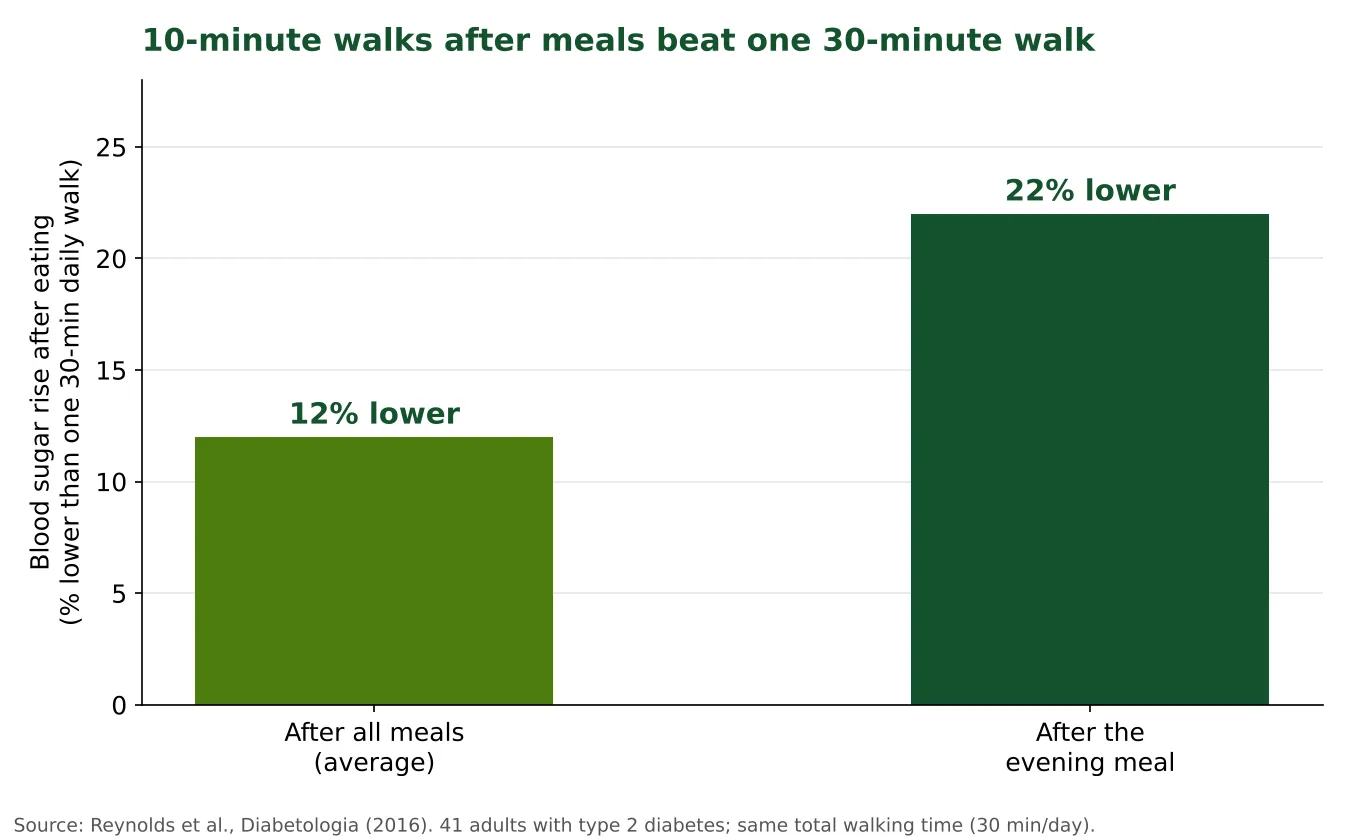
This is where the evening has its strongest evidence. In a 2016 trial published in Diabetologia, 41 adults with type 2 diabetes tried two plans for two weeks each: one 30-minute walk at any time of day, or a 10-minute walk after each main meal (starting within five minutes of finishing eating). Same total time, 30 minutes a day.
The after-meal walks won. Blood sugar after eating was about 12% lower overall, and about 22% lower after the evening meal, which the researchers called “particularly striking”. One possible reason: dinner is often a big meal followed by hours on the sofa.
One note: this study was in people with type 2 diabetes, so the exact numbers may not apply to everyone. Still, a gentle stroll after dinner is an easy, low-risk habit for most people.
Evening activity and long-term health
A large 2024 study in Diabetes Care followed about 30,000 UK adults over 40 living with obesity for around eight years. Those who did most of their moderate-to-vigorous activity between 6 pm and midnight had the lowest risk of early death and death from heart disease. Interesting, but again observational, and the authors say more research is needed before anyone can say evening activity causes better health.
Will an evening walk ruin my sleep?
Very unlikely. A review of 23 studies in Sports Medicine found that exercise in the four hours before bed did not harm sleep. Moderate exercise was fine even when it ended 30 minutes before bedtime. Only vigorous exercise within an hour of bed might make it harder to fall asleep. A normal walk is moderate, so you are fine.
The catch? Evening walks are the easiest to skip when you are tired, and in winter they often happen in the dark (more on staying safe below).
So which should you choose? A 3-question test
If you are still unsure, answer these three questions honestly:
- When am I least likely to be interrupted? That time wins most ties.
- What is my main goal? Better sleep and energy point to morning daylight. Blood sugar points to a walk after meals, especially dinner.
- What can I attach it to? Habits stick when they follow something you already do: “after I drop the kids at school” or “after I clear the dinner plates”.
And if two answers point in different directions? Then you don’t have to choose at all.
The busy person’s answer: split your walk
Many people never walk because they can’t find a spare 30 minutes. You don’t need one. Shorter walks add up, and the Diabetologia study above shows that three 10-minute walks can beat one 30-minute walk for blood sugar.
Here is a simple split day at an ordinary 3 mph pace, using the average step of 76.2 cm:
| When | Time | Distance | Approx. steps |
|---|---|---|---|
| Morning walk in daylight | 20 min | 1 mile | 2,112 |
| Stroll after dinner | 10 min | 0.5 miles | 1,056 |
| Total | 30 min | 1.5 miles | 3,168 |
Do that five days a week and you have hit the WHO’s 150-minute minimum, and you get the best of both worlds: morning light and an after-dinner blood sugar helper. Your everyday steps around the house and at work come on top. Curious what a 5,000-step day looks like? See the 5,000 steps to miles page.
How to turn any time slot into a clear plan
Most people don’t think “I will walk 1.5 miles”. They think “I have 20 minutes before work”. The problem is not knowing what those 20 minutes are worth. This chart shows roughly how many steps fit into common time slots:
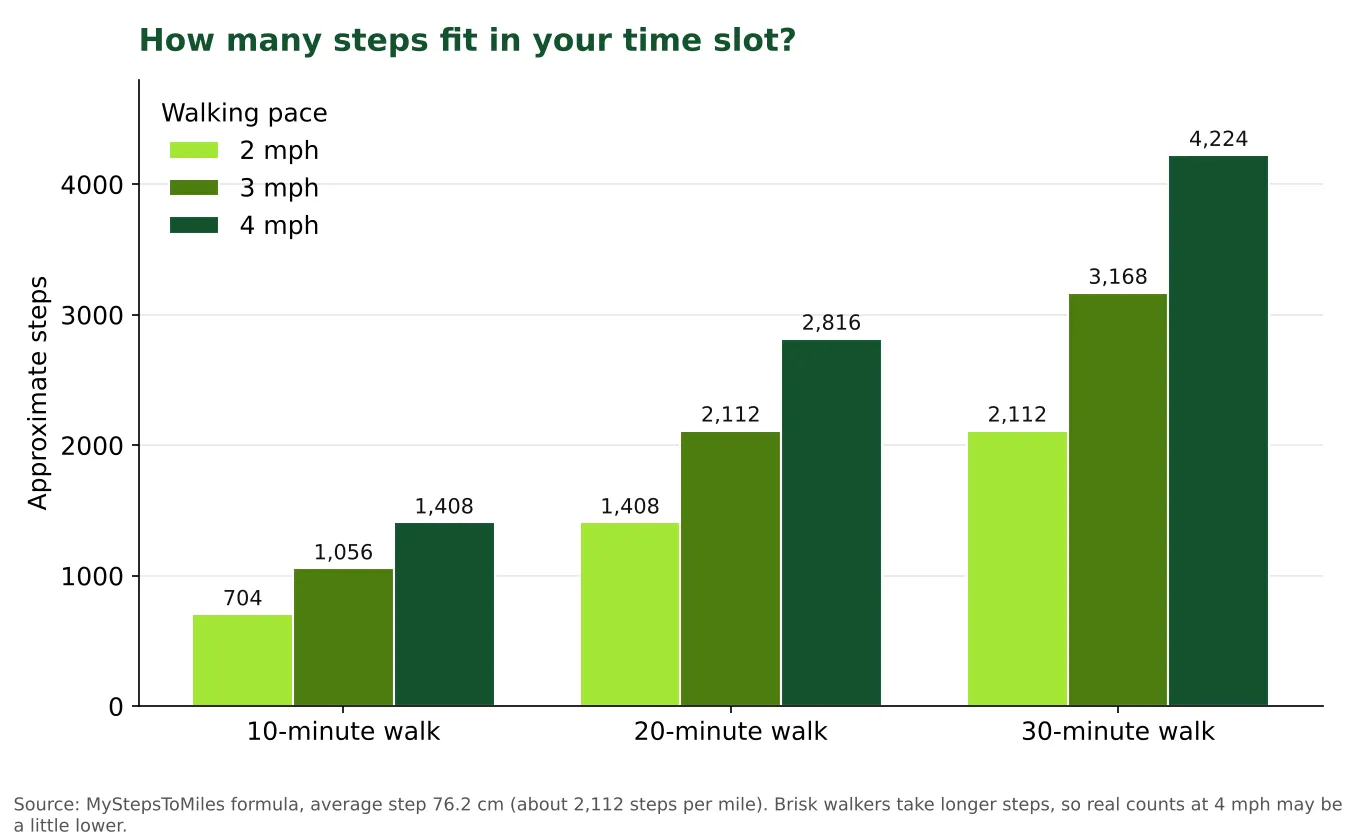
Those numbers use an average step. Your own step may be longer or shorter, and brisk walkers naturally lengthen their stride, so at 4 mph your real count may be a little lower. That’s where the MyStepsToMiles calculator saves you the guesswork. Here’s how to use it in under a minute:
- Open the calculator and type your step goal or your step count from yesterday.
- Pick a mode. Quick uses the average 76.2 cm step. Better uses your height. Exact uses your own measured stride.
- Choose your pace, 2, 3 or 4 mph, to see how long the walk will take.
- Fit it to your slot. If the time is longer than the slot you have, split it into a morning and an evening walk.
- Log it in My Walks. Your streak counts a morning walk and an evening walk exactly the same, and the 30-day milestone gives you something to aim for.
Here’s why the Better mode matters. Take a woman who is 160 cm tall. Her step is about 41.3% of her height, roughly 66 cm, so she needs about 2,435 steps to cover a mile, not 2,112. A 20-minute walk at 3 mph is one mile, so for her that walk is about 2,435 steps. Without that adjustment she would think she had walked further than she really had. No app, no sign-up: just type and see.
Bigger target? A 10,000-step day is about 4.73 miles (7.62 km), roughly 1 hour 35 minutes at 3 mph, which is far easier to split across morning, evening and everyday steps. See the 10,000 steps to miles page.
Small tweaks that make either time easier
If you walk in the morning
- Put your shoes and jacket by the door the night before, so you remove every excuse.
- Get outside rather than onto a treadmill when you can, so you catch the daylight.
- Keep the first five minutes gentle while your muscles wake up.
If you walk in the evening
- Head out soon after dinner. In the blood sugar study, walks started within five minutes of finishing the meal.
- Pick a well-lit route and wear something bright or reflective.
- Keep it at a comfortable, chatty pace if it is close to bedtime.

Frequently asked questions
Is it better to walk in the morning or evening for weight loss?
Neither is clearly better. One large study linked morning activity to a slightly lower BMI, but it could not prove cause and effect. For weight, the total amount you walk each week, and keeping it up for months, matters far more than the time of day.
Is walking after dinner good for you?
Yes, for most people. A controlled trial found that a 10-minute walk after each meal lowered the rise in blood sugar after eating, with the biggest effect after the evening meal. It is also a pleasant way to unwind.
Is it OK to walk on an empty stomach in the morning?
For most healthy people, a gentle walk before breakfast is fine. If you have diabetes, take blood sugar medication, or feel dizzy or weak, eat something small first and ask your doctor what is right for you.
How long should a morning or evening walk be?
Aim for about 30 minutes, five days a week, to reach the WHO’s 150-minute weekly minimum. Short walks of 10 minutes count too, so split it however suits your day.
Can I walk too close to bedtime?
A normal walk is moderate exercise, and research shows moderate exercise does not harm sleep, even shortly before bed. Only hard, vigorous exercise in the last hour before bed might delay sleep.
The best walk is the one you take
Morning or evening, you are winning the moment your shoes hit the pavement. Pick the time that fits your life, try a split day if your schedule is tight, and let the numbers do the motivating. Pop your steps into the free MyStepsToMiles calculator to see exactly how far you went, no app and no sign-up, then log it in My Walks and watch your streak grow.
This article is general information, not medical advice. Talk to a doctor before a big change in how active you are.
Sources
- World Health Organization, physical activity: https://www.who.int/europe/news-room/fact-sheets/item/physical-activity
- NHS, sleep advice on morning daylight: https://abuhb.nhs.wales/news/news/snooze-through-winter-simple-habits-for-restful-nights-during-the-darker-months/
- Obesity (2023), activity timing and BMI in US adults: https://www.healio.com/news/endocrinology/20231110/morning-exercise-linked-to-lower-bmi-waist-circumference-for-adults
- Reynolds et al. (2016), walking timing and blood sugar, Diabetologia: https://www.healio.com/news/endocrinology/20161020/timing-of-daily-walks-improves-glycemic-profile-in-type-2-diabetes
- Diabetes Care (2024), timing of activity and mortality: https://www.sciencedaily.com/releases/2024/04/240410112756.htm
- Sports Medicine review of exercise timing and sleep: https://pubmed.ncbi.nlm.nih.gov/30374942/