Your phone says 8,412 steps. Lovely. But if you grew up with kilometres, that number doesn’t really tell you anything. Was it a stroll to the shops or a proper walk? And when an app shows the distance in miles, you have to do a second conversion in your head before it means anything at all.
So let’s make steps speak your language.
Quick answer: For an average step of 76.2 cm, about 1,312 steps make 1 kilometre, so 10,000 steps is roughly 7.6 km. To convert, multiply your steps by your step length in metres, then divide by 1,000. Shorter walkers need more steps per km (often 1,450–1,600). Taller walkers need fewer (roughly 1,270–1,350).
- Mental shortcut: thousands of steps × 0.76 = kilometres. 6,500 steps ≈ 4.9 km.
- 1 km ≈ 1,300 steps and about 12½ minutes at a brisk 3 mph (4.8 km/h) walk.
- 5 km ≈ 6,560 steps. 10 km ≈ 13,100 steps.
- Want your own number? Use the Better (height) or Exact (your own stride) mode in the steps to miles calculator.
The steps-to-km formula (simpler than it looks)
Every step you take covers a small distance. That distance is your step length: the gap from the heel of one foot to the heel of the other. Multiply it by how many steps you took and you have your distance.
Kilometres = steps × step length in metres ÷ 1,000
Back to those 8,412 steps. With the average step of 0.762 m: 8,412 × 0.762 = 6,410 metres, which is 6.41 km. Not a stroll, then. That’s a solid walk.
One thing that trips people up: a stride is two steps (left foot plus right foot). If you measure a stride and plug it in as a step, you’ll double your distance. Nice for the ego, bad for accuracy.
Steps to km at a glance
Here are the step counts people search for most, converted with the average 76.2 cm step. The last column shows roughly how long each takes at a brisk 3 mph.
| Steps | Kilometres | Miles | Time at 3 mph |
|---|---|---|---|
| 1,000 | 0.76 km | 0.47 mi | 9 min |
| 2,500 | 1.91 km | 1.18 mi | 24 min |
| 5,000 | 3.81 km | 2.37 mi | 47 min |
| 6,000 | 4.57 km | 2.84 mi | 57 min |
| 8,000 | 6.10 km | 3.79 mi | 1 h 16 min |
| 10,000 | 7.62 km | 4.73 mi | 1 h 35 min |
| 12,000 | 9.14 km | 5.68 mi | 1 h 54 min |
| 14,000 | 10.67 km | 6.63 mi | 2 h 13 min |
| 15,000 | 11.43 km | 7.10 mi | 2 h 22 min |
| 20,000 | 15.24 km | 9.47 mi | 3 h 9 min |
If you’d like the full breakdown for a single number, each one has its own page, such as the 5,000 steps to miles page, the 8,000 steps to miles page and the 10,000 steps to miles page. Every page shows kilometres too.
A two-second shortcut you can do in your head
You won’t always have a calculator open. Mid-walk, with your phone in your pocket, this is the trick worth remembering:
Take the thousands of steps and multiply by 0.76.
Say you’ve done 12,300 steps. That’s 12.3 thousand. 12.3 × 0.76 = 9.35 km. The exact answer is 9.37 km, so the shortcut is almost spot on.
If multiplying by 0.76 feels fiddly, use three-quarters instead: 12.3 × ¾ ≈ 9.2 km. It’s a touch low, but close enough to know whether you’ve hit your goal. Or flip it round and divide your steps by 1,300: 6,500 ÷ 1,300 = 5 km.
These shortcuts work for an average step. If you’re noticeably shorter or taller than most people, read the next section first.
Why your kilometres may not match a friend’s

Walk side by side with someone for exactly one kilometre, and your step counts will almost certainly differ. Three things cause most of the gap.
1. Height
Taller people have longer legs and longer steps, so they cover a kilometre in fewer steps. A common estimate puts step length at about 41.3% of height for women and 41.5% for men. Here’s what that means in practice:
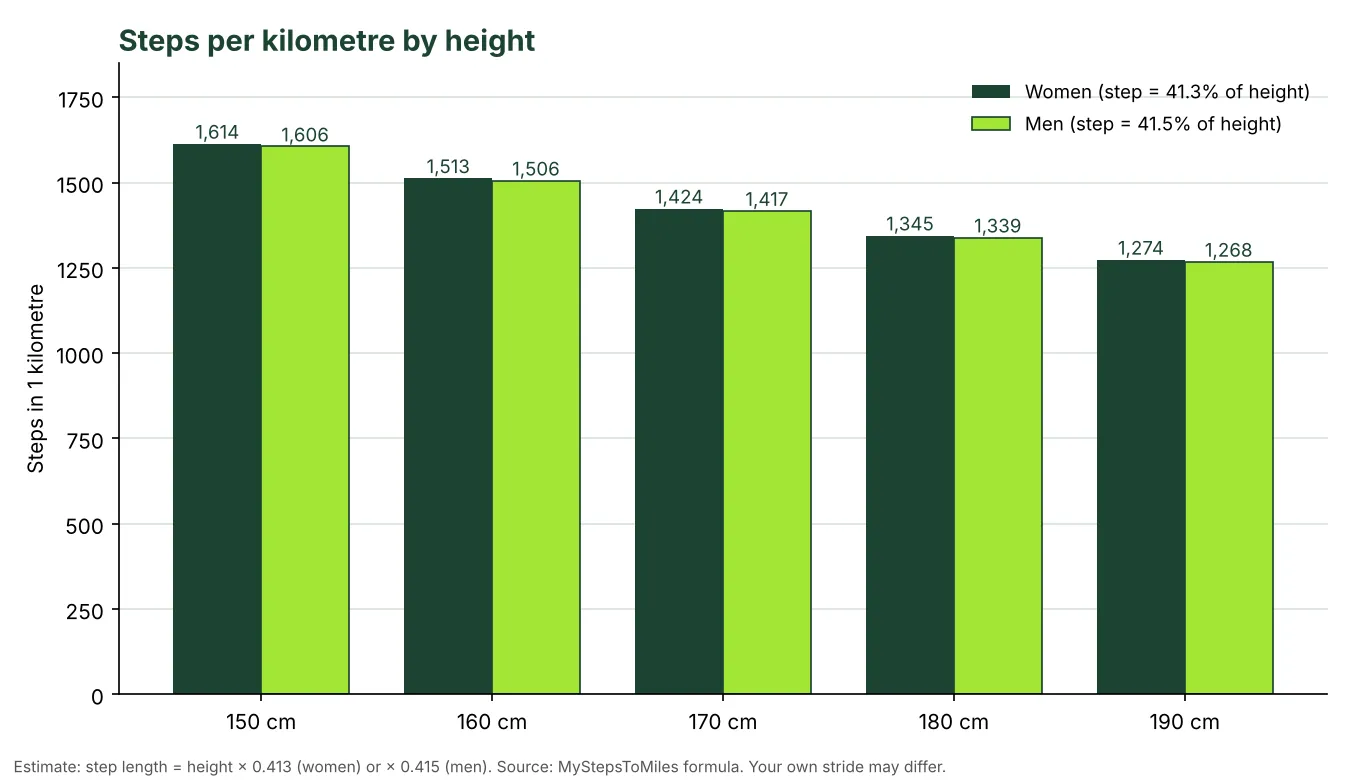
So a woman who is 160 cm tall takes about 1,513 steps per km, and her 10,000 steps come to about 6.6 km. A man who is 180 cm takes about 1,339 steps per km, so his 10,000 steps are about 7.5 km. Same step count, nearly a kilometre apart. That’s exactly why the calculator’s Better mode asks for your height.
2. Pace
When you speed up, your steps usually get longer. A slow amble around the shops covers less ground per step than a purposeful walk to catch a bus. Running stretches each step much further again, so a running kilometre takes far fewer steps than a walking one.
3. Treadmills, hills and busy pavements
Step length on a treadmill tends to be shorter than walking over ground, so a treadmill kilometre can take more steps. Uphill walking, crowded streets and stop-start town walks shorten your steps too. None of this means your tracker is wrong. It just means one “average” number can’t fit every walk.
Going the other way: km to steps
Sometimes you know the distance and want the steps. Maybe you’re planning a route, or you want to know whether a walk will hit your daily goal. Just reverse the formula: steps = kilometres × 1,000 ÷ step length in metres.
| Distance | Steps (76.2 cm step) | Time at 3 mph |
|---|---|---|
| 1 km | 1,312 | 12 min |
| 2 km | 2,625 | 25 min |
| 3 km | 3,937 | 37 min |
| 5 km | 6,562 | 1 h 2 min |
| 10 km | 13,123 | 2 h 4 min |
5 km is a popular distance for a reason. parkrun events are free, weekly, timed 5 km events, and walkers are welcome. At a brisk 3 mph you’d finish in a little over an hour, with around 6,560 steps in the bag before breakfast.
How long does a kilometre take to walk?

This is the other question km-thinkers ask, because time is easier to plan around than distance. It depends almost entirely on your pace:
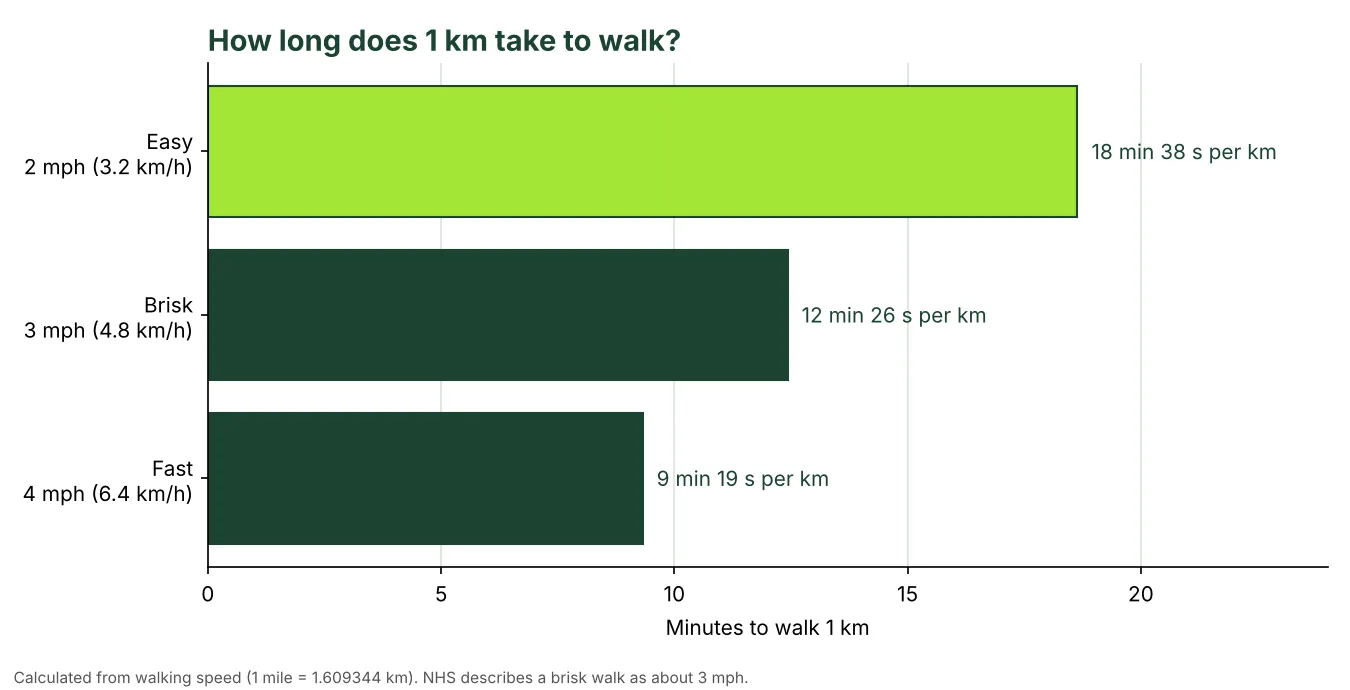
The NHS describes a brisk walk as about 3 miles an hour, which is roughly 4.8 km/h. A simple test: at a brisk pace you can still talk, but you couldn’t sing a song. The calculator lets you pick 2, 3 or 4 mph, so you can see the time for your usual pace rather than a one-size-fits-all guess.
Find your own steps per km in five minutes
Averages are handy. Your own number is better. Here’s how to measure it with nothing more than your phone:
- Find a distance you know. A standard running track is 400 m around the inside lane, or use a stretch you’ve measured on a map app.
- Note your phone’s step count, then walk the distance at your normal pace. Don’t stretch your legs to look impressive.
- Check your step count again and subtract to get the steps you took.
- Divide the distance in metres by your steps. That’s your step length. Example: 400 m in 530 steps = 0.755 m per step, or about 1,325 steps per km.
- Do it twice more and take the average, then enter it in the calculator’s Exact mode.
Once you know your step length, every number on the site is tailored to you.
Turning health targets into kilometres
Most health research counts steps, not kilometres. Translating them can make a goal feel more concrete.
A 2022 analysis in The Lancet Public Health pooled data from 47,471 adults across 15 studies. The lower risk of death linked to more steps levelled off at around 8,000–10,000 steps a day for adults under 60 (about 6.1–7.6 km at an average step) and 6,000–8,000 steps for adults 60 and over (about 4.6–6.1 km). One honest caveat: studies like this show a link, not proof that steps alone caused the benefit. Still, it’s a useful sign that you don’t need a marathon to do yourself good.
The World Health Organization suggests adults aim for 150–300 minutes of moderate activity a week. Thirty minutes of brisk walking, five days a week, gets you to 150. At 3 mph, 30 minutes is about 2.4 km, or roughly 3,170 steps. Very doable.
Whatever your target, it helps to see it add up. The My Walks log keeps a record of each walk, shows your streak, and marks your 30-day milestone, which is a nice nudge on the days motivation is low.
Frequently asked questions
How many steps are in 1 km?
About 1,312 steps for an average 76.2 cm step. Depending on height, most walkers fall somewhere between about 1,270 and 1,610 steps per kilometre.
How many km is 10,000 steps?
Roughly 7.6 km for an average step. A 160 cm woman covers about 6.6 km and a 180 cm man about 7.5 km. See the 10,000 steps to miles page for the full breakdown.
How many steps is 5 km?
Around 6,560 steps for an average walker. Taller walkers (around 190 cm) need closer to 6,300, while shorter walkers need more: about 7,550 at 160 cm and 8,050 at 150 cm.
How long does it take to walk 1 km?
About 12½ minutes at a brisk 3 mph. At a gentle 2 mph it’s nearer 19 minutes, and at a fast 4 mph a little over 9.
Do running steps convert to km the same way?
The formula is the same, but running steps are much longer, so each 1,000 steps covers more ground. Measure your running step separately and use it in Exact mode.
Ready to see your own number? Pop your steps into the free steps to miles calculator. No app, no sign-up. Choose Better mode with your height, or Exact mode with your own stride, and you’ll get kilometres, miles and walking time in seconds.
This article is general information, not medical advice. Talk to a doctor before a big change in how active you are.
Sources
- NHS, Walking for health: https://www.nhs.uk/live-well/exercise/walking-for-health/
- World Health Organization, physical activity guidance: https://www.who.int/europe/publications/i/item/9789240014886
- The Lancet Public Health (2022), daily steps and all-cause mortality, 15 cohorts: https://doaj.org/article/c3639c468b4348958202e52793ab979d
- Foundation for Public Health, The story behind parkrun: https://www.fph.org.uk/blog/the-story-behind-parkrun/