
Picture two friends doing a 1.5-mile loop of the park together. Same path, same pace, same chat the whole way round. At the end, she checks her phone: about 3,700 steps. He checks his: about 3,100. Nobody’s tracker is broken. She is 158 cm tall, he is 188 cm, and his steps are simply longer than hers.
The quick answer: your height sets roughly how long each step is, so it changes how far your steps take you. A popular rule of thumb puts step length at about 41.3% of height for women and 41.5% for men. That means a 160 cm woman needs roughly 2,435 steps to walk a mile, while a 185 cm man needs about 2,096. Over 10,000 steps, that is the difference between about 4.1 miles and 4.8 miles.
Below you’ll find how to work out steps to miles by height: the formula, a steps-per-mile table for heights from 150 cm to 195 cm, an honest look at how accurate the height rule is, and a five-minute way to measure your own stride so your numbers are actually yours.
Why height changes your steps per mile
Longer legs swing through a bigger arc, so each step lands further ahead. Taller people therefore cover more ground per step and need fewer steps to finish the same distance. It is the same reason a child trots to keep up with an adult who is barely trying.
A quick note on words, because they get mixed up a lot. A step is the distance from one foot landing to the other foot landing. A stride is two steps, from one foot landing to that same foot landing again (Healthline). Step counters count steps, so step length is the number that matters for converting steps to miles.
Height is not the only thing that changes your step length. Walking speed, age, terrain, footwear, injuries and even a treadmill all play a part. Height is just the easiest one to plug into a calculator, which is why it is such a popular starting point.
The height formula, step by step
Here is how the “Better” mode of the MyStepsToMiles calculator turns your height into a distance. You can do it on paper too:
- Find your height in centimetres. (Feet and inches? Multiply inches by 2.54. For example, 5 ft 5 in is 65 inches, or about 165 cm.)
- Work out your step length. Multiply your height by 0.413 if you are a woman or 0.415 if you are a man.
- Turn steps into metres. Multiply your step count by your step length in metres.
- Turn metres into miles. Divide by 1,609.344 (the number of metres in a mile). Or divide by 1,000 for kilometres.
Worked example: a 165 cm woman who walked 8,000 steps
- Step length: 165 × 0.413 = 68.1 cm (0.681 m)
- Distance: 8,000 × 0.681 = about 5,452 metres
- In miles: 5,452 ÷ 1,609.344 = about 3.39 miles (5.45 km)
Using the general average step of 76.2 cm instead, those same 8,000 steps would come out at about 3.79 miles, roughly 0.4 miles more than she probably walked. That gap is exactly why height matters.
Steps per mile by height: the table
Find your height in the left-hand column. The figures are estimates from the height rule, rounded to the nearest whole step or hundredth of a mile.
| Height | Step length (women / men) | Steps per mile (women / men) | 10,000 steps = (women / men) |
|---|---|---|---|
| 150 cm (4 ft 11 in) | 61.9 / 62.3 cm | 2,598 / 2,585 | 3.85 / 3.87 miles |
| 155 cm (5 ft 1 in) | 64.0 / 64.3 cm | 2,514 / 2,502 | 3.98 / 4.00 miles |
| 160 cm (5 ft 3 in) | 66.1 / 66.4 cm | 2,435 / 2,424 | 4.11 / 4.13 miles |
| 165 cm (5 ft 5 in) | 68.1 / 68.5 cm | 2,362 / 2,350 | 4.23 / 4.25 miles |
| 170 cm (5 ft 7 in) | 70.2 / 70.5 cm | 2,292 / 2,281 | 4.36 / 4.38 miles |
| 175 cm (5 ft 9 in) | 72.3 / 72.6 cm | 2,227 / 2,216 | 4.49 / 4.51 miles |
| 180 cm (5 ft 11 in) | 74.3 / 74.7 cm | 2,165 / 2,154 | 4.62 / 4.64 miles |
| 185 cm (6 ft 1 in) | 76.4 / 76.8 cm | 2,106 / 2,096 | 4.75 / 4.77 miles |
| 190 cm (6 ft 3 in) | 78.5 / 78.8 cm | 2,051 / 2,041 | 4.88 / 4.90 miles |
| 195 cm (6 ft 5 in) | 80.5 / 80.9 cm | 1,998 / 1,989 | 5.00 / 5.03 miles |
Estimates using step length = height × 0.413 (women) or × 0.415 (men); 1 mile = 1,609.344 m.
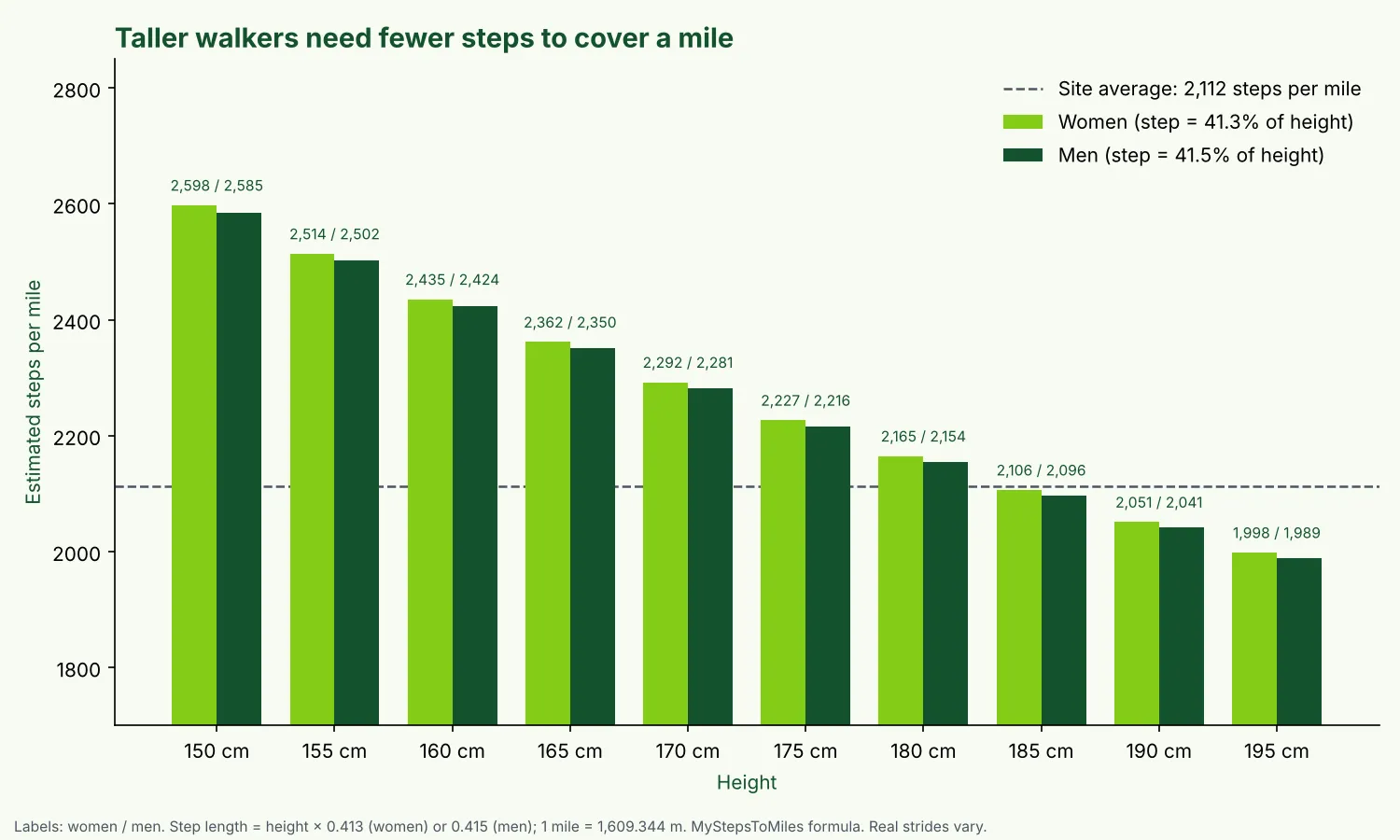
Two things jump out. First, the spread is big: someone 150 cm tall needs about 600 more steps per mile than someone 195 cm tall. Second, the difference between women and men of the same height is tiny, around 11 steps per mile at 170 cm. Women tend to take more steps per mile mainly because, on average, they are shorter, not because they walk differently.
Why the “average” 2,112 steps per mile suits taller walkers
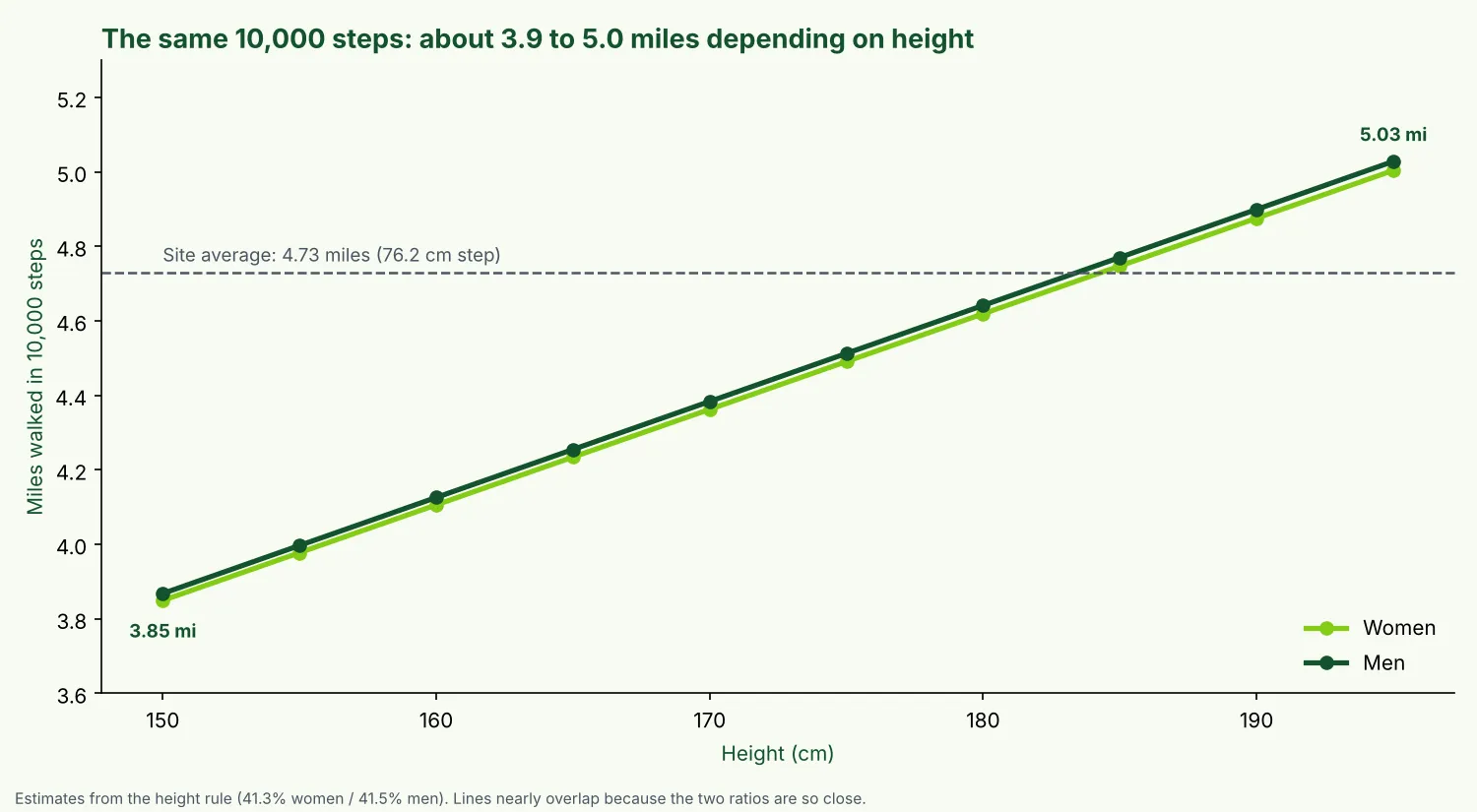
You will often see “about 2,000 steps per mile” or, on this site, “about 2,112 steps per mile”. That figure comes from an average step of 76.2 cm (2.5 ft), which is a sensible general number. But run it backwards through the height rule and a 76.2 cm step belongs to someone around 184 cm tall, about 6 ft ½ in.
So if you are shorter than that, the quick average will tend to flatter you. For a 160 cm woman, 10,000 steps works out at about 4.11 miles with the height rule, compared with 4.73 miles using the average step. That is roughly 15% more distance than she likely covered. If you are tracking a goal like a weekly mileage target, it adds up quickly.
Curious what the general average gives for your daily total? See our 10,000 steps to miles page, then compare it with your height-based number from the table above.
How accurate is the height rule? An honest look
The height rule is a good starting point, but it is an estimate, not a measurement. Here is what the research says:
- It points in the right direction. A Scientific American science activity based on real measurements puts the ratio of step length to height at roughly 0.41 to 0.45 (Scientific American).
- It can miss for individuals. In a study of 130 healthy young adults, a height-based estimate (42% of height) predicted an average step of 0.71 m, but the measured average was 0.78 m. The two were only moderately linked, and the authors advised using height-based estimates with caution (Barreira, Rowe & Kang, 2010).
- Speed changes your step. In a study of 261 adults aged 75 and over, step length relative to height was closely tied to how fast people could walk (Morio et al., 2019). Brisk walking usually means longer steps; a slow stroll means shorter ones.
- Height also changes your rhythm. One research abstract found that a moderate-intensity walk averaged about 114 steps per minute for 152 cm walkers but about 96 steps per minute for 183 cm walkers (ACSM conference abstract, 2007). Shorter people take more, quicker steps to keep the same effort.
The fair summary: height gets most people closer than a one-size-fits-all average, but your own measured step beats both. And if your evidence is mixed (say your distance looks off on hilly routes), that is normal. Terrain, tiredness and treadmills all shorten steps a little.
Measure your own stride in five minutes
If you want numbers you can trust, this is the single most useful thing you can do. You only need somewhere with a known distance.
- Pick a known distance. A 400 m running track (inside lane) is ideal. A measured 20 m stretch in a park or hallway works too.
- Get up to speed first. Start walking a few metres before the start line so you are at your normal pace when you cross it.
- Count every step until you cross the finish line.
- Divide the distance by your steps. For example, 400 m ÷ 570 steps = 0.70 m per step.
- Repeat two or three times and take the average. Longer distances give steadier results (Healthline).
Now pop that number into the Exact (“your own stride”) mode of the MyStepsToMiles calculator. If you walk at very different speeds (gentle dog walks and brisk commutes, say), it is worth measuring at both paces.

Which calculator mode should you use?
- Quick uses the average 76.2 cm step. Fine for a ballpark figure, especially if you are around 180–185 cm.
- Better uses your height. The best choice for most people who haven’t measured their stride.
- Exact uses your own measured stride. The most accurate option, and worth the five minutes above.
Putting it to work: plan by distance, not just steps
Here is a nice twist. If two people walk at the same pace, they finish a mile in the same time, whatever their height. Only the step count changes.

Say a 155 cm woman and a 190 cm man both want to walk 3 miles at 3 mph. They will both be out for about an hour. But she will clock roughly 7,540 steps and he will clock roughly 6,120. If she had set herself a step goal based on his numbers, she would be finishing her walk well short of 3 miles, or he would be walking further than he thinks.
The calculator lets you pick a walking pace of 2, 3 or 4 mph to see how long your distance will take. Once you have walked it, log it in My Walks to build your streak and work towards the 30-day milestone. Over a month, knowing your real distance makes your progress feel a lot more real too.
Want to see what popular step goals mean in distance? Try the 5,000 steps to miles page, the 8,000 steps to miles page or the 12,000 steps to miles page, then adjust using the table above.

Frequently asked questions
How many steps are in a mile for my height?
Roughly 2,600 steps at 150 cm, 2,300 at 170 cm and 2,000 at 195 cm, using the height rule. Check the table above for your exact height, or measure your own step for a personal figure.
Is stride length the same as step length?
No. A step is one foot to the other; a stride is two steps, back to the same foot. People often use the words interchangeably, but a stride is about twice as long as a step.
Do women take more steps per mile than men?
On average, yes, mainly because women are shorter on average. At the same height, the difference is tiny: around 11 steps per mile at 170 cm.
Does my height affect treadmill steps?
Your height still matters on a treadmill, but most people take slightly shorter steps on a treadmill than outdoors. If you mostly walk indoors, measure your step on the treadmill itself.
How can I find my step length without a tape measure?
Use something already measured: a 400 m running track, a sports pitch with known dimensions, or a route you have measured on a map app. Count your steps and divide the distance by that number.
Try it with your own height
Your height is one of the easiest ways to make your step count mean something real. Pop your steps and height into the MyStepsToMiles calculator (Better mode), or measure your stride and use Exact mode for your truest number. It’s free, there’s no app and no sign-up: just your steps, turned into miles that are actually yours.
This article is general information, not medical advice. Talk to a doctor before a big change in how active you are.
Sources
- Healthline, Stride length: https://www.healthline.com/health/stride-length
- Scientific American, Bring Science Home: estimating height from a walk: https://www.scientificamerican.com/article/bring-science-home-estimating-height-walk/
- Barreira TV, Rowe DA, Kang M (2010), International Journal of Exercise Science: https://intjexersci.com/files/ijes/vol3/iss1/2.pdf
- Morio et al. (2019), Diseases (MDPI): https://www.mdpi.com/2079-9721/7/1/17
- Influence of height and stride length on estimation of walking intensity from stepping rate (ACSM conference abstract, 2007): https://www.researchgate.net/publication/280568691_Influence_of_Height_and_Stride_Length_on_Estimation_of_Walking_Intensity_from_Stepping_Rate