
You know the feeling. Your head is full, your shoulders are up near your ears, and the same worry keeps looping round and round. Then you step outside, walk for ten minutes, and something loosens.
That isn’t just in your head, or rather, it is, in a good way. Walking is one of the simplest, best-supported ways to ease stress and lift a low mood. The NHS says even a brisk 10-minute walk can help clear your mind and help you relax. Over weeks and months, regular walking is linked to a lower risk of depression: a 2024 review of 33 studies found that every extra 1,000 steps a day was linked to about 9% lower risk.
Walking isn’t a cure-all, and it doesn’t replace proper care if you’re struggling. But it’s free, it needs no gym, and you can start today. Below, you’ll find the real mental health benefits of walking, how much walking seems to help, and what that looks like in steps and miles.
In short
- A brisk 10-minute walk can help you feel calmer straight away.
- For longer-term benefits, build towards 150 minutes a week (about 15,840 steps, or 7.5 miles, at an average stride).
- About 7,000+ steps a day is linked to a lower risk of depression, which is roughly 3.3 miles.
- Green spaces may add an extra calming effect, but any walk counts.
- Walking supports your mental health; it doesn’t replace seeing a doctor.
Why walking calms a busy mind
Scientists don’t think there’s one single reason. It’s more like several small things working together.
- Feel-good brain chemicals. Mayo Clinic explains that physical activity may boost endorphins, the brain’s “feel-good” messengers, which can lift your mood.
- “Meditation in motion”. When you focus on your steps and your breathing, there’s less room for the worry spiral. Mayo Clinic calls this kind of focus a way to “stay calm” and think more clearly.
- Better sleep. Stress and poor sleep feed each other. Regular activity can improve sleep, which then makes stress easier to handle.
- A break from rumination. Rumination means chewing over the same negative thoughts again and again. In a well-known Stanford study published in PNAS (summary here), people who took a 90-minute walk in a green, natural area reported less rumination afterwards, and brain scans showed calmer activity in an area linked to negative mood. People who walked the same time beside a busy road did not show that change.
There’s also a simple, practical benefit: a walk physically takes you away from the desk, the inbox or the room where the stress lives. Sometimes a change of scene is half the medicine.
What the research actually says (and what it doesn’t)
Let’s be honest about the evidence, because you deserve the real picture rather than hype.
Walking is linked to a lower risk of depression
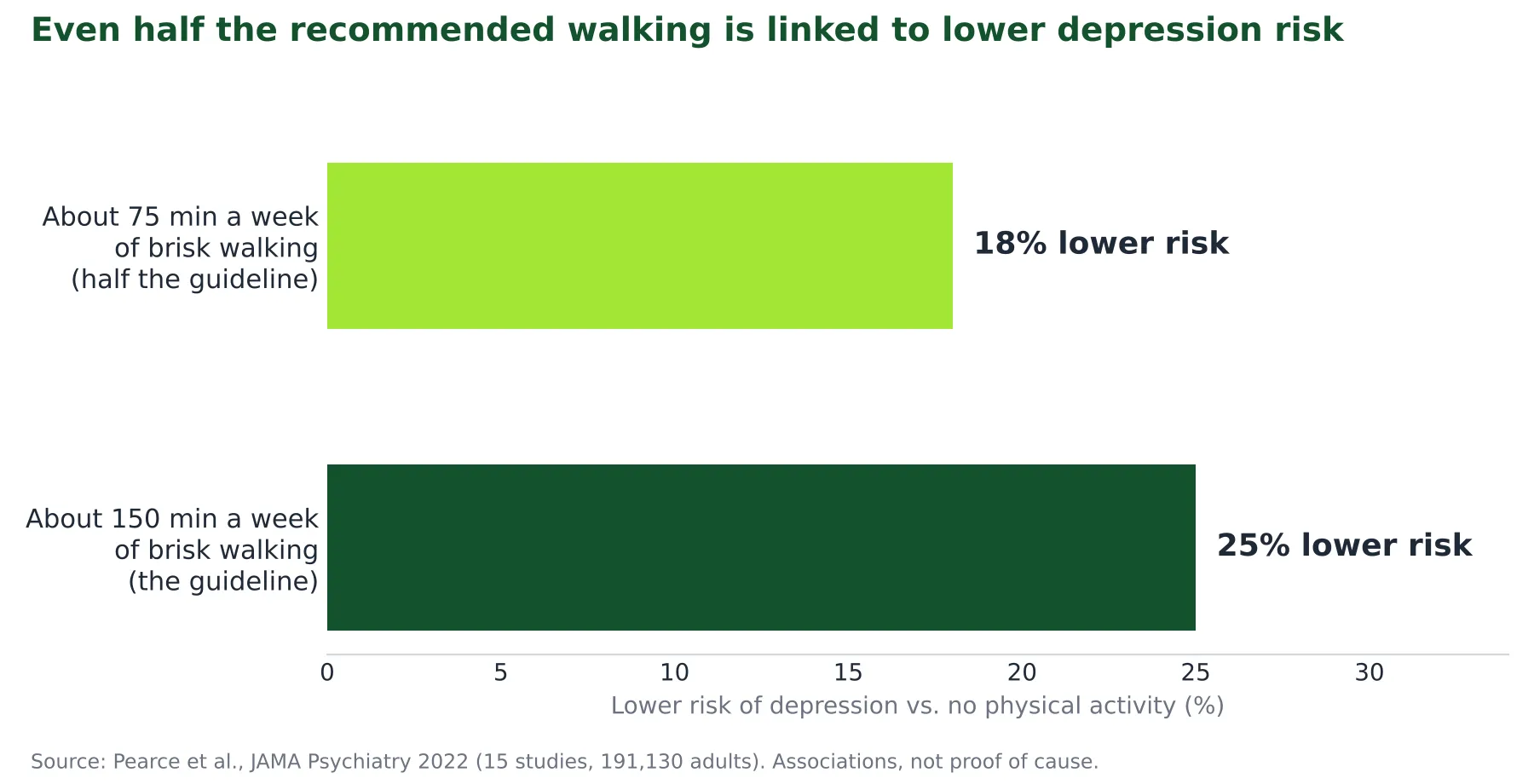
A large 2022 review in JAMA Psychiatry pooled 15 studies with over 191,000 adults. People who did activity equal to about 2.5 hours of brisk walking a week had a 25% lower risk of depression than inactive people. Even half that amount was linked to an 18% lower risk.
The step-count research points the same way. A 2024 JAMA Network Open review of 33 studies and more than 96,000 adults found that people walking 7,000 or more steps a day had a 31% lower risk of depression than those walking fewer, and each extra 1,000 steps was linked to around 9% lower risk.
Walking can help people who are already low
A big 2024 analysis in The BMJ looked at 218 trials of exercise for depression. Walking or jogging was among the most effective types of exercise for easing symptoms, alongside yoga and strength training. More vigorous effort tended to help more.
The honest caveats
- Most step studies show a link, not proof that walking causes the change. People who already feel better may simply walk more.
- The BMJ authors rated their confidence in the evidence as low to very low, mainly because many trials were small and people knew they were exercising.
- Walking is a helpful support, not a replacement for therapy, medication or talking to your doctor.
Even with those caveats, the overall message is consistent across many studies: moving more is good for your mind, and walking is the easiest place to start.
How much walking helps? The research in steps and miles
Research talks in minutes and hours. Your phone talks in steps. Here’s how the two connect, using the same averages as the MyStepsToMiles calculator: an average step of 76.2 cm (2.5 ft), so about 2,112 steps per mile, walking at 3 mph.
| Walk goal | Time at 3 mph | Approx. steps | Distance |
|---|---|---|---|
| Quick reset walk | 10 min | 1,056 | 0.5 mi (0.8 km) |
| Daily mood walk | 20 min | 2,112 | 1 mi (1.6 km) |
| 30 minutes, 5 days a week | 30 min a day | 3,168 a day | 1.5 mi (2.4 km) a day |
| “Half the guideline” (weekly) | 75 min a week | 7,920 a week | 3.75 mi (6.0 km) a week |
| Full guideline (weekly) | 150 min a week | 15,840 a week | 7.5 mi (12.1 km) a week |
| 7,000 steps in a day | about 66 min | 7,000 | 3.3 mi (5.3 km) |
| Long nature walk | 90 min | 9,504 | 4.5 mi (7.2 km) |
Figures use the MyStepsToMiles averages (76.2 cm step, 2,112 steps per mile, 3 mph). Your own numbers depend on your stride.
A few things jump out. The “half the guideline” amount that was linked to an 18% lower depression risk is only about 75 minutes a week, which is two 20-minute walks plus a 35-minute weekend stroll. And the full 150-minute guideline is roughly 15,840 steps across the whole week, or about 7.5 miles. That’s much less daunting than it sounds.
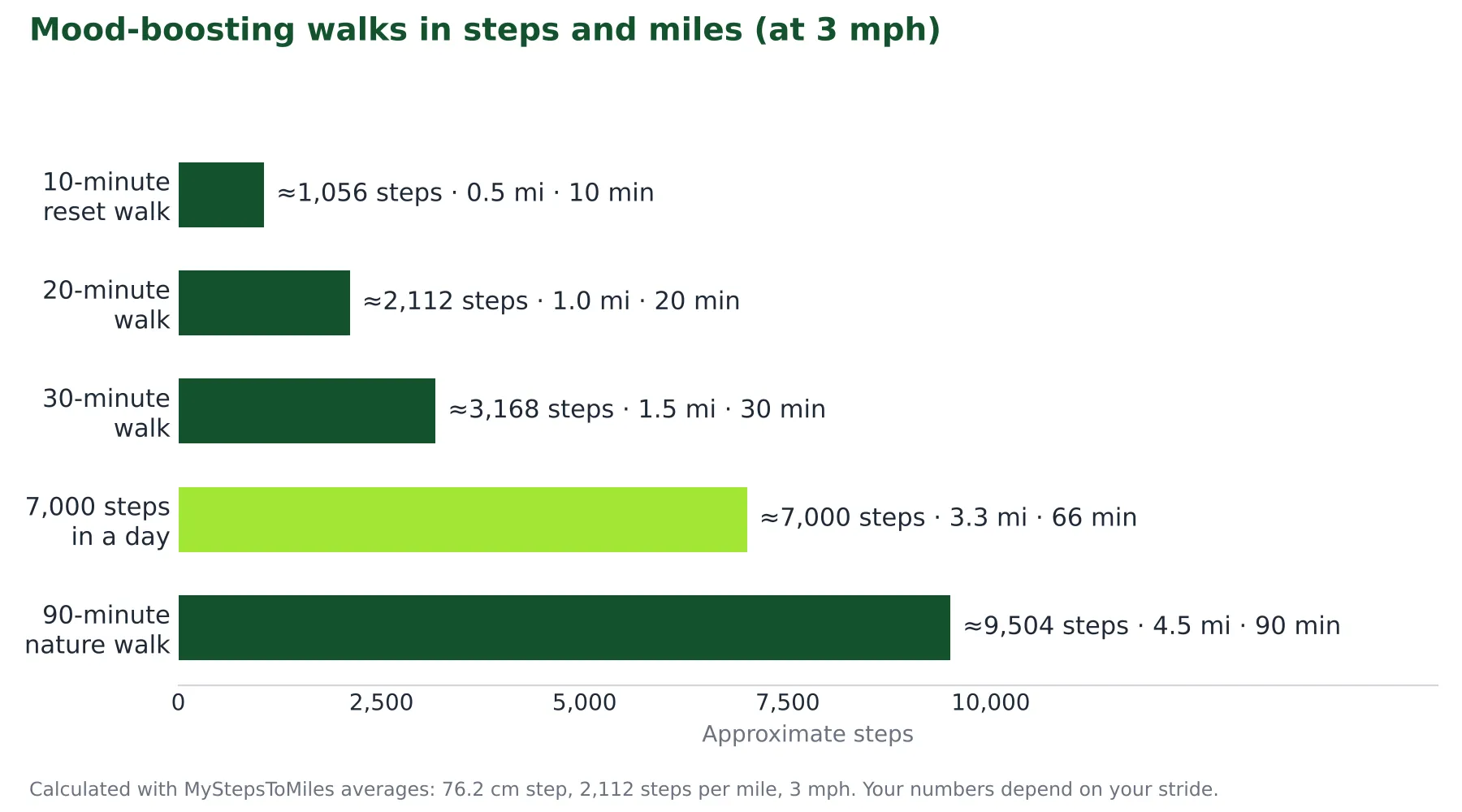
Your own numbers will differ, because step length depends on your height and stride. If you’d like a closer figure, use the Better mode on the MyStepsToMiles calculator, which uses your height, or the Exact mode if you’ve measured your own stride. You can also pick a walking pace of 2, 3 or 4 mph to see how long a walk will take.
Curious how your usual day adds up? See the 5,000 steps to miles page, the 8,000 steps to miles page or the 10,000 steps to miles page.
A 20-minute stress-relief walk you can do today
You don’t need a plan, kit or a special route. Walking for stress relief works best when it’s simple. Try this next time stress starts to build.
- Pick your moment. Choose the time your stress usually peaks: after a tough meeting, before the school run, or when you finish work.
- Silence the pings. Put your phone on “do not disturb”. You can keep it for safety and to count your steps; you just don’t need to read it.
- Start easy for 2–3 minutes. Let your body warm up and your breathing settle.
- Pick up the pace. Walk briskly enough that you can talk but not sing. That’s how the CDC describes moderate effort.
- Use your senses. Notice five things you can see, a few things you can hear, and how your feet feel on the ground. This keeps your attention in the present instead of in your worries.
- Find some green if you can. A park, a tree-lined street or a canal path. The Stanford study suggests natural surroundings may add an extra calming effect.
- Slow down for the last few minutes, then log the walk.
At 3 mph, those 20 minutes come to roughly 2,112 steps, one mile. Do it on most days and you’re well on your way to the weekly guideline.

How to keep walking when you’re stressed or low
Here’s the catch: the times you most need a walk are often the times you least feel like taking one. These ideas make it easier.

- Shrink the goal. On a hard day, aim for “out of the door and to the end of the road”. Most days, you’ll keep going once you’ve started.
- Walk with someone. A friend, a neighbour or a walking group adds company and a gentle reason to show up.
- Track it kindly. The My Walks log on MyStepsToMiles keeps a simple record of your walks, with streaks and a 30-day milestone. Seeing your progress can be quietly motivating, but a missed day isn’t a failure, just a pause.
- Have a bad-weather plan. Walk round a shopping centre, up and down the stairs at home, or on a treadmill.
- Notice how you feel after. Rate your mood out of 10 before and after a few walks. Your own results are often the most convincing evidence of all.
When walking isn’t enough
Walking is a great tool, but it’s one tool. If you’ve felt low, anxious or unable to cope for more than a couple of weeks, please talk to your GP or doctor. The NHS notes that doctors can recommend proven treatments, including talking therapies, medicines and supervised group exercise. If you ever feel unsafe or in crisis, contact your local emergency services or a crisis helpline straight away.
Frequently asked questions
Does walking help with anxiety?
It can. The WHO says regular physical activity reduces symptoms of depression and anxiety. Many people find a brisk walk eases the physical tension of anxiety, though it works best alongside other support if anxiety is severe.
How long should I walk for my mental health?
Even 10 minutes can help you feel calmer in the moment. For longer-term benefits, aim to build towards 150 minutes of moderate activity a week, for example 30 minutes on five days. Research suggests even half that is better than nothing.
How many steps a day are good for mental health?
Studies link about 7,000 steps a day or more with a lower risk of depression. That’s around 3.3 miles (5.3 km) for an average stride. If you’re on 3,000 steps now, adding 1,000 a day is a sensible first goal.
Is walking in nature better than walking in town?
Some studies suggest green spaces add an extra calming effect, but any walk counts. If a park isn’t nearby, a quieter side street is still a good choice.
Can walking replace therapy or medication?
No. Walking can support your mental health and may ease mild symptoms, but it’s not a substitute for treatment. Talk to your doctor before stopping or changing any treatment.
Take your first step today
You don’t need to fix everything at once. Just put on your shoes and walk for ten minutes. Then pop your steps into the MyStepsToMiles calculator to see how far you went, and add it to My Walks to start your streak. Tomorrow, do it again.
This article is general information, not medical advice. Talk to a doctor before a big change in how active you are.
Sources
- NHS, Exercise for depression: https://www.nhs.uk/mental-health/self-help/guides-tools-and-activities/exercise-for-depression
- Mayo Clinic, Exercise and stress: https://www.mayoclinic.org/healthy-lifestyle/stress-management/in-depth/exercise-and-stress/art-20044469
- Pearce et al. (2022), physical activity and depression, JAMA Psychiatry: https://hospitalhealthcare.com/specialisms/depression-risk-greatly-reduced-even-by-low-levels-of-physical-activity/
- JAMA Network Open (2024), steps per day and depression: https://jamanetwork.com/journals/jamanetworkopen/fullarticle/2828073
- BMJ (2024), exercise for depression: https://www.bmj.com/content/384/bmj-2023-075847
- Stanford Daily, summary of the Stanford nature-walk study (PNAS, 2015): https://stanforddaily.com/2015/07/26/researchers-find-walking-in-nature-provides-mental-health-benefits/
- CDC, Measuring physical activity intensity: https://www.cdc.gov/physical-activity-basics/measuring/index.html
- WHO, Physical activity fact sheet: https://www.who.int/news-room/fact-sheets/detail/physical-activity