
Here’s the short answer: for most people, the better exercise is the one you’ll keep doing. Running gets you more benefit per minute. Walking gets you very similar benefits per unit of energy you burn, with a much lower chance of getting hurt. If you have plenty of time, walking can match running. If you’re short on time, running squeezes more into less.
That probably sounds like a cop-out, so let’s put real numbers on it. By the end of this article you’ll know what the research says, how the calories compare, which suits your body and your week, and how to mix the two.
What the big studies say about health
The most useful study on this question compared about 33,000 runners with nearly 16,000 walkers over roughly six years. Researchers Paul Williams and Paul Thompson didn’t compare people by time spent exercising. They compared them by energy used. That’s a fairer test, because a 30-minute run uses far more energy than a 30-minute stroll.
When the energy matched, the results were close. For each extra unit of energy used per day, running lowered the risk of high blood pressure by 4.2% and walking by 7.2%. For high cholesterol it was 4.3% vs 7.0%, for diabetes 12.1% vs 12.3%, and for heart disease 4.5% vs 9.3% (HealthDay summary of the study, published in Arteriosclerosis, Thrombosis and Vascular Biology).
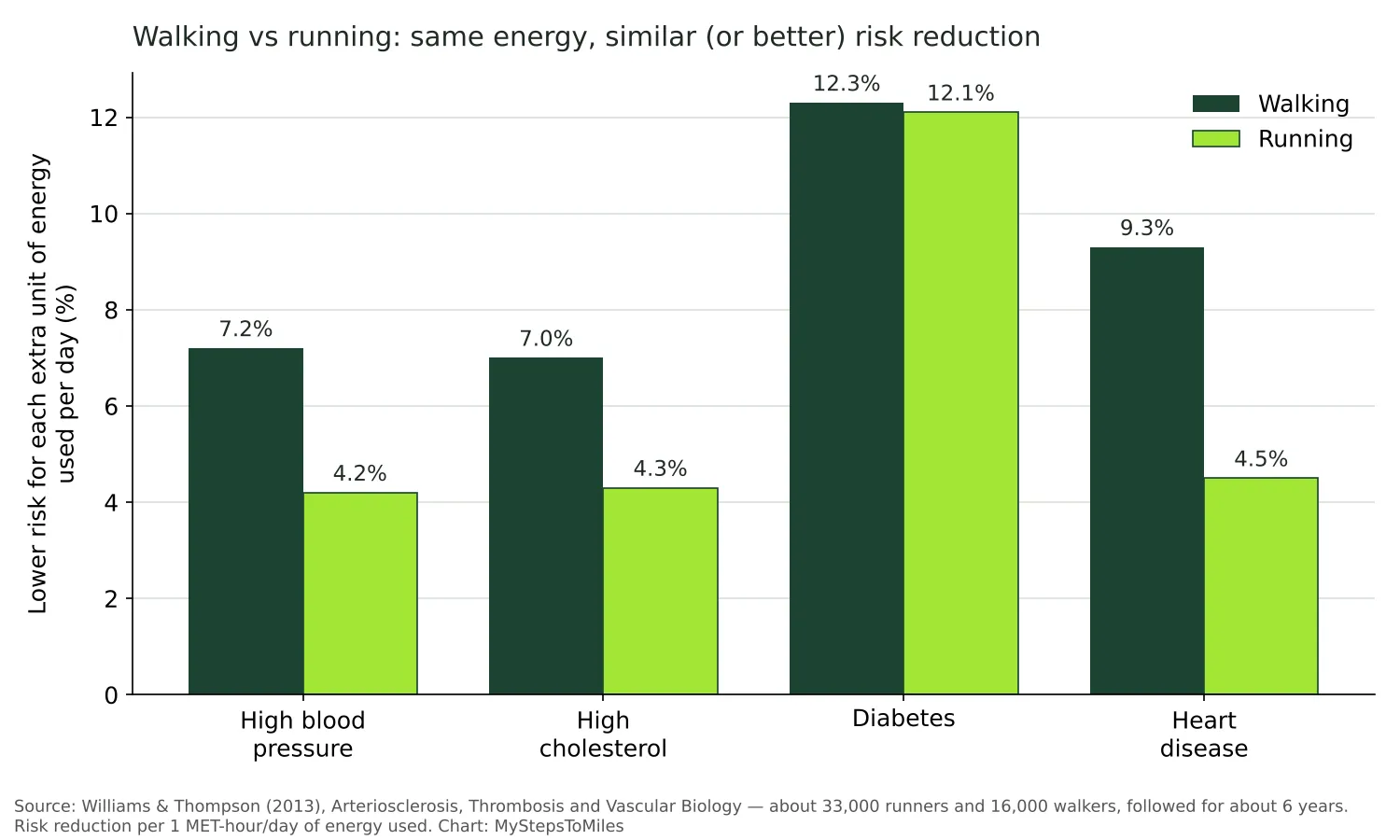
So is walking actually better? Not quite. This was an observational study, so it shows links, not proof, and the people choosing to walk or run may differ in other ways. The fair takeaway is this: burn the same energy and walking holds its own. The catch is that walking needs roughly twice the time to burn that energy.
Running has strong evidence of its own. A study of 55,137 adults followed for about 15 years found that runners had a 30% lower risk of dying from any cause and a 45% lower risk of dying from heart disease than non-runners. Even people who ran under 51 minutes a week, about 5–10 minutes a day, saw the benefit (American College of Cardiology summary of Lee et al., 2014).
The official guidelines treat both as good options. The World Health Organization recommends adults do 150–300 minutes of moderate activity a week, like brisk walking, or 75–150 minutes of vigorous activity, like running, or a mix of the two. Put simply, a minute of running counts for about two minutes of brisk walking. The WHO also says plainly that doing some activity is better than doing none.
Calories: the per-minute vs per-mile trap
This is where most people get confused, so let’s run the numbers.
Scientists measure effort in METs. One MET is what your body uses sitting still. The 2024 Adult Compendium of Physical Activities lists walking at 3 mph at 3.8 METs, a brisk 4 mph walk at 5.5 METs, and running at 6 mph at 9.3 METs. Multiply METs by your weight in kilograms and by hours and you get a rough calorie estimate.
For a 70 kg adult, that works out like this:
- 30 minutes walking at 3 mph: about 133 calories (1.5 miles)
- 30 minutes brisk walking at 4 mph: about 192 calories (2 miles)
- 30 minutes running at 6 mph: about 326 calories (3 miles)
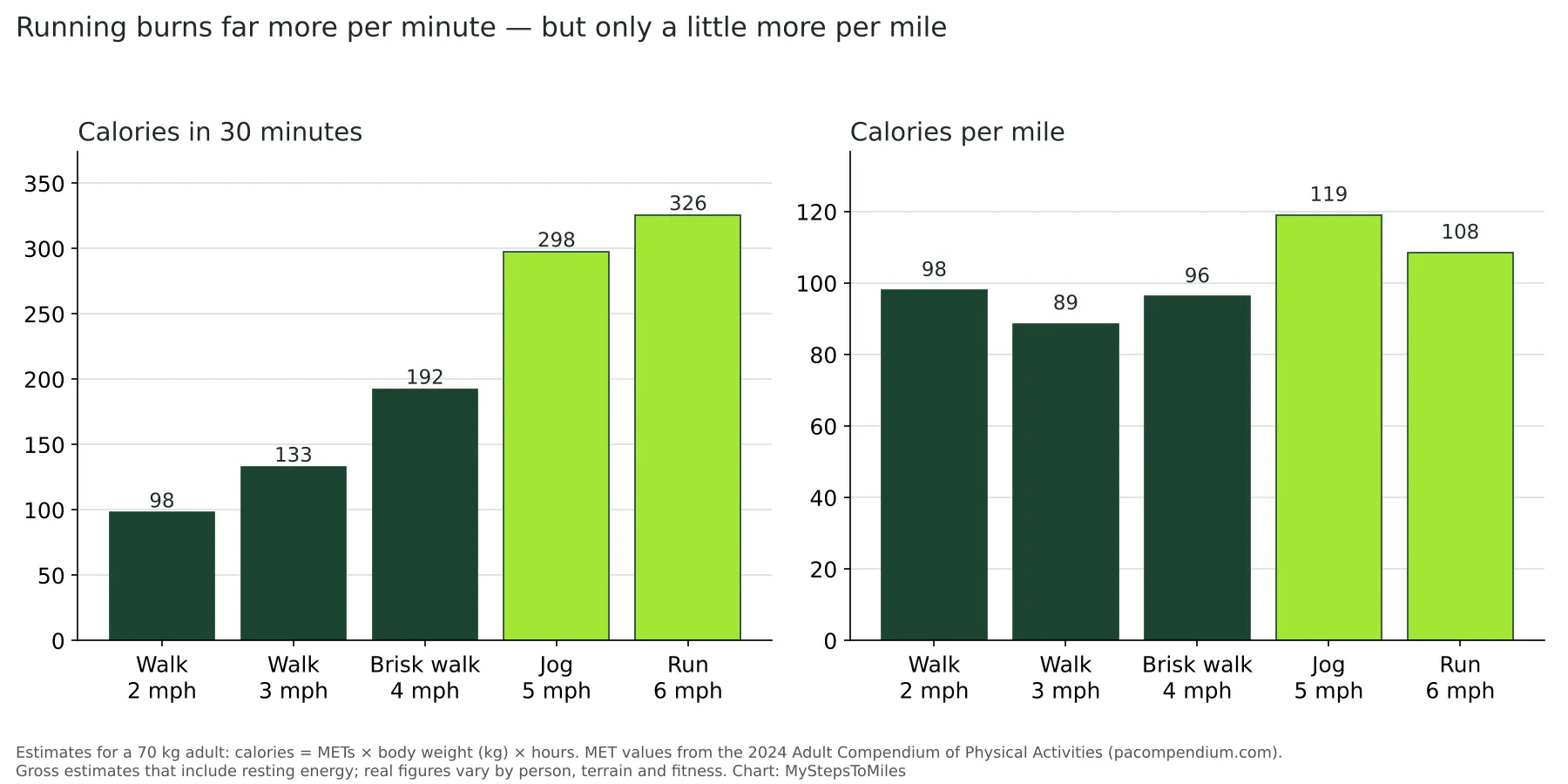
Per minute, running burns roughly two and a half times as much as an easy walk. But look at the right side of the chart. Per mile, the gap shrinks a lot: about 89 calories walking at 3 mph against about 108 running at 6 mph. A mile is a mile, and your legs have to carry you the whole way either way. Running just gets it done faster.
These are estimates. Your real number depends on your weight, fitness, hills and how efficiently you move. But the pattern holds: if you care about calories and you’re short on time, run. If you have time, walk further.
Curious how far your usual walk really is? Pop your step count into the MyStepsToMiles calculator and pick 2, 3 or 4 mph to see the distance and time.
Injury risk: walking’s biggest advantage
Running is a high-impact activity. Each stride lands with much more force than a walking step, and that adds up.
A large review pooled results from many running studies. It found that new runners had about 17.8 injuries for every 1,000 hours of running, compared with 7.7 for regular recreational runners (Videbæk et al., Sports Medicine, 2015). Beginners are hurt more than twice as often, mostly because they do too much too soon.
Walking has nothing like that reputation. It’s gentle on the joints, easy to start at any age, and you can do it in everyday shoes. That’s why it’s often the first exercise doctors suggest for people returning to activity.
None of this means running is dangerous. It means running needs a slower build-up. If you want to start, a run-walk plan that slowly adds running minutes week by week, such as the free NHS Couch to 5K app, is a sensible way in.
Time: how far you get in the same 30 minutes
Time is often the deciding factor, so here’s what different speeds give you in half an hour. These use the site’s average step of 76.2 cm (about 2,112 steps per mile):
- Easy walk, 2 mph: 1 mile, about 2,112 steps
- Steady walk, 3 mph: 1.5 miles (2.4 km), about 3,168 steps
- Brisk walk, 4 mph: 2 miles, about 4,224 steps
- Run, 6 mph: 3 miles, but fewer steps than you’d expect, because your stride gets longer when you run
That last point surprises people. Running takes fewer steps per mile than walking, so a step counter can undersell a run. (We’ll dig into exactly why in a later article on walking a mile vs running a mile.)
Now think about a 10,000-step day. That’s about 4.73 miles (7.62 km). At 3 mph it takes around 1 hour 35 minutes of walking. At a brisk 4 mph it’s about 71 minutes. Running the same 4.73 miles at 6 mph takes about 47 minutes. You can see the full breakdown on our 10,000 steps to miles page.
Which one should you choose?

Choose walking if:
- you’re new to exercise, older, or coming back after a long break
- you have joint pain, are carrying extra weight, or have had injuries
- you’d like to exercise while chatting with a friend, walking the dog or getting to work
- you have time for longer sessions and want the lowest injury risk
Choose running if:
- you’re short on time and want more benefit per minute
- you enjoy a challenge, a race goal, or that post-run buzz
- your joints are healthy and you’re willing to build up slowly
And the honest answer for many people is both. You don’t have to pick a team.
How to get the best of both
Here are a few simple ways to combine walking and running.
Speed up your walks. A brisk walk at 4 mph counts as moderate activity, and it’s a big step up from a stroll. Try walking at a pace where you can talk but not sing.
Try walk-run intervals. Walk 4 minutes, jog 1 minute, and repeat. Over a few weeks, slowly shift the balance towards jogging. This is how most beginners’ running plans work.
Walk on easy days, run on hard days. Lots of runners walk on their rest days. It keeps you moving without adding much strain.
Add hills. Walking uphill raises the effort a lot without the pounding of running.
Keep track. Seeing your progress helps. The My Walks log on MyStepsToMiles records your walks, builds a streak, and celebrates a 30-day milestone. It’s a nice nudge on the days you’d rather stay on the sofa.

Get your distance right
Whichever you pick, it helps to know how far you actually go. Most step counters assume an average stride, which can be well off for very tall or short people.
The MyStepsToMiles calculator has three modes. Quick uses the average step. Better uses your height (step length is about 41.3% of height for women and 41.5% for men). Exact uses your own measured stride. For running, use Exact and measure your running stride, because it’s longer than your walking stride.
If you walk 5,000 steps a day now, our 5,000 steps to miles page shows what that’s worth. If you’re aiming higher, see the 12,000 steps to miles or 15,000 steps to miles pages.

Frequently asked questions
Is walking as good as running for weight loss?
It can be, if you walk enough. Per mile, the calorie difference is fairly small. Per minute, running burns much more. So walking works well for weight loss if you have the time to walk further. Diet still matters most for losing weight.
Is it better to walk fast or run slowly?
Both count. A brisk 4 mph walk is moderate exercise, while even a slow jog is usually vigorous. If running hurts your joints, fast walking is an excellent choice. If you feel fine, a slow jog gives more benefit per minute.
How many minutes of walking equals a 30-minute run?
Under the WHO guidelines, one minute of vigorous activity counts for about two minutes of moderate activity. So a 30-minute run is roughly the same as 60 minutes of brisk walking.
Do you take more steps walking or running a mile?
Walking. Your stride is longer when you run, so you cover each mile in fewer steps. A walking mile is about 2,112 steps with an average stride.
Is walking every day enough exercise?
For many people, yes. About 30 minutes of brisk walking on five days a week meets the WHO’s 150-minute minimum. Adding some muscle-strengthening activity on two days a week, which the WHO also recommends, rounds it out.
Ready to see your numbers?
Walking or running, it all starts with knowing where you stand. Type your steps into the MyStepsToMiles calculator to see your miles, kilometres and walking time. It’s free, with no app and no sign-up. Then lace up and go, at whatever speed feels right today.
This article is general information, not medical advice. Talk to a doctor before a big change in how active you are.
Sources
- HealthDay, Brisk walking equals running for heart health (Williams & Thompson, 2013)
- American College of Cardiology, Any amount of leisure-time running lowers cardiovascular mortality (Lee et al., JACC 2014)
- WHO 2020 Guidelines on Physical Activity and Sedentary Behaviour (NCBI Bookshelf)
- 2024 Adult Compendium of Physical Activities, Walking
- 2024 Adult Compendium of Physical Activities, Running
- Videbæk et al. (2015), Incidence of running-related injuries per 1000 h, Sports Medicine