
If you’ve ever watched someone jog past and thought, “I could never do that”, this one is for you.
Here’s the short answer. Running is one of the most time-efficient ways to look after your heart and your long-term health. Large studies link even small amounts of it (a few slow runs a week) to a noticeably lower risk of dying early. And a complete beginner can start safely with three simple habits: mix running with walking, run slowly enough to talk, and rest between runs.
That’s the whole recipe. The rest of this guide explains why it works, gives you a first week you can start tomorrow, and shows you how to track your progress without buying a gadget.
What running does for your body (and what the evidence really says)
The World Health Organization recommends that adults get at least 150 minutes of moderate activity a week, like brisk walking, or at least 75 minutes of vigorous activity, plus muscle-strengthening exercise on two or more days.
For most people, running counts as vigorous. That means it can tick the same box in roughly half the time. (Weighing it up against walking? See Walking vs running: which one is better for you?)
A longer, healthier life
This is the headline benefit, and it’s backed by big numbers. A 2020 review in the British Journal of Sports Medicine pooled 14 studies covering 232,149 people. Compared with non-runners, people who ran had a:
- 27% lower risk of dying from any cause
- 30% lower risk of dying from heart disease or stroke
- 23% lower risk of dying from cancer
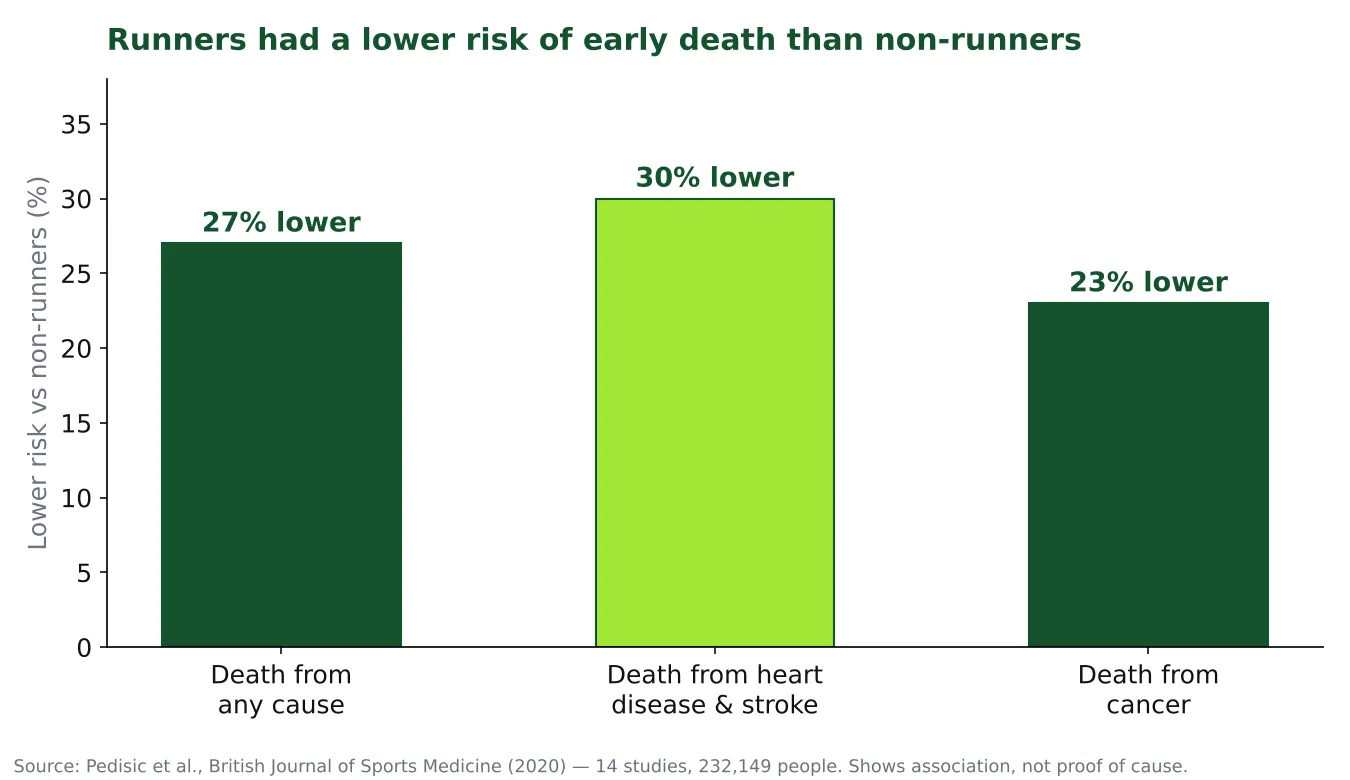
The most encouraging part for beginners? The researchers found no clear sign that running more, faster or more often gave extra protection. Their conclusion was that any amount of running, even just once a week, is better than none.
An earlier study of 55,137 adults, published in the Journal of the American College of Cardiology, pointed the same way. Runners lived about three years longer on average, and the benefits showed up even for people who ran just 5 to 10 minutes a day at speeds below 6 mph.
One honest caveat: these studies observe people rather than randomly assigning them to run. Runners may differ from non-runners in other healthy ways too, so the numbers show a strong link, not absolute proof. Still, the pattern is consistent and reassuring.
A stronger heart, a calmer mind and better sleep
According to the CDC, regular physical activity can lower blood pressure, improve cholesterol and cut your risk of heart disease, stroke and type 2 diabetes. It can also help you sleep better and ease short-term feelings of anxiety, and some brain benefits kick in right after a single session. Many new runners notice that last one first: you come home a bit sweaty, but clearer-headed.
“Won’t running wreck my knees?”
It’s the most common worry, and the evidence is kinder than you might expect. A 2017 meta-analysis of 17 studies (114,829 people) found hip or knee arthritis in:
- 3.5% of recreational runners
- 10.2% of people who didn’t run (sedentary)
- 13.3% of elite or competitive runners
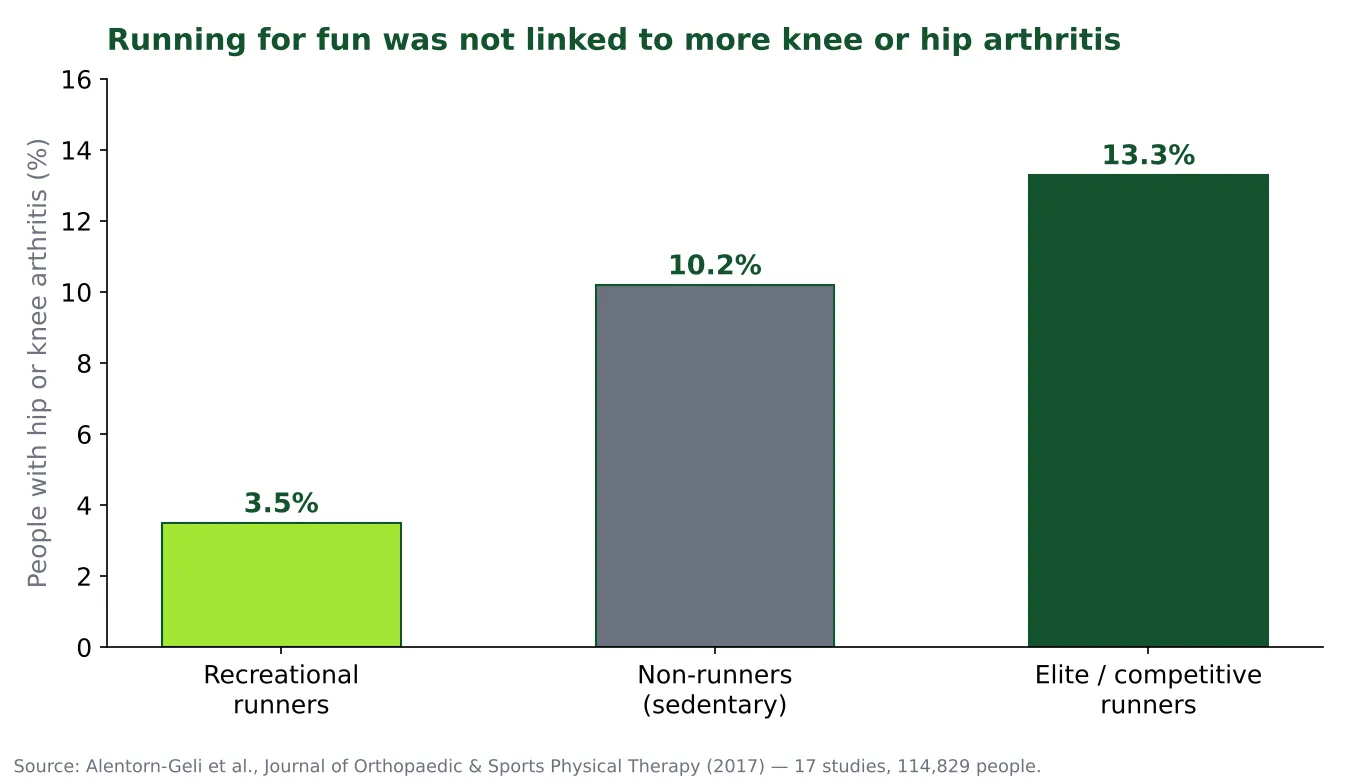
So everyday running was not linked to worse joints; the higher figure appeared in people who’d trained at a very high level for years. If you already have joint pain or arthritis, though, talk to a doctor or physio about what suits you.

How to start running safely: 5 rules for complete beginners
Knowing running is good for you is the easy part. Starting without getting hurt or fed up is where most people stumble. These five rules fix that.
1. Check in with your doctor if you need to
The NHS advises speaking to a GP before you start if you have any health concerns, for example a heart condition, chest pain, dizziness, a long-term illness, or if you haven’t been active for a long time. It’s a quick conversation that can save a lot of worry.
2. Start with walk–run intervals, not a non-stop run
You don’t have to run continuously on day one, or even in week one. The free NHS Couch to 5K plan has you run just 1 minute at a time, with walking breaks in between, three times a week. Over nine weeks the running blocks grow until you can run for 30 minutes.
Walking breaks aren’t cheating. They’re how your heart, lungs, muscles and tendons get time to adapt.
3. Run slowly enough to talk
Use the “talk test” from Mayo Clinic: at a moderate effort your breathing quickens but you can still hold a conversation. If you can only manage a few words before gasping, you’re working hard, too hard for most beginner runs. Slow down until you could chat in full sentences. It will feel almost embarrassingly slow. That’s fine; it’s meant to.
4. Rest between runs and build up gradually
The NHS plan builds in a rest day between each run, and that’s a smart default. Doing too much, too soon is one of the most common reasons new runners get injured, according to Mayo Clinic Press.
You may have heard of the “10% rule” (never add more than 10% a week). In fairness, the evidence for that exact number is weak: a Dutch trial of novice runners found a slower 10%-a-week plan didn’t reduce injuries compared with a standard plan. The bigger lesson is simply: build up gently and pay attention to how your body responds.
5. Listen to pain, and know when to stop
Mild stiffness the day after is normal. But Mayo Clinic Press suggests stopping if pain gets worse as you run, wakes you at night, or comes with swelling. Rest, and get it checked if it doesn’t settle. Adding low-impact exercise (cycling, swimming) and some strength work on other days helps your body cope with running, and also covers the WHO’s muscle-strengthening advice.
What you need (hint: not much)
- Comfortable, supportive shoes. You don’t need anything fancy to start; fit and comfort matter most. Our guide on how to choose walking shoes covers the basics.
- Clothes you can move in, a supportive sports bra if needed, and reflective or bright layers if it’s getting dark.
- Water, especially on warm days.
- A light snack with some carbohydrate 1–2 hours before, as the NHS suggests. A banana or a slice of toast works.

Your first week, step by step
Here’s week 1 of the NHS Couch to 5K plan, laid out so you can follow it from tomorrow. Each session takes about 30 minutes.
| Day | What to do |
|---|---|
| Day 1 | 5-minute brisk warm-up walk → jog 1 min, walk 1½ min, repeated 7 times → one last 1-min jog → 5-minute cool-down walk |
| Day 2 | Rest, or an easy walk |
| Day 3 | Repeat Day 1 |
| Day 4 | Rest, or an easy walk |
| Day 5 | Repeat Day 1 |
| Days 6–7 | Rest. A gentle walk is great if you feel like moving |
If week 1 feels too hard, repeat it. There’s no prize for rushing, and the plan works just as well at your own speed.
Track your progress the easy way: turn sessions into miles
Seeing progress keeps you going, and you don’t need a smartwatch for that.
Take your warm-up and cool-down. That’s 10 minutes of walking, which at 3 mph is half a mile, about 1,056 steps for someone with an average 76.2 cm (2.5 ft) step. Pop your daily step count into the MyStepsToMiles calculator and choose the walking pace that matches you (2, 3 or 4 mph) to see your distance and walking time.
For bigger targets, it helps to know the yardsticks. A 5K is about 3.1 miles. Walked with an average step, that’s roughly 6,560 steps and a little over an hour at 3 mph. And 10,000 steps works out at about 4.73 miles (7.62 km), around 1 hour 35 minutes at 3 mph. See the 5,000 steps to miles page and 10,000 steps to miles page for the full breakdown.
One thing to know: running strides are longer than walking steps, so a mile run takes fewer steps than a mile walked. That’s why step-based distance can look a bit off on run days. For the closest answer, use the calculator’s Exact (“your own stride”) mode. To find your running stride, run a known distance, say one 400-metre lap of a track, count your steps, and divide 400 by that number. (We’ll dig into this in a future post on walking a mile vs running a mile.)
Then log each session in My Walks. Watching your streak grow, and hitting the 30-day milestone, is a surprisingly good reason to lace up on a grey morning.
Common beginner mistakes (and easy fixes)

- Going too fast. Fix: use the talk test. Slow is the goal.
- Doing extra because you feel great. Fix: stick to the plan. Tendons adapt more slowly than lungs.
- Running with much faster friends. Fix: run with them on walk days, or ask them to go at your pace.
- Only running. Fix: add two short strength sessions a week (squats, lunges, step-ups).
- Skipping the warm-up walk. Fix: treat those first 5 minutes as part of the run, not an extra.
Frequently asked questions
How long should a beginner run for?
Start with 1-minute jogs inside a 30-minute walk–run session, as in week 1 of the NHS Couch to 5K plan. Most people can work up to 30 minutes of continuous running over about nine weeks.
Is it OK to walk during a run?
Yes. Walk breaks are a proven part of beginner plans, not a sign of failure. Even experienced runners use them.
How many times a week should a beginner run?
Three times a week, with a rest day between runs, is a sensible start. But research suggests even one run a week is better than none.
Is running bad for your knees?
For recreational runners, the evidence says probably not. A large review found lower rates of hip and knee arthritis in recreational runners (3.5%) than in non-runners (10.2%). If you already have joint problems, ask a doctor or physio first.
Ready for your first run?
You don’t need to be fit to start running; you get fit by starting. Pick a day this week, try the week-1 session, then pop your steps into the MyStepsToMiles calculator and log it in My Walks. Free, no app, no sign-up. Your future self will thank you.
This article is general information, not medical advice. Talk to a doctor before a big change in how active you are.
Sources
- World Health Organization, Physical activity: https://www.who.int/initiatives/behealthy/physical-activity
- Pedisic Z et al. Is running associated with a lower risk of all-cause, cardiovascular and cancer mortality? British Journal of Sports Medicine, 2020: https://bjsm.bmj.com/content/54/15/898
- American College of Cardiology press release on Lee et al., Journal of the American College of Cardiology, 2014 (running 5–10 minutes a day): https://www.acc.org/About-ACC/Press-Releases/2014/07/29/09/32/Leisure-Running-JACC-PR
- CDC, Benefits of physical activity: https://www.cdc.gov/physical-activity-basics/benefits/index.html
- Alentorn-Geli E et al. The association of recreational and competitive running with hip and knee osteoarthritis. Journal of Orthopaedic & Sports Physical Therapy, 2017: https://doi.org/10.2519/jospt.2017.7137
- NHS, Couch to 5K running plan: https://www.nhs.uk/better-health/get-active/get-running-with-couch-to-5k/couch-to-5k-running-plan/
- Mayo Clinic, Exercise intensity: https://www.mayoclinic.org/healthy-lifestyle/fitness/in-depth/exercise-intensity/art-20046887
- Mayo Clinic Press, To prevent running injuries, avoid these common mistakes: https://mcpress.mayoclinic.org/nutrition-fitness/to-prevent-running-injuries-avoid-these-common-mistakes/
- Buist I et al., trial of a graded (10%-a-week) training plan in novice runners, British Journal of Sports Medicine: https://bjsm.bmj.com/content/43/2/155