
You took the stairs all day. Four floors up to the office, down for lunch, up again, down to the car. Your legs know it. Your tracker says you walked a decent distance. But did you? Converting stairs to miles is trickier than it looks.
Quick answer: Your phone or fitness watch counts every stair step as a normal walking step, then turns it into distance using your usual stride (about 76.2 cm for an average step). But a stair only moves you forwards about 22–30 cm. So stairs make your “miles” look about three times bigger than the ground you actually covered. The good news: climbing stairs is roughly twice the effort of walking at a steady pace, so the work you did is real, even if the distance is not.
In this guide you’ll see exactly what happens when you take the stairs, how many stairs make a “mile”, and three honest ways to count your stair effort.
What your tracker actually does when you take the stairs
Most step counters work the same way. A small motion sensor (an accelerometer) feels the bounce of each step. On stairs, every step up or down feels like a step, so it gets counted.
Distance is then a simple sum. As Fitbit’s own help page puts it: steps × stride length = distance travelled. Your stride length is guessed from your height and sex, or set by you. Nothing in that sum knows you were on a staircase. (We looked at this in more detail in how Fitbit calculates steps to miles.)
“Floors” are counted separately. Devices with an altimeter (a sensor that reads air pressure) log one floor each time you climb about 3 metres (10 feet), according to Fitbit. Going down does not add floors, and stair machines at the gym usually don’t either, because your height above the ground never changes.
So on a stair-heavy day, you get two numbers: steps (which feed your distance) and floors (which don’t).

Why stair “miles” don’t add up on the ground
Here’s the catch. A normal walking step carries you about 76 cm forwards. A stair step doesn’t.
In the UK, building rules for home staircases allow each step to rise 150–220 mm and to be 220–300 mm deep. So a stair step moves you forwards roughly a quarter of a metre, and upwards about 18 cm.
Take 1,000 stair steps and see what happens:
| What 1,000 stair steps “measure” | Distance |
|---|---|
| Distance your tracker credits (1,000 × 76.2 cm) | 762 m (about 0.47 miles) |
| Ground actually covered forwards (1,000 × 25 cm) | 250 m (about 0.16 miles) |
| Height climbed, if every step went up (1,000 × 18 cm) | 180 m |
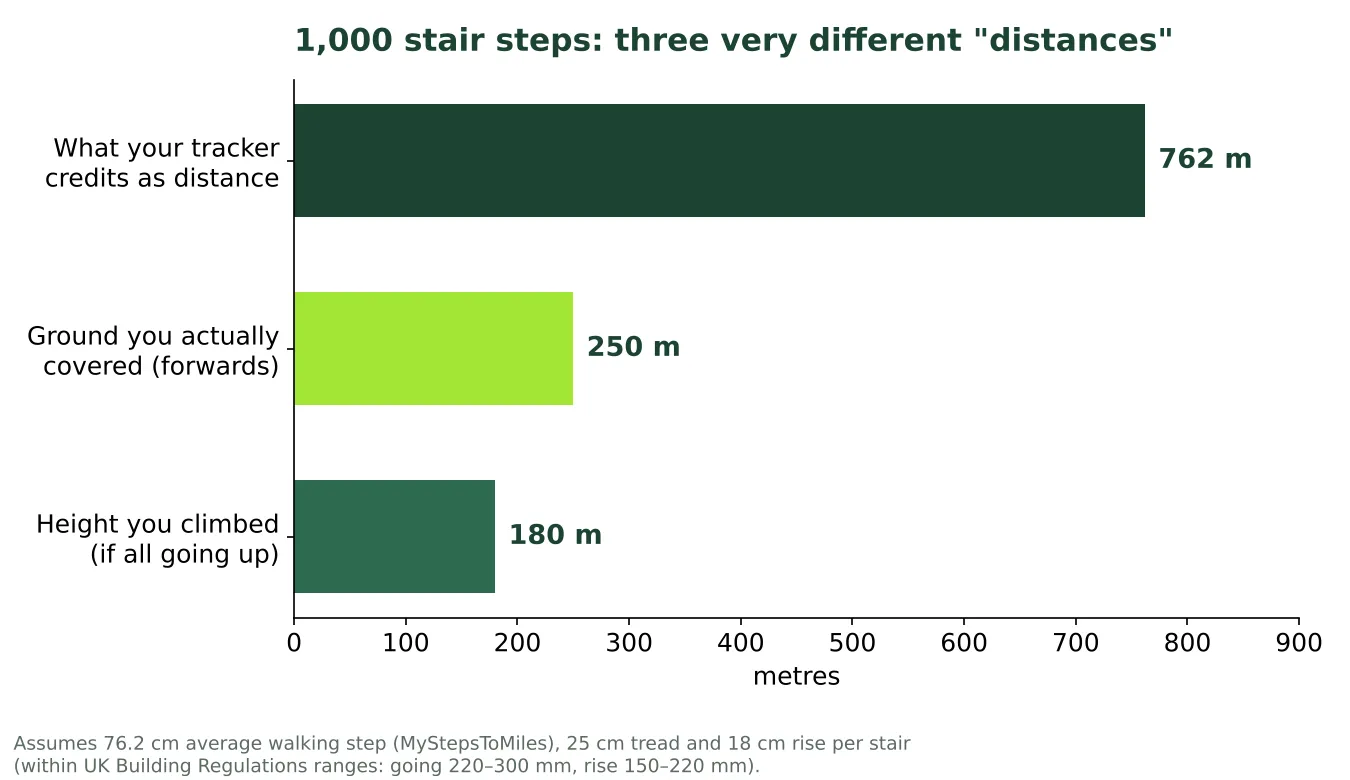
That is roughly a threefold gap between what your screen says and what the map would say. On a normal day with only a few flights, it barely matters. On a day when you run stair repeats for half an hour, it can add a lot of make-believe distance.
How many steps is a flight of stairs?
There’s no single number, because buildings differ. A useful rule of thumb:
- One tracker “floor” is about 3 metres of height. With stairs rising 18–20 cm each, that’s about 15–17 steps.
- A home staircase is often shorter. If your floors are, say, 2.6 metres apart and each step rises 20 cm, that’s 13 steps.
- A big UK Biobank study of stair climbing treated five flights as about 50 steps, so around 10 steps a flight.
Count your own once. Next time you climb your usual staircase, count the steps. That one number makes every calculation after this easy.
So how many stairs is a mile?
It depends what you mean by “a mile”:
- Tracker mile: about 2,112 steps, the same as walking, because your tracker can’t tell the difference. That’s roughly 130 flights of 16 steps.
- Ground mile: about 6,400 stair steps, if each moves you 25 cm forwards.
- Height: if all 2,112 of those steps went up, you’d climb around 380 metres. That’s a lot of hill.
The part that does count: effort
Stairs may not cover ground, but they are hard work. The Adult Compendium of Physical Activities, the reference researchers use to compare activities, rates general stair climbing at 6.8 METs. A MET is a way of comparing energy use with sitting still, which is 1. Walking at a moderate 2.8–3.4 mph is 3.8 METs.
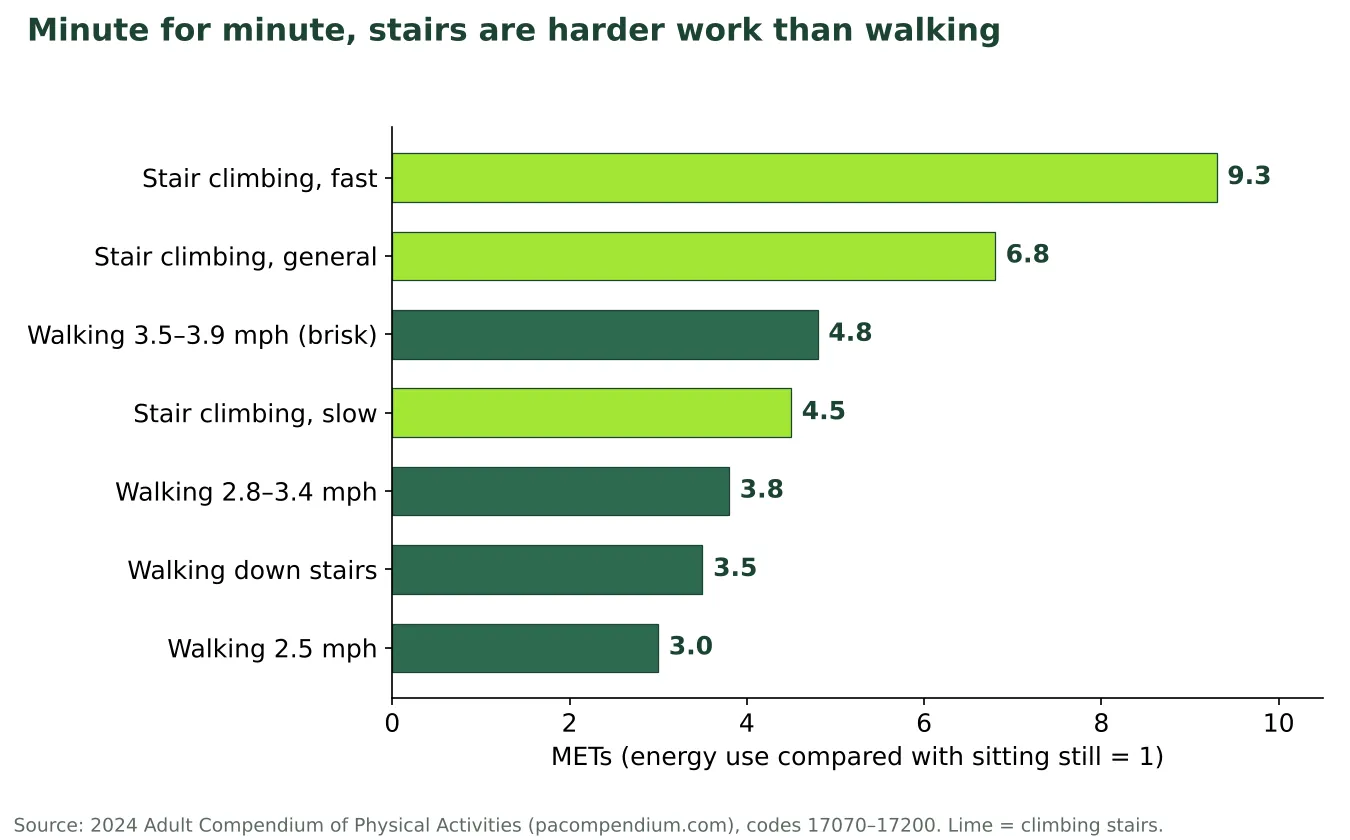
So, minute for minute, climbing stairs is roughly 1.8 times the effort of a steady walk. Going down is easier, at 3.5 METs, close to a gentle walk.
The health research is encouraging too, with honest limits:
- A 2024 review of nine studies covering about 480,000 people, presented at a European Society of Cardiology conference, found people who climbed stairs had a 24% lower risk of dying from any cause and 39% lower risk of dying from heart disease than those who didn’t. It was a conference presentation, so treat it as early findings.
- The UK Biobank study of over 450,000 adults linked climbing more than five flights (about 50 steps) a day with a 20% lower risk of heart disease.
Both show a link, not proof that stairs caused the benefit. People who take the stairs may be healthier in other ways. Still, Mayo Clinic is clear that taking the stairs counts as useful everyday activity, burning about 65 calories in 15 minutes.

Three honest ways to count your stairs
Pick the one that fits why you track.
1. Leave it as it is (simplest)
If your main goal is a daily step count, stairs count fully. Every step is a step. Just remember that on stair-heavy days your “distance” is padded, so don’t use it to plan a long walk.
2. Work out the ground you really covered
Useful if you care about true distance, say for a walking challenge.
- Estimate your stair steps for the day (flights × steps per flight × trips).
- Take those away from your total steps, and put the rest into the MyStepsToMiles calculator. Use Better mode (it uses your height; see steps to miles by height for why that matters) or Exact mode (your own measured stride).
- For the stair part, put the stair steps into Exact mode and enter 2.5 metres as the distance of your 10 steps. That’s a 25 cm stair step; use 10 × your own tread depth if you’ve measured it. Add the two answers together.
3. Count “effort miles” (best for fitness)
If you care about the workout, convert time on the stairs into walking time. Multiply your stair minutes by about 1.8 to get the equivalent minutes of moderate walking. Then use the calculator’s 3 mph pace to see the walking distance that effort matches.
It’s a rough guide, not lab science. But it gives stairs fair credit.
A worked example
Say you work on the 4th floor, and each flight has 14 steps. You go up and down twice a day.
- Steps up: 4 × 14 × 2 = 112. Steps down: another 112. Total: 224 stair steps.
- Your tracker credits: 224 × 76.2 cm ≈ 171 metres.
- Ground actually covered: 224 × 25 cm = 56 metres.
- Height climbed: 112 × 18 cm ≈ 20 metres, and those 112 steps up are more than double the “about 50 steps a day” level in the UK Biobank study.
Now a stair workout. Twenty minutes of steady stair climbing × 1.8 ≈ 36 minutes of moderate walking. At 3 mph, that’s about 1.8 “effort miles”, even though you barely left the building.
Making stairs part of your daily walking
Stairs are a handy way to fit hard-working minutes into a busy day. A few ideas:
- Take the stairs for one to three floors. Use the lift for the rest if you need to. Every flight adds up.
- Try short “stair snacks”. Two or three flights after a long sit breaks up your day.
- Go at a pace where you can still talk. The UK physical activity guidelines describe moderate activity as breathing harder but still able to talk. Fast stair climbing quickly becomes vigorous: breathing fast, hard to talk.
- Hold the handrail, especially going down. Coming down is where slips happen, and it’s harder on the knees.
- Log it. Add your walks to My Walks on MyStepsToMiles. You’ll see your streak grow towards the 30-day milestone.
If your goal is simply to move more, stairs plus a daily walk is a strong pair. See how your total compares on the 10,000 steps to miles page or the 5,000 steps to miles page.

Frequently asked questions
Do stairs count as steps on Fitbit or my phone?
Yes. The motion sensor counts each stair step as a step, going up and going down. Devices with an altimeter also log “floors” when you climb about 3 metres.
How many flights of stairs equal a mile?
For your tracker, about 2,112 steps, which is roughly 130 flights of 16 steps. In true ground covered, it would take far more, around 6,400 stair steps.
Is climbing stairs better than walking?
Minute for minute, it’s harder work: about 6.8 METs against 3.8 for moderate walking. Walking is easier to do for longer, so many people do both.
Does walking down stairs count?
Down steps count as steps, but not as floors. It’s lighter effort (about 3.5 METs) and still useful movement.
Why does my tracker show floors I didn’t climb?
Floors come from changes in air pressure. Things that shift pressure, such as weather, can sometimes add or miss a floor.
Try it yourself
Count the steps on your usual staircase today, then pop your numbers into the MyStepsToMiles calculator. Use Exact mode for your stair steps and Better mode for the rest, and see your real distance. No app, no sign-up, just the answer.
This article is general information, not medical advice. Talk to a doctor before a big change in how active you are.
Sources
- Fitbit Help, how Fitbit calculates distance and floors: https://support.google.com/fitbit/answer/14237111?hl=en
- Livingetc, UK staircase regulations: https://www.livingetc.com/advice/staircase-regulations-uk
- Tulane University, UK Biobank study on stair climbing and heart disease: https://news.tulane.edu/print/pdf/node/1652308
- 2024 Adult Compendium of Physical Activities, Walking: https://pacompendium.com/walking/
- European Society of Cardiology, Climb stairs to live longer (2024): https://www.escardio.org/news/press/press-releases/Climb-stairs-to-live-longer/
- Mayo Clinic, Does taking the stairs count as exercise?: https://www.mymlc.com/health-information/faqs/e/exercising-does-taking-the-stairs-count/
- UK Government, Physical activity guidelines for adults and older adults: https://www.gov.uk/government/publications/physical-activity-guidelines-adults-and-older-adults/physical-activity-for-adults-and-older-adults-19-and-over-text-of-the-infographic