It is 5 pm. You have answered forty emails, sat through three meetings and fixed somebody else’s spreadsheet. Then you glance at your phone: 2,900 steps. Your brain has run a marathon. Your legs have barely left the chair.
If that sounds familiar, you are not lazy. Desk jobs are simply built for sitting. The good news is that you do not need a gym membership or an extra free hour to fix it. You need a handful of small walks that fit into the day you already have.
The quick answer: Get up for a 1–2 minute stroll every 30 minutes, walk whenever you are on the phone, take a 10–15 minute walk at lunch, and add short walks before work and after dinner.
Together that is about 90 minutes spread across the day, and it can add roughly 7,600 steps, about 3.6 miles (5.8 km) for an average stride. From a 3,000-step starting point, that takes you past 10,000.
Pop your own numbers into the free MyStepsToMiles calculator to see exactly how far you are walking.
Why sitting all day is worth fixing, even if you exercise
The NHS says many adults in the UK sit for around nine hours a day, and that long spells of sitting are linked to weight gain, type 2 diabetes, some cancers and early death (NHS: Why we should sit less). To be fair, most of that evidence comes from studies that spot links rather than prove cause. But the direction is consistent, and the fix is cheap.
Two pieces of research are especially useful if you work at a desk:
- Breaking up sitting matters. In a small Columbia University trial, 11 adults sat for eight hours in a lab. A 5-minute walk every 30 minutes cut blood-sugar spikes after big meals by 58% compared with sitting all day. Every walking schedule lowered blood pressure by about 4–5 mmHg, and most of them improved mood and reduced tiredness. Walking only once an hour did not help blood sugar (Duran et al., 2023, Medicine & Science in Sports & Exercise; summary via Healthline). It was a small study, so treat it as a strong hint, not the final word.
- Total movement matters too. A Cambridge-led analysis of more than a million people found that about 60–75 minutes a day of moderate activity, such as brisk walking at around 3.5 mph, appeared to cancel out the extra risk of early death linked to sitting for 8+ hours (University of Cambridge, 2016).
So the target has two parts: interrupt your sitting often, and add up enough walking overall. The World Health Organization recommends at least 150–300 minutes of moderate activity a week for adults. A desk worker can get there without ever seeing a treadmill.
1. Find your real starting number
Before you change anything, find out where you are. Open your phone’s health app and look at your average daily steps for the last seven days, not just today.
Now turn that into distance. In the MyStepsToMiles calculator, use Better mode (“uses your height”) for a more personal answer, or Exact mode if you have measured your own stride. At an average step of 76.2 cm, 3,000 steps is about 1.4 miles (2.3 km). Seeing it as distance makes it real: “I walk less than a mile and a half on a work day” is a much clearer starting point than a vague feeling of being stuck at a desk.
Then set your first target: your average plus 2,000 steps. Not 10,000 on day one. A big study of 15 groups of adults found the risk of early death kept falling as daily steps rose, levelling off at around 8,000–10,000 steps for people under 60 and 6,000–8,000 for people over 60 (Paluch et al., 2022, The Lancet Public Health). Every extra thousand on the way counts. You can see what those totals mean in miles on our 8,000 steps to miles page and 10,000 steps to miles page.
2. Use the 30-minute rule (it beats one long break)
This is the single most useful habit for desk workers. Both the NHS and the Columbia trial point the same way: get up roughly every 30 minutes. The NHS suggests simply setting a reminder to do it.
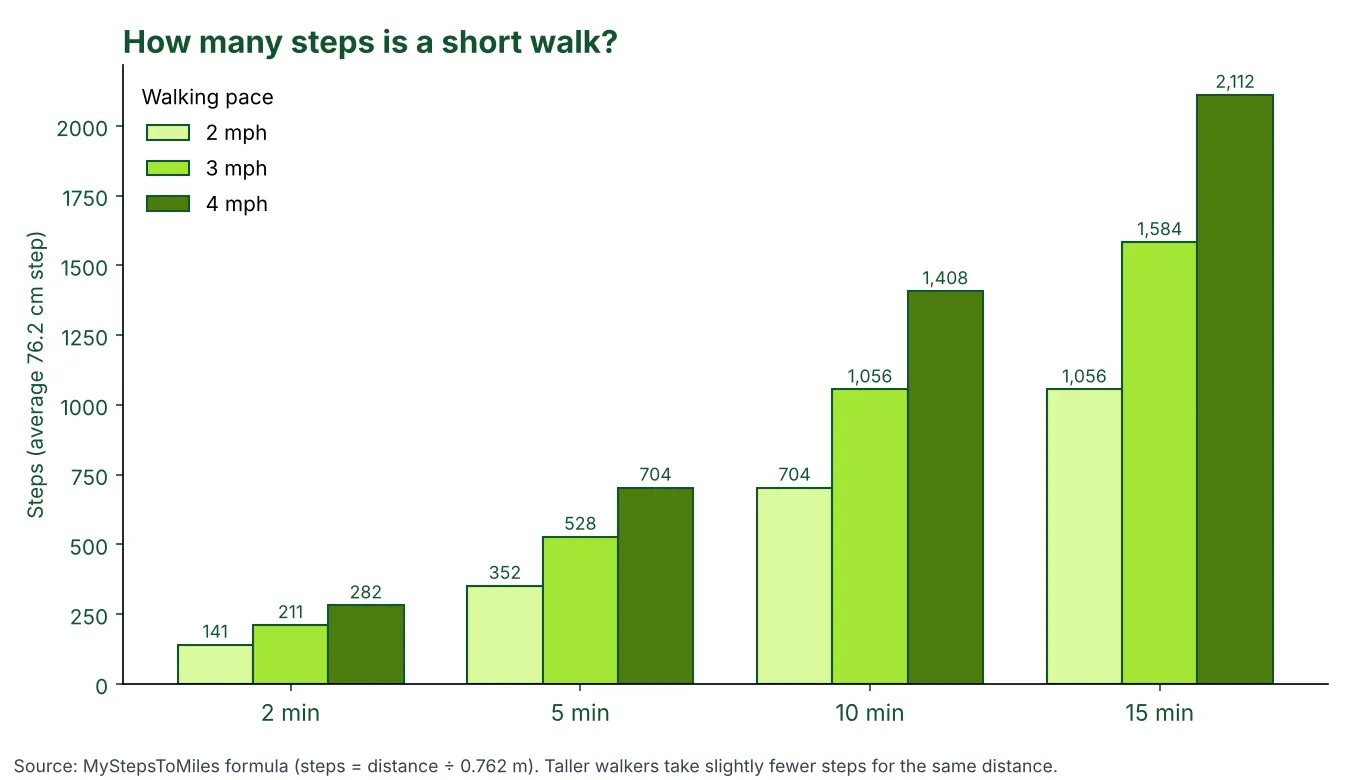
A 2-minute stroll at an easy 2 mph is about 141 steps. That sounds tiny. But in an eight-hour day you get around 14 of those breaks, roughly 1,970 steps, almost a mile, without ever leaving the building.
How to make it happen without thinking
- Set a quiet timer on your watch or computer for every 30 minutes. Many smartwatches already have a “time to stand” nudge. Switch it on.
- Use a small water glass instead of a big bottle. Refilling it becomes your built-in break.
- Pick the far option: the toilet on another floor, the printer at the end of the corridor, the kettle in the next kitchen.
- Walk to colleagues instead of messaging them. The NHS lists this one too, and it is often quicker than a five-message chat thread.
- Take the stairs for anything up to two or three floors. (Curious how stairs count? Read stairs to miles.)
Can’t manage every 30 minutes? Do what you can. In the Columbia trial, even a 1-minute walk every half hour gave a modest benefit, and hourly breaks still helped blood pressure and mood.
3. Turn phone calls and 1-to-1s into walks
If your job involves calls, you have a hidden walking track. Pop in earphones and walk for any call where you don’t need a screen. A 10-minute call at an easy 2 mph is about 700 steps. Two of those a day is 1,400 steps you were going to spend sitting anyway.

Walking meetings work for 1-to-1 chats and brainstorms too. In Stanford experiments, people came up with more creative ideas while walking than while sitting. In one test, creative output rose by about 60% when people walked on a treadmill rather than sat (Stanford Graduate School of Education). That is a handy point to make if you need to persuade your manager.
4. Hide walking inside your commute and lunch break
These are the “big blocks” of the day, and they are easier to protect than you think.
- Get off one stop early or park at the far end of the car park. Ten extra minutes at 3 mph is about 1,050 steps.
- Eat, then walk. A 15-minute loop after lunch at 3 mph adds about 1,580 steps, gets you some daylight, and breaks up the afternoon slump. (Why walking after food is extra useful: read walking after meals.)
- Book it in. Put a 15-minute “walk” block in your calendar at lunchtime. If it is in the diary, it is far less likely to be swallowed by meetings.

5. Working from home? Build a “fake commute”
Home workers often have it hardest. There is no walk to the station, no corridor to the meeting room, and the kitchen is six steps away. It is easy for your step count to drop sharply on work-from-home days.
The fix is a fake commute: a 10-minute walk round the block before you open your laptop, and another when you close it. It adds around 2,100 steps at 3 mph and gives your day a clear “work starts” and “work ends” moment.
Put it together: a realistic desk-day plan
Here is what a full day can look like if your tracker currently shows around 3,000 steps. This is a worked example, not an average. Your numbers will differ with your height, pace and job.
| What you add | Time | Pace | Extra steps |
|---|---|---|---|
| Walk before work (or fake commute) | 10 min | 3 mph | 1,056 |
| 2-minute stroll every 30 minutes (14 breaks) | 28 min | 2 mph | 1,971 |
| Walk during two phone calls | 20 min | 2 mph | 1,408 |
| Lunch walk | 15 min | 3 mph | 1,584 |
| Walk after dinner | 15 min | 3 mph | 1,584 |
| Total added | 88 min | 7,603 (≈ 3.6 miles / 5.8 km) |
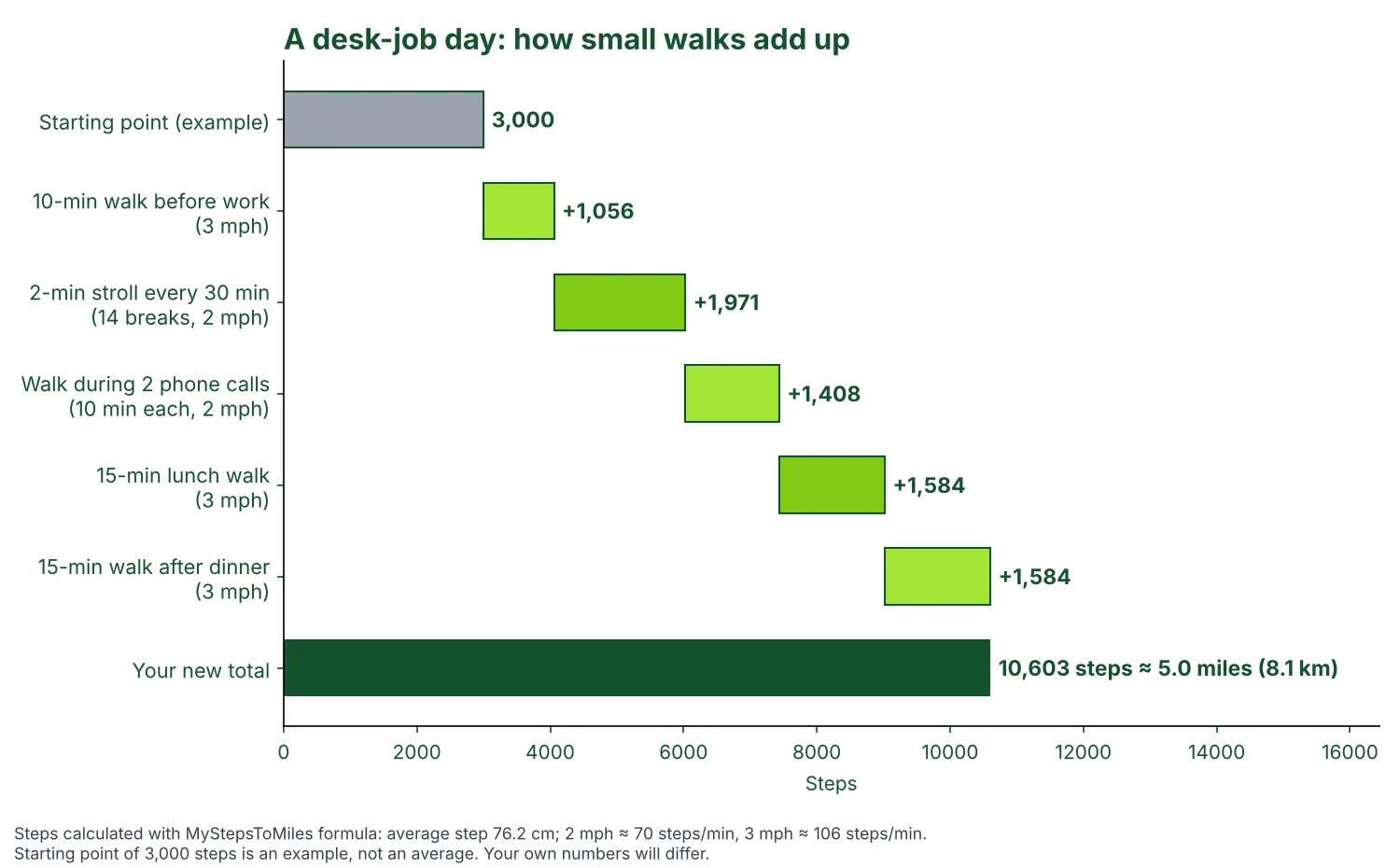
That brings you to about 10,600 steps, roughly 5 miles (8.1 km). And not one minute of it needed a gym, special kit or a free evening. Most of it happens in gaps you already have.
Not ready for the full plan? Pick just two rows. The lunch walk plus the 30-minute rule alone adds about 3,500 steps, enough to move a 3,000-step day close to 6,500.
Make it stick: track it, don’t just hope
The hardest part of walking more is not the walking. It is remembering on a busy Wednesday. Two things help:
- Know your distance, not just your steps. Pop your daily total into the MyStepsToMiles calculator. If you want to plan by time instead, choose a walking pace (2, 3 or 4 mph) and it shows how long your walk takes. “I need 15 more minutes to reach 4 miles” is easier to act on than a big step number.
- Log it and protect your streak. The free My Walks log on MyStepsToMiles keeps a record of your walks, counts your streak and marks a 30-day milestone. Seeing a streak you do not want to break is a surprisingly strong nudge. No app to download and no sign-up.
For more on turning this into a routine, read how to build a daily walking habit.
What about standing desks?
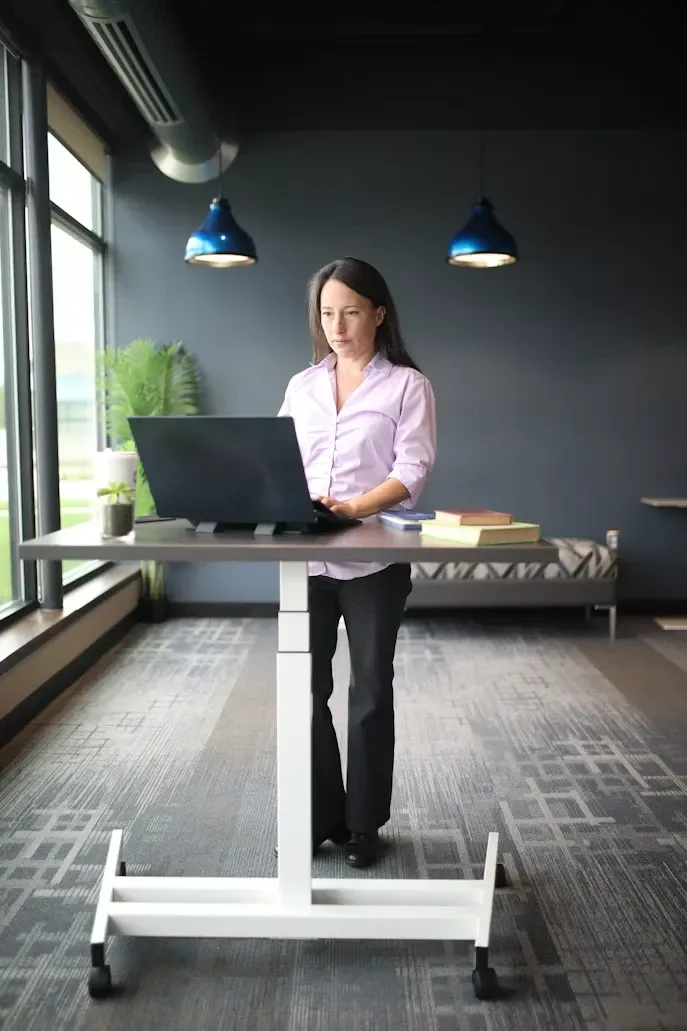
A standing desk can help you sit less, and the NHS suggests working standing up for part of the day. But standing still does not add steps. Think of it as a partner to walking, not a replacement: stand for some tasks, and still take your 30-minute strolls.
Frequently asked questions
How often should I get up from my desk?
Roughly every 30 minutes. The NHS suggests setting a reminder to get up every half hour, and a small 2023 trial found 5-minute walks every 30 minutes worked best for blood sugar and blood pressure. Even 1–2 minutes is better than nothing.
Can you get 10,000 steps a day with a desk job?
Yes, for many people. Starting from about 3,000 steps, roughly 90 minutes of walking spread through the day (short breaks, walking calls, a lunch loop and an evening walk) adds around 7,600 steps and takes you past 10,000.
Is 5,000 steps a day enough if I sit at work?
It is a good start and much better than 2,000–3,000. Research suggests health benefits keep building up to about 8,000–10,000 steps a day for adults under 60, so aim to add 1,000–2,000 at a time. 5,000 steps is about 2.4 miles (3.8 km) for an average stride.
Does exercising after work cancel out sitting all day?
Partly. A large analysis found 60–75 minutes a day of moderate activity seemed to cancel out the extra risk linked to sitting for 8+ hours. Most people find it easier to reach that by combining an evening walk with short breaks during the day.
Do the steps I take around the office count?
Yes, every step counts. Your phone can’t count steps while it sits on your desk, though, so keep it in your pocket or wear a tracker during breaks. See how accurate step counters are.
Your next step
Tomorrow, try just one thing: a 2-minute stroll every 30 minutes until lunch. At the end of the day, put your step count into the MyStepsToMiles calculator and see how far you really went. Then log it in My Walks and start your streak. Small walks, done often, add up to miles.
This article is general information, not medical advice. Talk to a doctor before a big change in how active you are.
Sources
- NHS, Why sitting too much is bad for us: https://www.nhs.uk/live-well/exercise/why-sitting-too-much-is-bad-for-us/
- Duran AT et al. (2023), breaking up sitting and glucose, blood pressure and mood, Medicine & Science in Sports & Exercise: https://doi.org/10.1249/MSS.0000000000003109
- Healthline, summary of the Columbia walking-breaks trial: https://www.healthline.com/health-news/how-5-minute-walks-every-half-hour-can-counter-prolonged-sitting
- University of Cambridge (2016), moderate activity and prolonged sitting: https://www.cam.ac.uk/research/news/an-hour-of-moderate-exercise-a-day-enough-to-counter-health-risks-from-prolonged-sitting
- Paluch AE et al. (2022), daily steps and all-cause mortality, The Lancet Public Health: https://pubmed.ncbi.nlm.nih.gov/35247352/
- Stanford Graduate School of Education, walking and creativity: https://ed.stanford.edu/news/study-finds-walking-boosts-creativity
- World Health Organization, physical activity: https://www.who.int/europe/news-room/fact-sheets/item/physical-activity